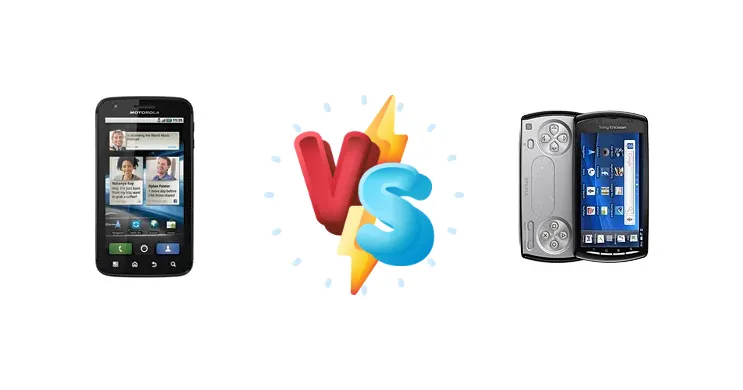
In 2011, Motorola and Sony Ericsson attempted to redefine the smartphone experience. The Motorola ATRIX, with its powerful Nvidia Tegra 2 processor and innovative laptop dock, aimed for desktop replacement. Simultaneously, the Sony Ericsson Xperia PLAY, uniquely featuring integrated gaming controls, targeted mobile gamers. This comparison revisits these ambitious devices, analyzing their strengths and weaknesses in a modern context.
🏆 Quick Verdict
For the average user seeking a functional piece of Android history, the Motorola ATRIX emerges as the slightly better choice. Its Tegra 2 chipset provides a more versatile performance profile, handling general tasks and some gaming with greater ease than the Xperia PLAY’s Snapdragon S2. However, the Xperia PLAY remains a niche champion for dedicated mobile gaming.
| Network |
|---|
| 2G bands | GSM 850 / 900 / 1800 / 1900 | GSM 850 / 900 / 1800 / 1900 |
| 3G bands | HSDPA 850 / 900 / 1900 / 2100 | HSDPA 900 / 2100 |
| 4G bands | - | 2, 4, 5, 7, 12, 38, 66, 71 |
| Speed | HSPA 14.4/2 Mbps | HSPA 7.2/5.76 Mbps |
| Technology | GSM / HSPA | GSM / HSPA |
| | - | HSDPA 850 / 1900 / 2100 / 800 |
| Launch |
|---|
| Announced | 2011, January. Released 2011, April | 2011, February. Released 2011, March |
| Status | Discontinued | Discontinued |
| Body |
|---|
| Dimensions | 117.8 x 63.5 x 11 mm (4.64 x 2.5 x 0.43 in) | 119 x 62 x 16 mm (4.69 x 2.44 x 0.63 in) |
| SIM | Mini-SIM | Mini-SIM |
| Weight | 135 g (4.76 oz) | 175 g (6.17 oz) |
| Display |
|---|
| Protection | Corning Gorilla Glass | - |
| Resolution | 540 x 960 pixels, 16:9 ratio (~275 ppi density) | 480 x 854 pixels, 16:9 ratio (~245 ppi density) |
| Size | 4.0 inches, 44.1 cm2 (~59.0% screen-to-body ratio) | 4.0 inches, 44.1 cm2 (~59.8% screen-to-body ratio) |
| Type | TFT | LED-backlit LCD, |
| | Touch sensitive controls
MOTOBLUR UI with Live Widgets | Touch-sensitive gaming controls
PSP like gaming buttons
Timescape UI |
| Platform |
|---|
| CPU | Dual-core 1.0 GHz Cortex-A9 | 1.0 GHz Scorpion |
| Chipset | Nvidia Tegra 2 AP20H | Qualcomm MSM8255 Snapdragon S2 |
| GPU | ULP GeForce | Adreno 205 |
| OS | Android 2.2 (Froyo), upgradable to 2.3 (Gingerbread) | Android 2.3.4 (Gingerbread) |
| Memory |
|---|
| Card slot | microSDHC (dedicated slot) | microSDHC (dedicated slot), 8 GB included |
| Internal | 16GB 1GB RAM | 400MB 512MB RAM |
| Main Camera |
|---|
| Features | LED flash | LED flash |
| Single | 5 MP, AF | 5 MP, AF |
| Video | 720p@30fps, 1080p (via SW update) | 720p |
| Selfie camera |
|---|
| Features | - | LED flash |
| Single | VGA | VGA |
| Sound |
|---|
| 3.5mm jack | Yes | Yes |
| 35mm jack | Yes | Yes |
| Loudspeaker | Yes | Yes, with stereo speakers |
| Comms |
|---|
| Bluetooth | 2.1, A2DP, EDR | 2.1, A2DP, EDR |
| NFC | - | No |
| Positioning | GPS, A-GPS | GPS, A-GPS, GLONASS |
| Radio | No | No |
| USB | microUSB 2.0 | microUSB 2.0, OTG |
| WLAN | Wi-Fi 802.11 a/b/g/n, dual-band, DLNA, hotspot | Wi-Fi 802.11 b/g/n, DLNA, hotspot |
| Features |
|---|
| Browser | HTML, Adobe Flash | WAP 2.0/xHTML, HTML5, Adobe Flash |
| Sensors | Fingerprint (rear-mounted), accelerometer, proximity, compass | Accelerometer, proximity, compass |
| | HDMI port
MP3/WAV/WMA/eAAC+ player
MP4/H.264/WMV/Xvid/DivX player
Photo viewer/editor
Organizer
Document editor
Voice memo/dial/commands
Predictive text input | Dedicated game store
MP4/H.264/WMV player
MP3/eAAC+/WMA/WAV player
Organizer
Document viewer/editor
Voice memo/dial/commands
Predictive text input (Swype) |
| Battery |
|---|
| Charging | - | 10W wired |
| Music play | - | Up to 31 h |
| Stand-by | Up to 400 h (2G) / Up to 350 h (3G) | Up to 425 h (2G) / Up to 413 h (3G) |
| Talk time | Up to 8 h 50 min (2G) / Up to 9 h (3G) | Up to 8 h 25 min (2G) / Up to 6 h 25 min (3G) |
| Type | Removable Li-Po 1930 mAh battery | Removable Li-Ion 1500 mAh battery |
| Misc |
|---|
| Colors | Black | Black, White, Stealth Blue (for Play 4G), Orange |
| Price | About 170 EUR | About 140 EUR |
| SAR EU | - | 0.36 W/kg (head) |
| Tests |
|---|
| Audio quality | - |
Noise -89.6dB / Crosstalk -91.0dB |
| Camera | - |
Photo |
| Loudspeaker | - |
Voice 66dB / Noise 62dB / Ring 79dB
|
Motorola ATRIX
- More powerful Tegra 2 processor for better overall performance.
- Potential for desktop-like experience with the laptop dock.
- Likely better multimedia capabilities due to Nvidia’s GPU focus.
- Lacks dedicated gaming controls.
- Battery life may be impacted by the more powerful processor.
Sony Ericsson Xperia PLAY
- Integrated gaming controls for a console-like experience.
- Optimized for retro gaming emulation.
- Potentially better battery life during gaming sessions due to the Snapdragon S2’s efficiency.
- Less powerful processor compared to the Tegra 2.
- Compromised display size due to the gamepad.
- Camera likely a secondary consideration.
Display Comparison
Neither device boasts a standout display by today’s standards. Specifics regarding panel technology (IPS, TFT) and resolution are missing, but both likely featured displays around 480x800. The focus wasn’t on screen quality; it was on functionality. The ATRIX, being slightly larger, may have offered a marginally more immersive experience, but the Xperia PLAY’s display was constrained by the need to accommodate the physical gamepad.
Camera Comparison
Both devices feature a 'Photo' camera, but lack specific details. Given the era, expect resolutions around 5-8 megapixels. The Xperia PLAY’s camera was likely a secondary consideration, overshadowed by its gaming features. The ATRIX, positioned as a more all-around device, may have had slightly better image processing capabilities, but neither camera would compete with modern smartphone cameras. The absence of details like aperture or sensor size makes a precise comparison impossible.
Performance
The core difference lies in the chipsets. The Motorola ATRIX’s Nvidia Tegra 2 AP20H, with its dual-core 1.0 GHz Cortex-A9 CPU, was a significant step up in mobile processing power. Nvidia’s focus on GPU performance meant better graphics rendering, crucial for games and multimedia. The Sony Ericsson Xperia PLAY’s Qualcomm MSM8255 Snapdragon S2, also a dual-core 1.0 GHz processor, was less focused on raw graphical power. While adequate for basic Android tasks, it lagged behind the Tegra 2 in demanding applications. The ATRIX’s architecture allowed for more efficient handling of complex tasks, while the Xperia PLAY prioritized power efficiency to extend battery life during gaming sessions.
Battery Life
Battery capacity details are missing for both devices. However, the Xperia PLAY’s 10W wired charging suggests a slower charging speed compared to what would become standard. The ATRIX, while likely not featuring fast charging, benefited from the Tegra 2’s relatively efficient power management. The Xperia PLAY’s gaming focus likely resulted in faster battery drain during intensive use, requiring more frequent charging.
Buying Guide
Buy the Motorola ATRIX if you need a device capable of multitasking, running demanding applications (for its time), and potentially utilizing its laptop dock for a pseudo-desktop experience. Buy the Sony Ericsson Xperia PLAY if you prioritize dedicated gaming controls and are interested in retro gaming emulation, accepting compromises in overall processing power and camera capabilities.
Frequently Asked Questions
❓ Can the Motorola ATRIX still be used as a daily driver in 2024?
While technically possible, the ATRIX’s age and outdated software make it impractical for most users. App compatibility is a major issue, and security updates are non-existent. It’s best suited for collectors or those interested in retro Android experiences.
❓ Is the Xperia PLAY’s gamepad comfortable for extended gaming sessions?
The Xperia PLAY’s gamepad, while innovative, is relatively small and may not be comfortable for users with larger hands. It’s best suited for shorter gaming sessions or retro games that don’t require complex controls. The button travel is also limited.
❓ Does the ATRIX laptop dock actually provide a usable desktop experience?
The ATRIX laptop dock offered a surprisingly functional desktop experience for its time. It allowed users to connect a monitor, keyboard, and mouse, effectively turning the ATRIX into a basic desktop computer. However, performance was limited by the Tegra 2’s processing power.
❓ What kind of games are best suited for the Xperia PLAY?
The Xperia PLAY excels at retro gaming emulation, particularly PlayStation Portable (PSP) games, given Sony’s heritage. It also handles simpler Android games well. Demanding 3D games will struggle due to the Snapdragon S2’s limited graphical capabilities.