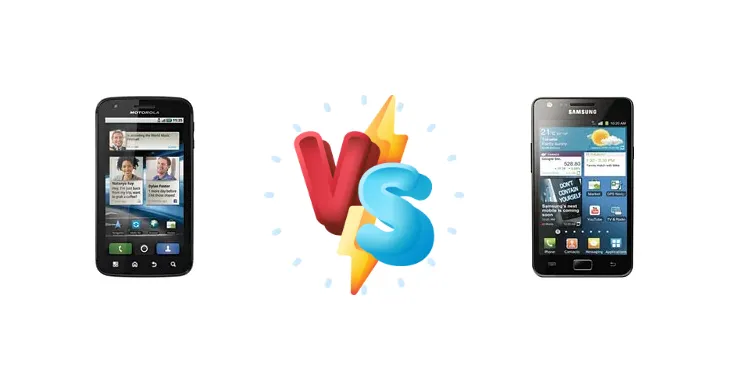
The Motorola ATRIX and Samsung Galaxy S II 4G represented the pinnacle of Android smartphone technology in 2011. Both devices pushed boundaries with dual-core processors and ambitious features, but they took fundamentally different approaches. The ATRIX, with its Nvidia Tegra 2, focused on multimedia and a unique laptop dock experience, while the Galaxy S II 4G prioritized raw processing power and a more conventional smartphone experience. This comparison revisits these titans to determine which holds up better today.
🏆 Quick Verdict
For the average user seeking a functional piece of smartphone history, the Samsung Galaxy S II 4G I9100M is the better choice. Its Exynos 4210 offers a slight performance edge, coupled with the convenience of 18W wired and Qi wireless charging – features the ATRIX lacks. While the ATRIX’s laptop dock was innovative, its limited software support and aging hardware make it less practical in 2024.
| Network |
|---|
| 2G bands | GSM 850 / 900 / 1800 / 1900 | GSM 850 / 900 / 1800 / 1900 |
| 3G bands | HSDPA 850 / 900 / 1900 / 2100 | HSDPA 850 / 900 / 1900 / 2100 /1800 |
| 4G bands | - | 1, 2, 3, 4, 5, 7, 8, 12, 17, 20, 28, 38, 40 |
| Speed | HSPA 14.4/2 Mbps | HSPA 21.1/5.76 Mbps |
| Technology | GSM / HSPA | GSM / HSPA |
| Launch |
|---|
| Announced | 2011, January. Released 2011, April | 2011, July. Released 2011, July |
| Status | Discontinued | Discontinued |
| Body |
|---|
| Dimensions | 117.8 x 63.5 x 11 mm (4.64 x 2.5 x 0.43 in) | 125.3 x 66.1 x 8.5 mm (4.93 x 2.60 x 0.33 in) |
| SIM | Mini-SIM | Mini-SIM |
| Weight | 135 g (4.76 oz) | 116 g (4.09 oz) |
| Display |
|---|
| Protection | Corning Gorilla Glass | Corning Gorilla Glass |
| Resolution | 540 x 960 pixels, 16:9 ratio (~275 ppi density) | 480 x 800 pixels, 5:3 ratio (~217 ppi density) |
| Size | 4.0 inches, 44.1 cm2 (~59.0% screen-to-body ratio) | 4.3 inches, 52.6 cm2 (~63.5% screen-to-body ratio) |
| Type | TFT | Super AMOLED Plus |
| | Touch sensitive controls
MOTOBLUR UI with Live Widgets | ClearBlack display |
| Platform |
|---|
| CPU | Dual-core 1.0 GHz Cortex-A9 | Dual-core 1.2 GHz Cortex-A9 |
| Chipset | Nvidia Tegra 2 AP20H | Exynos 4210 Dual |
| GPU | ULP GeForce | Mali-400MP4 |
| OS | Android 2.2 (Froyo), upgradable to 2.3 (Gingerbread) | Android 2.3 (Gingerbread) |
| Memory |
|---|
| Card slot | microSDHC (dedicated slot) | microSDHC (dedicated slot) |
| Internal | 16GB 1GB RAM | 16GB 1GB RAM |
| | - | eMMC 5.0 |
| Main Camera |
|---|
| Features | LED flash | LED flash |
| Single | 5 MP, AF | 8 MP, f/2.6, 1/3.2", AF |
| Video | 720p@30fps, 1080p (via SW update) | 1080p@30fps |
| Selfie camera |
|---|
| Single | VGA | 2 MP |
| Video | - | 1080p@30fps |
| Sound |
|---|
| 3.5mm jack | Yes | Yes |
| 35mm jack | Yes | Yes |
| Loudspeaker | Yes | Yes |
| Comms |
|---|
| Bluetooth | 2.1, A2DP, EDR | 3.0, A2DP, aptX |
| NFC | - | Yes |
| Positioning | GPS, A-GPS | GPS, A-GPS |
| Radio | No | No |
| USB | microUSB 2.0 | microUSB 2.0 (MHL TV-out), OTG |
| WLAN | Wi-Fi 802.11 a/b/g/n, dual-band, DLNA, hotspot | Wi-Fi 802.11 a/b/g/n, dual-band, Wi-Fi Direct, DLNA, hotspot |
| Features |
|---|
| Browser | HTML, Adobe Flash | - |
| Sensors | Fingerprint (rear-mounted), accelerometer, proximity, compass | Accelerometer, gyro, proximity, compass |
| | HDMI port
MP3/WAV/WMA/eAAC+ player
MP4/H.264/WMV/Xvid/DivX player
Photo viewer/editor
Organizer
Document editor
Voice memo/dial/commands
Predictive text input | Microsoft Continuum support |
| Battery |
|---|
| Charging | - | 18W wired
Wireless (Qi) |
| Music play | - | Up to 67 h |
| Stand-by | Up to 400 h (2G) / Up to 350 h (3G) | Up to 372 h (2G) / Up to 610 h (3G) |
| Talk time | Up to 8 h 50 min (2G) / Up to 9 h (3G) | Up to 6 h (2G) / Up to 8 h 30 min (3G) |
| Type | Removable Li-Po 1930 mAh battery | Removable Li-Ion 1700 mAh battery |
| Misc |
|---|
| Colors | Black | Black |
| Models | - | GT-I9100M |
| Price | About 170 EUR | About 260 EUR |
| SAR | - | 0.16 W/kg (head) 0.96 W/kg (body) |
| SAR EU | - | 0.34 W/kg (head) |
Motorola ATRIX
- Innovative laptop dock functionality
- Potentially superior GPU performance (Tegra 2)
- Unique design and form factor
- Lacks fast charging and wireless charging
- Lower CPU clock speed
- Limited software support for the laptop dock
Samsung Galaxy S II 4G I9100M
- Faster CPU (1.2 GHz Exynos 4210)
- 18W wired and Qi wireless charging
- More robust software ecosystem
- Less innovative feature set
- Potentially less impressive GPU performance
- Larger size may not appeal to all
Display Comparison
Neither device boasts a particularly impressive display by modern standards. Both likely utilized Super AMOLED or similar LCD technologies common at the time, but specific details like resolution and peak brightness are unavailable. However, the Galaxy S II 4G’s larger 4.3-inch screen (versus the ATRIX’s 4.0-inch) provides a slightly more immersive viewing experience. The absence of high refresh rates or HDR support on both devices is expected for their era.
Camera Comparison
Camera details are sparse, but both phones featured rear cameras capable of 1080p video recording, a significant achievement for 2011. The Galaxy S II 4G likely benefited from Samsung’s established camera expertise, potentially offering better image processing and color accuracy. The ATRIX’s camera performance was adequate but not a standout feature. The inclusion of a 2MP front-facing camera on both devices was standard for video calls.
Performance
The Samsung Galaxy S II 4G I9100M holds a slight performance advantage thanks to its 1.2 GHz dual-core Exynos 4210 processor, compared to the ATRIX’s 1.0 GHz Nvidia Tegra 2 AP20H. Both CPUs are based on the Cortex-A9 architecture, but the higher clock speed translates to quicker application loading and smoother multitasking. The Tegra 2’s strength lay in its GPU, offering superior graphics performance for gaming at the time, but the Exynos 4210’s overall system optimization likely provides a more balanced experience today. Thermal management is a concern for both, as early dual-core chips were prone to throttling under sustained load.
Battery Life
Battery capacity details are unavailable for both devices. However, the Galaxy S II 4G’s inclusion of 18W wired charging and Qi wireless charging provides a significant convenience advantage. The ATRIX lacks both features, relying solely on slower wired charging. While battery life would have been comparable in 2011, the Galaxy S II 4G’s charging options make it more practical for modern usage patterns.
Buying Guide
Buy the Motorola ATRIX if you're a collector fascinated by early Android experimentation and the unique laptop dock functionality, understanding its limitations. Buy the Samsung Galaxy S II 4G I9100M if you prioritize a more usable, slightly faster experience with the added benefit of modern charging options and a more robust software ecosystem, even if it's also aged.
Frequently Asked Questions
❓ Does the Nvidia Tegra 2 in the ATRIX suffer from significant thermal throttling during extended gaming sessions?
Yes, the Nvidia Tegra 2, while powerful for its time, was known to generate considerable heat under sustained load. This would likely result in noticeable performance throttling during extended gaming sessions on the ATRIX, limiting its ability to maintain peak performance for prolonged periods.
❓ Is the laptop dock functionality of the Motorola ATRIX still usable with modern operating systems and software?
The ATRIX’s laptop dock functionality is severely limited by its age. While the hardware connection may still work, finding compatible software and drivers for modern operating systems is extremely difficult. Support for the dock was largely abandoned after Motorola’s acquisition by Google, making it a largely nostalgic feature today.
❓ Does the Exynos 4210 in the Galaxy S II 4G overheat during demanding tasks?
The Exynos 4210, like most early dual-core processors, is susceptible to overheating under heavy load. However, Samsung’s thermal management implementation likely provided slightly better control compared to the ATRIX, mitigating the risk of severe throttling. Expect some performance reduction during prolonged gaming or video recording.