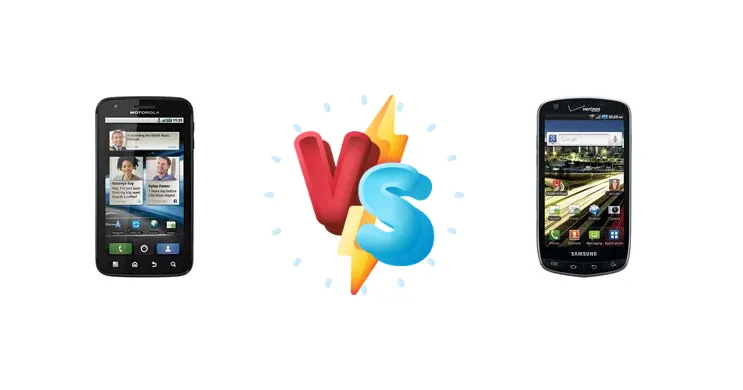
In 2011, Motorola and Samsung battled for Android supremacy with the ATRIX and Droid Charge, respectively. The ATRIX, powered by Nvidia’s Tegra 2, promised a console-like gaming experience, while the Droid Charge, with Samsung’s Hummingbird processor, focused on multimedia and emerging fast-charging capabilities. This comparison revisits these devices to determine which held the edge, and how their architectural choices impacted the user experience.
🏆 Quick Verdict
For the average user seeking a more future-proof and versatile experience, the Motorola ATRIX emerges as the winner. Its Nvidia Tegra 2 chipset provides a noticeable performance advantage over the Samsung Droid Charge’s Hummingbird, particularly in graphics-intensive tasks. While the Droid Charge boasts impressive charging speeds, the ATRIX’s broader feature set and superior processing power offer greater long-term value.
| Network |
|---|
| 2G bands | GSM 850 / 900 / 1800 / 1900 | CDMA 800 / 1900 |
| 3G bands | HSDPA 850 / 900 / 1900 / 2100 | CDMA2000 1xEV-DO |
| 4G bands | - | 13 |
| Speed | HSPA 14.4/2 Mbps | EV-DO Rev.A 3.1 Mbps, LTE |
| Technology | GSM / HSPA | CDMA / EVDO / LTE |
| Launch |
|---|
| Announced | 2011, January. Released 2011, April | 2011, January. Released 2011, May |
| Status | Discontinued | Discontinued |
| Body |
|---|
| Build | - | Glass front (Gorilla Glass 6), glass back (Gorilla Glass 5), aluminum frame (7000 series) |
| Dimensions | 117.8 x 63.5 x 11 mm (4.64 x 2.5 x 0.43 in) | 130 x 68 x 12 mm (5.12 x 2.68 x 0.47 in) |
| SIM | Mini-SIM | Mini-SIM |
| Weight | 135 g (4.76 oz) | 143 g (5.04 oz) |
| Display |
|---|
| Protection | Corning Gorilla Glass | Corning Gorilla Glass 6 |
| Resolution | 540 x 960 pixels, 16:9 ratio (~275 ppi density) | 480 x 800 pixels, 5:3 ratio (~217 ppi density) |
| Size | 4.0 inches, 44.1 cm2 (~59.0% screen-to-body ratio) | 4.3 inches, 52.6 cm2 (~59.5% screen-to-body ratio) |
| Type | TFT | Super AMOLED Plus |
| | Touch sensitive controls
MOTOBLUR UI with Live Widgets | - |
| Platform |
|---|
| CPU | Dual-core 1.0 GHz Cortex-A9 | 1.0 GHz Cortex-A8 |
| Chipset | Nvidia Tegra 2 AP20H | Hummingbird |
| GPU | ULP GeForce | PowerVR SGX540 |
| OS | Android 2.2 (Froyo), upgradable to 2.3 (Gingerbread) | Android 2.2 (Froyo) |
| Memory |
|---|
| Card slot | microSDHC (dedicated slot) | microSDHC (dedicated slot) |
| Internal | 16GB 1GB RAM | 2GB |
| Main Camera |
|---|
| Features | LED flash | LED flash |
| Single | 5 MP, AF | 8 MP, AF |
| Triple | - | 48 MP, f/1.8, 27mm (wide), 1/2.0", 0.8µm, PDAF, Laser AF
12 MP, f/2.2, 54mm (telephoto), 1/3.6", 1.0µm, PDAF, 2x optical zoom
16 MP, f/2.2, 13mm (ultrawide), 1/3.0", 1.0µm, PDAF |
| Video | 720p@30fps, 1080p (via SW update) | Yes |
| Selfie camera |
|---|
| Features | - | HDR |
| Single | VGA | 1.3 MP |
| Sound |
|---|
| 3.5mm jack | Yes | Yes |
| 35mm jack | Yes | Yes |
| Loudspeaker | Yes | Yes |
| Comms |
|---|
| Bluetooth | 2.1, A2DP, EDR | 3.0, A2DP |
| Infrared port | - | Yes |
| NFC | - | Yes |
| Positioning | GPS, A-GPS | GPS, A-GPS |
| Radio | No | No |
| USB | microUSB 2.0 | microUSB 2.0 |
| WLAN | Wi-Fi 802.11 a/b/g/n, dual-band, DLNA, hotspot | Wi-Fi 802.11 b/g, DLNA, hotspot |
| Features |
|---|
| Browser | HTML, Adobe Flash | HTML5, Adobe Flash |
| Sensors | Fingerprint (rear-mounted), accelerometer, proximity, compass | Accelerometer, proximity, compass |
| | HDMI port
MP3/WAV/WMA/eAAC+ player
MP4/H.264/WMV/Xvid/DivX player
Photo viewer/editor
Organizer
Document editor
Voice memo/dial/commands
Predictive text input | MP4/DivX/WMV/H.264 player
MP3/WAV/eAAC+/FLAC player
Organizer
Photo/video editor
Voice memo/dial/commands
Predictive text input |
| Battery |
|---|
| Charging | - | 40W wired, QC4
30W wireless
10W reverse wireless |
| Stand-by | Up to 400 h (2G) / Up to 350 h (3G) | Up to 280 h |
| Talk time | Up to 8 h 50 min (2G) / Up to 9 h (3G) | Up to 11 h |
| Type | Removable Li-Po 1930 mAh battery | Removable Li-Ion 1600 mAh battery |
| Misc |
|---|
| Colors | Black | Black |
| Price | About 170 EUR | About 130 EUR |
| SAR | - | 1.01 W/kg (head) 1.00 W/kg (body) |
Motorola ATRIX
- Superior processing power with Nvidia Tegra 2
- Enhanced graphics performance for gaming
- Laptop dock functionality for desktop-like experience
- Lacks advanced charging capabilities
- Potentially lower battery life under heavy load
Samsung Droid Charge I510
- Groundbreaking 40W wired and 30W wireless charging
- Focus on multimedia consumption
- Reverse wireless charging for accessories
- Less powerful processor compared to Tegra 2
- Inferior graphics performance for demanding games
Display Comparison
Neither device’s display specifications are provided, but given the 2011 timeframe, both likely featured LCD panels with resolutions around 480x800. The Droid Charge’s focus on multimedia suggests a potentially slightly more color-accurate display, but without specific data, this is speculative. The ATRIX’s larger ecosystem, including the laptop dock, implies a greater emphasis on display connectivity and versatility, even if the panel itself wasn’t demonstrably superior.
Camera Comparison
Without specific camera sensor details, a direct comparison is difficult. However, flagship phones of this era typically prioritized megapixel count over sensor size. It’s likely both devices featured similar camera capabilities, with the ATRIX potentially benefiting from the Tegra 2’s image processing capabilities for faster photo capture and improved video encoding. The lack of information prevents a definitive assessment of image quality or low-light performance.
Performance
The core difference lies in the chipsets. The Motorola ATRIX’s Nvidia Tegra 2 AP20H, with its dual-core 1.0 GHz Cortex-A9 CPU, offered a significant architectural advantage over the Samsung Droid Charge’s 1.0 GHz Cortex-A8 Hummingbird. The Tegra 2’s inclusion of a dedicated GPU provided substantially better graphics performance, crucial for gaming and video playback. While both CPUs clocked at 1.0 GHz, the Cortex-A9 architecture in the Tegra 2 was more efficient and capable than the Cortex-A8. This translates to smoother multitasking and a more responsive user interface on the ATRIX.
Battery Life
Battery capacity details are missing for both devices. However, the Samsung Droid Charge’s standout feature is its charging capabilities: 40W wired, QC4, 30W wireless, and 10W reverse wireless. This was groundbreaking for 2011. The ATRIX, lacking these advanced charging features, would have relied on slower, standard charging methods. While the ATRIX’s Tegra 2 might be more power-efficient under load, the Droid Charge’s rapid charging could offset a potentially smaller battery capacity for users prioritizing quick top-ups.
Buying Guide
Buy the Motorola ATRIX if you prioritize gaming performance, multitasking, and the unique functionality of the laptop dock. The Tegra 2 chipset delivers a smoother experience for demanding applications. Buy the Samsung Droid Charge I510 if you value fast charging – a relatively new feature at the time – and a focus on multimedia consumption. The 40W wired and 30W wireless charging capabilities were ahead of their time, appealing to users needing quick power-ups.
Frequently Asked Questions
❓ Did the Nvidia Tegra 2 in the ATRIX suffer from significant thermal throttling during extended gaming sessions?
While the Tegra 2 was a powerful chip for its time, thermal throttling was a common issue in early mobile processors. The ATRIX likely experienced some throttling during prolonged, demanding games, but the overall performance advantage over the Hummingbird would still be noticeable. The effectiveness of Motorola’s thermal management solution would have been a key factor.
❓ Was the Samsung Droid Charge's 40W charging truly faster than other phones at the time, and did it generate excessive heat?
Yes, 40W charging was exceptionally fast for 2011, significantly reducing charging times compared to standard USB charging. However, faster charging often comes with increased heat generation. The Droid Charge likely experienced some warmth during fast charging, but Samsung likely implemented thermal safeguards to prevent overheating and damage to the battery.
❓ How practical was the ATRIX's laptop dock in real-world usage?
The ATRIX's laptop dock was a novel concept. While it didn't offer the full performance of a dedicated laptop, it provided a convenient way to use the phone as a desktop computer for basic tasks like web browsing, email, and document editing. The experience was limited by the phone's processing power and Android's desktop interface at the time, but it was a unique and useful feature for productivity on the go.