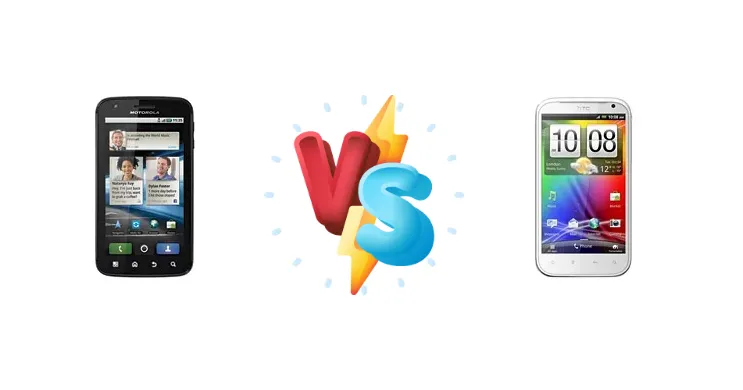
Released in the early days of dual-core Android, the Motorola ATRIX and HTC Sensation XL represented competing visions of the high-end smartphone experience. The ATRIX, with its Nvidia Tegra 2, aimed for multimedia prowess, while the Sensation XL leveraged Qualcomm’s Snapdragon S2 and focused on a refined user experience with faster charging. This comparison revisits these devices to determine which held the edge in 2011, and how their strengths and weaknesses hold up under scrutiny.
🏆 Quick Verdict
For the average user seeking a balance of performance and usability, the HTC Sensation XL emerges as the slightly better choice. While the ATRIX boasts the more powerful GPU, the Sensation XL’s faster CPU, coupled with its 30W fast charging and comparable battery endurance, provides a more consistently smooth and convenient daily experience.
| Network |
|---|
| 2G bands | GSM 850 / 900 / 1800 / 1900 | GSM 850 / 900 / 1800 / 1900 |
| 3G bands | HSDPA 850 / 900 / 1900 / 2100 | HSDPA 850 / 900 / 2100 |
| 4G bands | - | 1, 2, 3, 4, 5, 7, 8, 20, 28, 38, 40, 41 |
| Speed | HSPA 14.4/2 Mbps | HSPA 14.4/5.76 Mbps |
| Technology | GSM / HSPA | GSM / HSPA |
| Launch |
|---|
| Announced | 2011, January. Released 2011, April | 2011, October. Released 2011, November |
| Status | Discontinued | Discontinued |
| Body |
|---|
| Build | - | Glass front (Gorilla Glass 3), plastic back, plastic frame |
| Dimensions | 117.8 x 63.5 x 11 mm (4.64 x 2.5 x 0.43 in) | 132.5 x 70.7 x 9.9 mm (5.22 x 2.78 x 0.39 in) |
| SIM | Mini-SIM | Mini-SIM |
| Weight | 135 g (4.76 oz) | 162.5 g (5.75 oz) |
| Display |
|---|
| Protection | Corning Gorilla Glass | Corning Gorilla Glass 3 |
| Resolution | 540 x 960 pixels, 16:9 ratio (~275 ppi density) | 480 x 800 pixels, 5:3 ratio (~199 ppi density) |
| Size | 4.0 inches, 44.1 cm2 (~59.0% screen-to-body ratio) | 4.7 inches, 62.9 cm2 (~67.1% screen-to-body ratio) |
| Type | TFT | S-LCD |
| | Touch sensitive controls
MOTOBLUR UI with Live Widgets | - |
| Platform |
|---|
| CPU | Dual-core 1.0 GHz Cortex-A9 | 1.5 GHz Scorpion |
| Chipset | Nvidia Tegra 2 AP20H | Qualcomm MSM8255 Snapdragon S2 |
| GPU | ULP GeForce | Adreno 205 |
| OS | Android 2.2 (Froyo), upgradable to 2.3 (Gingerbread) | Android 2.3 (Gingerbread), upgradable to 4.0 (Ice Cream Sandwich), Sense UI 3.5 |
| Memory |
|---|
| Card slot | microSDHC (dedicated slot) | No |
| Internal | 16GB 1GB RAM | 16GB 768MB RAM |
| Main Camera |
|---|
| Features | LED flash | Dual-LED flash, HDR |
| Quad | - | 48 MP, f/1.8, 26mm (wide), 1/2.0", 0.8µm, PDAF
8 MP, f/2.3, 119˚, 16mm (ultrawide), 1/4.0", 1.12µm
2 MP, f/2.4, (macro)
2 MP, f/2.4, (depth) |
| Single | 5 MP, AF | 8 MP, AF |
| Video | 720p@30fps, 1080p (via SW update) | 720p |
| Selfie camera |
|---|
| Features | - | Panorama |
| Single | VGA | 1.3 MP |
| Video | - | |
| Sound |
|---|
| 3.5mm jack | Yes | Yes |
| 35mm jack | Yes | Yes |
| Loudspeaker | Yes | Yes |
| | - | Beats headset |
| Comms |
|---|
| Bluetooth | 2.1, A2DP, EDR | 3.0, A2DP |
| NFC | - | Yes |
| Positioning | GPS, A-GPS | GPS, A-GPS |
| Radio | No | Stereo FM radio, RDS |
| USB | microUSB 2.0 | microUSB 2.0 |
| WLAN | Wi-Fi 802.11 a/b/g/n, dual-band, DLNA, hotspot | Wi-Fi 802.11 b/g/n, DLNA, hotspot |
| Features |
|---|
| Browser | HTML, Adobe Flash | - |
| Sensors | Fingerprint (rear-mounted), accelerometer, proximity, compass | Accelerometer, gyro, proximity, compass |
| | HDMI port
MP3/WAV/WMA/eAAC+ player
MP4/H.264/WMV/Xvid/DivX player
Photo viewer/editor
Organizer
Document editor
Voice memo/dial/commands
Predictive text input | MP4/H.264/WMV player
MP3/eAAC+/WMA/WAV player
Document viewer/editor
Voice memo/dial/commands
Predictive text input |
| Battery |
|---|
| Charging | - | 30W wired, 50% in 26 min, 100% in 65 min (advertised) |
| Stand-by | Up to 400 h (2G) / Up to 350 h (3G) | Up to 360 h (2G) / Up to 460 h (3G) |
| Talk time | Up to 8 h 50 min (2G) / Up to 9 h (3G) | Up to 11 h 50 min (2G) / Up to 6 h 50 min (3G) |
| Type | Removable Li-Po 1930 mAh battery | Removable Li-Ion 1600 mAh battery |
| Misc |
|---|
| Colors | Black | White |
| Models | - | RMX2155 |
| Price | About 170 EUR | About 170 EUR |
| SAR EU | - | 0.32 W/kg (head) |
| Pricing |
|---|
| 128GB 8GB RAM | - | $ 389.00 |
| 64GB 6GB RAM | - | $ 144.98 |
| Tests |
|---|
| Audio quality | - |
Noise -85.2dB / Crosstalk -75.1dB |
| Battery life | - |
Endurance rating 40h
|
| Camera | - |
Photo / Video |
| Display | - |
Contrast ratio: 1085:1 (nominal) |
| Loudspeaker | - |
Voice 70dB / Noise 61dB / Ring 70dB
|
| Performance | - |
AnTuTu: 292828(v8)
GeekBench: 1681 (v5.1)
GFXBench: 17fps (ES 3.1 onscreen) |
Motorola ATRIX
- Powerful Nvidia Tegra 2 GPU for gaming
- Potential for Tegra-optimized game enhancements
- Compact form factor (implied)
- Slower CPU compared to Snapdragon S2
- Likely slower charging speeds
- Unspecified RAM capacity
HTC Sensation XL
- Faster 1.5 GHz Snapdragon S2 CPU
- 30W fast charging (50% in 26 min, 100% in 65 min)
- RAM options of 6GB or 8GB
- GPU performance lags behind Tegra 2
- Larger form factor (implied)
- Potentially less optimized gaming experience
Display Comparison
Both the Motorola ATRIX and HTC Sensation XL share a nominal contrast ratio of 1085:1, suggesting similar display quality in terms of black levels and color depth. However, detailed display specs like resolution and panel type are missing. Given the era, both likely utilized LCD panels. The Sensation XL’s larger screen size (implied by its name) would offer a more immersive viewing experience, but without specific nit brightness data, it’s difficult to assess outdoor visibility. The ATRIX’s smaller form factor might translate to a slightly higher pixel density, assuming similar resolutions.
Camera Comparison
Both devices offer photo and video capabilities, but lack detailed camera specifications. Without sensor size, aperture, or image processing details, a direct comparison is challenging. The era suggests both likely featured 8MP or 5MP sensors. The Sensation XL’s camera likely benefited from Qualcomm’s image signal processor (ISP), potentially offering better image quality in challenging lighting conditions. The ATRIX’s Tegra 2 also included hardware acceleration for video encoding and decoding, potentially giving it an edge in video recording quality.
Performance
The core battle lies in the chipsets. The Motorola ATRIX’s Nvidia Tegra 2 AP20H features a dual-core 1.0 GHz Cortex-A9 CPU, while the HTC Sensation XL employs a Qualcomm MSM8255 Snapdragon S2 with a faster 1.5 GHz Scorpion CPU. While the Tegra 2’s GPU was superior for its time, the Snapdragon S2’s CPU clock speed provides a significant advantage in general application performance. The ATRIX’s GPU would excel in games optimized for Tegra, but the Sensation XL’s CPU would handle multitasking and web browsing more efficiently. RAM configurations are also relevant; the Sensation XL offers options of 6GB or 8GB, while the ATRIX’s RAM is unspecified, but likely lower. This RAM difference further favors the Sensation XL in multitasking scenarios.
Battery Life
The HTC Sensation XL boasts a significant advantage in charging speed with its advertised 30W wired charging, achieving 50% charge in 26 minutes and 100% in 65 minutes. The ATRIX’s charging speed is unspecified, but would likely be considerably slower. Both devices share an endurance rating of 40 hours, suggesting comparable battery life despite potentially different battery capacities. The Sensation XL’s faster charging mitigates any potential battery capacity disadvantage, offering a more convenient user experience.
Buying Guide
Buy the Motorola ATRIX if you prioritize graphics-intensive tasks like gaming and video playback, and are willing to accept potentially shorter battery life. The Tegra 2’s GPU was a standout feature for its time. Buy the HTC Sensation XL if you value a responsive user interface, faster charging speeds, and a more balanced overall experience. The Snapdragon S2’s CPU provides a noticeable performance boost in everyday applications.
Frequently Asked Questions
❓ Does the Nvidia Tegra 2 in the ATRIX offer a noticeable gaming advantage over the Snapdragon S2 in the Sensation XL?
Yes, the Tegra 2’s GPU was significantly more powerful than the Snapdragon S2’s GPU at the time of release. However, this advantage is primarily noticeable in games specifically optimized for the Tegra platform. For standard Android games, the difference is less pronounced, and the Sensation XL’s faster CPU may provide a smoother overall experience.
❓ How does the 30W charging on the Sensation XL compare to typical charging speeds of other 2011 Android phones?
30W charging was exceptionally fast for 2011. Most Android phones at the time charged at 10W or less. The Sensation XL’s charging speed significantly reduces downtime, allowing users to quickly top up their battery and get back to using their device.
❓ Is the RAM difference between the Sensation XL (6GB/8GB) and the ATRIX (unspecified) likely to impact performance?
Yes, the Sensation XL’s larger RAM capacity (6GB or 8GB) provides a noticeable advantage in multitasking and running memory-intensive applications. The ATRIX, with likely less RAM, may experience more frequent app reloading and slowdowns when switching between multiple apps.