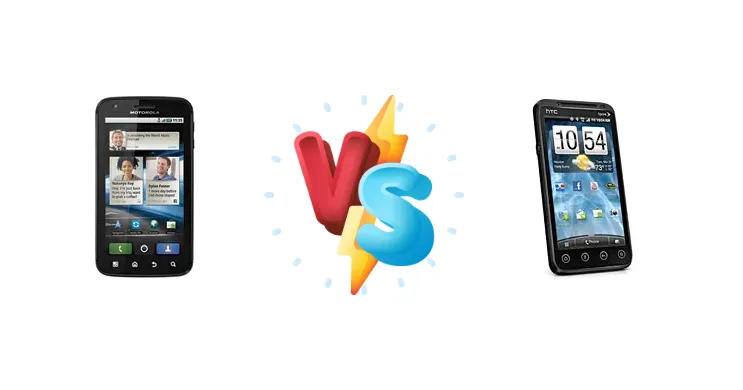
In 2011, Motorola's ATRIX and HTC's EVO 3D represented the cutting edge of Android smartphones, both boasting dual-core processors and ambitious features. The ATRIX aimed for desktop replacement with its laptop dock, while the EVO 3D pioneered glasses-free 3D. This comparison revisits these pioneers to determine which held the edge in performance, features, and overall user experience.
🏆 Quick Verdict
For the average user today, the HTC EVO 3D CDMA edges out the Motorola ATRIX. While the ATRIX’s Tegra 2 offered strong initial GPU performance, the Snapdragon S3 in the EVO 3D provides a more consistently smooth experience due to better thermal management and a slightly higher clock speed, coupled with the unique 3D camera capabilities.
| Network |
|---|
| 2G bands | GSM 850 / 900 / 1800 / 1900 | CDMA 800 / 1900 |
| 3G bands | HSDPA 850 / 900 / 1900 / 2100 | CDMA2000 1xEV-DO |
| Speed | HSPA 14.4/2 Mbps | EV-DO Rev.A 3.1 Mbps |
| Technology | GSM / HSPA | CDMA / EVDO |
| Launch |
|---|
| Announced | 2011, January. Released 2011, April | 2011, March. Released 2011, June |
| Status | Discontinued | Discontinued |
| Body |
|---|
| Dimensions | 117.8 x 63.5 x 11 mm (4.64 x 2.5 x 0.43 in) | 127 x 66 x 11.9 mm (5.0 x 2.60 x 0.47 in) |
| SIM | Mini-SIM | Mini-SIM |
| Weight | 135 g (4.76 oz) | 170.1 g (6.00 oz) |
| Display |
|---|
| Protection | Corning Gorilla Glass | - |
| Resolution | 540 x 960 pixels, 16:9 ratio (~275 ppi density) | 540 x 960 pixels, 16:9 ratio (~256 ppi density) |
| Size | 4.0 inches, 44.1 cm2 (~59.0% screen-to-body ratio) | 4.3 inches, 51.0 cm2 (~60.8% screen-to-body ratio) |
| Type | TFT | 3D S-LCD |
| | Touch sensitive controls
MOTOBLUR UI with Live Widgets | - |
| Platform |
|---|
| CPU | Dual-core 1.0 GHz Cortex-A9 | Dual-core 1.2 GHz Scorpion |
| Chipset | Nvidia Tegra 2 AP20H | Qualcomm MSM8660 Snapdragon S3 |
| GPU | ULP GeForce | Adreno 220 |
| OS | Android 2.2 (Froyo), upgradable to 2.3 (Gingerbread) | Android 2.3 (Gingerbread), Sense UI 3 |
| Memory |
|---|
| Card slot | microSDHC (dedicated slot) | microSDHC (dedicated slot) |
| Internal | 16GB 1GB RAM | 4GB 1GB RAM |
| Main Camera |
|---|
| Features | LED flash | Dual-LED flash |
| Single | 5 MP, AF | 5 MP, AF |
| Video | 720p@30fps, 1080p (via SW update) | 720p@30fps |
| Selfie camera |
|---|
| Single | VGA | 1.3 MP |
| Sound |
|---|
| 3.5mm jack | Yes | Yes |
| 35mm jack | Yes | Yes |
| Loudspeaker | Yes | Yes |
| | - | SRS virtual surround sound (via wired headphones)
|
| Comms |
|---|
| Bluetooth | 2.1, A2DP, EDR | 3.0, A2DP, EDR |
| Positioning | GPS, A-GPS | GPS, A-GPS |
| Radio | No | Stereo FM radio, RDS |
| USB | microUSB 2.0 | microUSB 2.0 (MHL TV-out) |
| WLAN | Wi-Fi 802.11 a/b/g/n, dual-band, DLNA, hotspot | Wi-Fi 802.11 b/g/n, WiMAX 802.16 e, DLNA, hotspot |
| Features |
|---|
| Browser | HTML, Adobe Flash | HTML |
| Sensors | Fingerprint (rear-mounted), accelerometer, proximity, compass | Accelerometer, gyro, proximity, compass |
| | HDMI port
MP3/WAV/WMA/eAAC+ player
MP4/H.264/WMV/Xvid/DivX player
Photo viewer/editor
Organizer
Document editor
Voice memo/dial/commands
Predictive text input | MP3/AAC+/WAV/WMA player
MP4/Xvid/H.264/WMV player
Organizer
Document viewer/editor
Voice memo/dial/commands
Predictive text input |
| Battery |
|---|
| Stand-by | Up to 400 h (2G) / Up to 350 h (3G) | Up to 200 h |
| Talk time | Up to 8 h 50 min (2G) / Up to 9 h (3G) | Up to 6 h |
| Type | Removable Li-Po 1930 mAh battery | Removable Li-Ion 1730 mAh battery |
| Misc |
|---|
| Colors | Black | Black, plum |
| Price | About 170 EUR | About 220 EUR |
| SAR | - | 0.89 W/kg (head) |
Motorola ATRIX
- Unique laptop dock functionality for desktop-like experience
- Potentially stronger initial GPU performance with Tegra 2
- Sleek design for its time
- Tegra 2 prone to thermal throttling
- Lower CPU clock speed compared to EVO 3D
- Lacks 3D camera capabilities
HTC EVO 3D CDMA
- Glasses-free 3D camera for unique content creation
- More efficient Snapdragon S3 processor
- Higher CPU clock speed for smoother performance
- 3D effect may be gimmicky for some users
- Potentially lower peak GPU performance compared to ATRIX (initially)
- Larger size due to 3D camera module
Display Comparison
Both devices featured displays typical of the era – likely 4.0-inch LCD panels with resolutions around 480x800. However, specific details like peak brightness and color gamut are unavailable. The EVO 3D’s primary display feature was its glasses-free 3D capability, which, while a gimmick, differentiated it. The ATRIX lacked this, focusing on a standard viewing experience. Bezels were substantial on both, reflecting the design constraints of 2011.
Camera Comparison
The HTC EVO 3D’s standout feature was its dual 5MP cameras capable of capturing 3D photos and videos. While the image quality wouldn’t compete with modern smartphones, the 3D effect was a unique selling point. The ATRIX featured an 8MP rear camera, likely offering better still image quality in 2D, but lacked the 3D functionality. Both devices likely included front-facing cameras for video calls, but details on their resolution are scarce. The EVO 3D’s dual-camera setup, while a novelty, offered a distinct photographic experience.
Performance
The core difference lies in the chipsets. The Motorola ATRIX utilizes the Nvidia Tegra 2 AP20H with a dual-core 1.0 GHz Cortex-A9 CPU. The HTC EVO 3D employs the Qualcomm MSM8660 Snapdragon S3, featuring a dual-core 1.2 GHz Scorpion CPU. While the Tegra 2 initially showcased superior GPU performance, the Snapdragon S3’s architecture and 45nm process generally resulted in better sustained performance and thermal efficiency. The higher clock speed of the Snapdragon S3 also contributes to a snappier overall experience. The ATRIX’s GPU was more prone to throttling under heavy load, impacting gaming performance over extended periods.
Battery Life
Battery capacity details are limited, but both devices likely housed batteries around 1500-1800 mAh, typical for the time. The Snapdragon S3’s improved power efficiency likely translated to slightly better real-world battery life for the EVO 3D. Charging speeds were slow by today’s standards, relying on micro-USB connections. The ATRIX’s laptop dock could potentially extend battery life when connected, but at the cost of portability.
Buying Guide
Buy the Motorola ATRIX if you prioritize a unique desktop-like experience through the laptop dock and are interested in exploring the early potential of Nvidia's Tegra platform. Buy the HTC EVO 3D CDMA if you value a more refined Android experience, a capable 3D camera for novelty content creation, and a processor that maintains performance under sustained load.
Frequently Asked Questions
❓ Does the Nvidia Tegra 2 in the ATRIX overheat during extended gaming sessions?
Yes, the Tegra 2 in the ATRIX is known to throttle under sustained load, leading to reduced performance during prolonged gaming. The Snapdragon S3 in the EVO 3D generally manages heat more effectively, providing a more consistent gaming experience.
❓ Is the 3D camera on the HTC EVO 3D actually useful, or is it just a gimmick?
The 3D camera is largely a novelty feature. While it allows for capturing 3D photos and videos, the effect is often limited by the lack of readily available 3D displays. However, it provides a unique content creation option not found on the ATRIX.
❓ How well does the Motorola ATRIX laptop dock function as a true desktop replacement?
The ATRIX laptop dock offered a surprisingly functional desktop experience for its time. It allowed users to connect a monitor, keyboard, and mouse, and run applications in a desktop-like environment. However, performance was limited by the Tegra 2’s processing power and the Android operating system’s limitations.