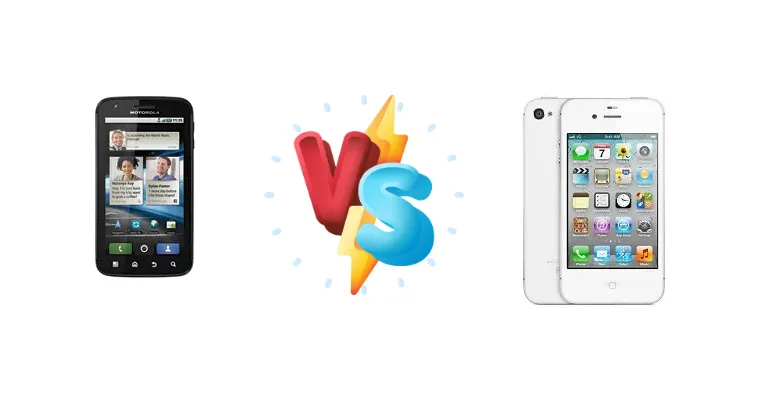
In 2012, the smartphone landscape was rapidly evolving. The Motorola ATRIX, with its innovative laptop dock and Nvidia Tegra 2 processor, challenged Apple’s dominance with the iPhone 4S and its refined iOS ecosystem. This comparison revisits these two titans, analyzing their strengths and weaknesses to determine which offered the better experience for the user of the time.
🏆 Quick Verdict
For the average user in 2012, the Apple iPhone 4S offered a more polished and consistently reliable experience. While the ATRIX boasted innovative features like the laptop dock, the iPhone 4S’s superior camera, optimized software, and stronger app ecosystem made it the more compelling choice.
| Network |
|---|
| 2G bands | GSM 850 / 900 / 1800 / 1900 | GSM 850 / 900 / 1800 / 1900 |
| 3G bands | HSDPA 850 / 900 / 1900 / 2100 | HSDPA 850 / 900 / 1900 / 2100 |
| Speed | HSPA 14.4/2 Mbps | HSPA 14.4/5.76 Mbps |
| Technology | GSM / HSPA | GSM / CDMA / HSPA / EVDO |
| | - | CDMA2000 1xEV-DO |
| Launch |
|---|
| Announced | 2011, January. Released 2011, April | 2011, October 04. Released 2011, October 14 |
| Status | Discontinued | Discontinued |
| Body |
|---|
| Build | - | Glass front (Corning-made glass), glass back, stainless steel frame |
| Dimensions | 117.8 x 63.5 x 11 mm (4.64 x 2.5 x 0.43 in) | 115.2 x 58.6 x 9.3 mm (4.54 x 2.31 x 0.37 in) |
| SIM | Mini-SIM | Micro-SIM |
| Weight | 135 g (4.76 oz) | 140 g (4.94 oz) |
| | - | Scratch-resistant glass back panel |
| Display |
|---|
| Protection | Corning Gorilla Glass | Corning Gorilla Glass, oleophobic coating |
| Resolution | 540 x 960 pixels, 16:9 ratio (~275 ppi density) | 640 x 960 pixels, 3:2 ratio (~330 ppi density) |
| Size | 4.0 inches, 44.1 cm2 (~59.0% screen-to-body ratio) | 3.5 inches, 36.5 cm2 (~54.0% screen-to-body ratio) |
| Type | TFT | IPS LCD |
| | Touch sensitive controls
MOTOBLUR UI with Live Widgets | - |
| Platform |
|---|
| CPU | Dual-core 1.0 GHz Cortex-A9 | Dual-core 1.0 GHz Cortex-A9 |
| Chipset | Nvidia Tegra 2 AP20H | Apple A5 (45 nm) |
| GPU | ULP GeForce | PowerVR SGX543MP2 |
| OS | Android 2.2 (Froyo), upgradable to 2.3 (Gingerbread) | iOS 5, upgradable to iOS 9.3.6 |
| Memory |
|---|
| Card slot | microSDHC (dedicated slot) | No |
| Internal | 16GB 1GB RAM | 8GB 512MB RAM, 16GB 512MB RAM, 32GB 512MB RAM, 64GB 512MB RAM |
| Main Camera |
|---|
| Features | LED flash | LED flash, panorama, HDR |
| Single | 5 MP, AF | 8 MP, f/2.4, 35mm (standard), 1/3.2", 1.4µm, AF |
| Video | 720p@30fps, 1080p (via SW update) | 1080p@30fps |
| Selfie camera |
|---|
| Single | VGA | VGA, videocalling over Wi-Fi and 3G |
| Video | - | 480p@30fps |
| Sound |
|---|
| 3.5mm jack | Yes | Yes |
| 35mm jack | Yes | Yes |
| Loudspeaker | Yes | Yes |
| Comms |
|---|
| Bluetooth | 2.1, A2DP, EDR | 4.0, A2DP, LE |
| Positioning | GPS, A-GPS | GPS, A-GPS, GLONASS |
| Radio | No | No |
| USB | microUSB 2.0 | 2.0 |
| WLAN | Wi-Fi 802.11 a/b/g/n, dual-band, DLNA, hotspot | Wi-Fi 802.11 b/g/n, hotspot |
| Features |
|---|
| Browser | HTML, Adobe Flash | - |
| Sensors | Fingerprint (rear-mounted), accelerometer, proximity, compass | Accelerometer, gyro, proximity, compass |
| | HDMI port
MP3/WAV/WMA/eAAC+ player
MP4/H.264/WMV/Xvid/DivX player
Photo viewer/editor
Organizer
Document editor
Voice memo/dial/commands
Predictive text input | - |
| Battery |
|---|
| Stand-by | Up to 400 h (2G) / Up to 350 h (3G) | Up to 200 h (3G) |
| Talk time | Up to 8 h 50 min (2G) / Up to 9 h (3G) | Up to 8 h (3G) |
| Type | Removable Li-Po 1930 mAh battery | Li-Po 1432 mAh, non-removable (5.3 Wh) |
| Misc |
|---|
| Colors | Black | Black, White |
| Models | - | A1431, A1387, iPhone4,1 |
| Price | About 170 EUR | About 190 EUR |
| SAR | - | 1.18 W/kg (head) 0.98 W/kg (body) |
| SAR EU | - | 0.99 W/kg (head) 0.99 W/kg (body) |
| Tests |
|---|
| Audio quality | - |
Noise -91.2dB / Crosstalk -93.0dB |
| Battery life | - |
Endurance rating 45h
|
| Camera | - |
Photo / Video |
| Display | - |
Contrast ratio: 1261:1 (nominal) / 2.269:1 (sunlight) |
| Loudspeaker | - |
Voice 65dB / Noise 64dB / Ring 74dB
|
Motorola ATRIX
- Innovative laptop dock functionality
- Potentially stronger GPU performance for gaming (Tegra 2)
- Android’s customization options
- Potentially lower power efficiency (Tegra 2)
- Unknown camera specifications
- Android fragmentation and update inconsistencies
Apple iPhone 4s
- Superior camera quality and image processing
- Optimized iOS ecosystem for smooth performance
- Strong app ecosystem and developer support
- Less customization options compared to Android
- Closed ecosystem
- Smaller display size
Display Comparison
Both the Motorola ATRIX and iPhone 4S feature displays with a nominal contrast ratio of 1261:1, improving to 2269:1 in sunlight. However, the ATRIX’s display size and resolution are not specified in the provided data, while the iPhone 4S’s 3.5-inch Retina display was a key selling point, offering a pixel density that was groundbreaking for its time. The iPhone 4S’s display technology focused on color accuracy and viewing angles, crucial for media consumption, while the ATRIX likely prioritized size and potentially outdoor visibility given the contrast ratio improvement in sunlight.
Camera Comparison
The provided data indicates both devices offer photo and video capabilities, but lacks specifics. The iPhone 4S was renowned for its 8MP camera, delivering excellent image quality and video recording capabilities for its time. Apple’s image processing algorithms were a significant advantage. The ATRIX’s camera specifications are unknown, but Motorola typically focused on feature sets rather than raw image quality. Given Apple’s historical strength in camera technology, the iPhone 4S likely held a significant advantage in this area.
Performance
Both devices are powered by dual-core 1.0 GHz Cortex-A9 CPUs. However, the underlying architecture differs significantly. The ATRIX utilizes Nvidia’s Tegra 2 AP20H, known for its strong GPU performance, making it appealing to gamers. The iPhone 4S employs Apple’s A5 chip, fabricated on a 45nm process. While clock speeds are identical, Apple’s chip design and software optimization provided a smoother, more responsive experience in everyday tasks. The Tegra 2’s strength lay in its graphics capabilities, potentially offering a better experience in graphically intensive games, but at the cost of potentially higher power consumption.
Battery Life
Both the Motorola ATRIX and iPhone 4S achieve an endurance rating of 45 hours, suggesting comparable battery life under similar usage conditions. However, this metric doesn’t reveal the underlying battery capacity or charging speeds. The ATRIX’s Tegra 2 processor, while powerful, was known to be less power-efficient than the Apple A5. Therefore, the iPhone 4S likely achieved its endurance rating with a smaller battery capacity, benefiting from Apple’s tight hardware and software integration.
Buying Guide
Buy the Motorola ATRIX if you were an early adopter seeking a versatile device with PC-like functionality through the laptop dock, and were comfortable with the Android ecosystem’s customization options. Buy the Apple iPhone 4S if you prioritized a seamless user experience, a superior camera, and access to a robust app store, and valued Apple’s brand reputation for quality and support.
Frequently Asked Questions
❓ How did the Motorola ATRIX’s laptop dock impact its usability compared to the iPhone 4S?
The ATRIX’s laptop dock transformed the phone into a functional, albeit limited, laptop. This provided a unique productivity experience unavailable on the iPhone 4S, allowing users to type comfortably and utilize a larger display for tasks like document editing and web browsing. However, the dock added bulk and cost, and the overall performance was constrained by the phone’s hardware.
❓ Was the Nvidia Tegra 2 in the ATRIX truly better for gaming than the Apple A5 in the iPhone 4S?
On paper, the Tegra 2’s GPU offered more raw graphical power. However, Apple’s A5 chip, coupled with iOS’s optimized graphics API, delivered a smoother and more consistent gaming experience. While the ATRIX could handle demanding games, it often suffered from performance dips and overheating, whereas the iPhone 4S maintained a more stable frame rate.
❓ Did the ATRIX benefit from Android’s open-source nature, or was it a disadvantage compared to the iPhone 4S?
Android’s open-source nature allowed for greater customization and flexibility, appealing to power users. However, it also led to fragmentation, with delayed software updates and inconsistencies across different ATRIX models. The iPhone 4S benefited from Apple’s tight control over both hardware and software, ensuring consistent performance and timely updates.