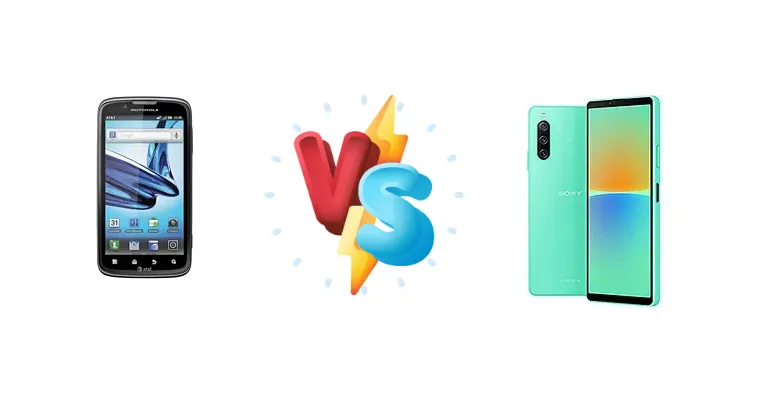
The Motorola ATRIX 2, a pioneer of its time, and the Sony Xperia 10 IV, a modern mid-range contender. This comparison pits a classic Android device against a contemporary offering, exploring how technology has evolved and which phone best suits today's needs. Let's dive into a detailed breakdown.
🏆 Quick Verdict
The Sony Xperia 10 IV is the clear winner. While the ATRIX 2 holds nostalgic appeal, the Xperia 10 IV boasts a significantly faster processor, better camera, longer battery life, and modern features like 5G. It's a practical choice for everyday use.
| Network |
|---|
| 2G bands | GSM 850 / 900 / 1800 / 1900 | GSM 850 / 900 / 1800 / 1900 |
| 3G bands | HSDPA 850 / 1900 / 2100 | HSDPA 850 / 900 / 1700(AWS) / 2100 |
| 4G bands | - | 1, 3, 4, 5, 7, 8, 20, 28, 38, 39, 40, 41 |
| 5G bands | - | 1, 3, 7, 8, 28, 38, 41, 77, 78, 79 SA/NSA |
| Speed | HSPA 21.1/5.76 Mbps | HSPA, LTE, 5G |
| Technology | GSM / HSPA | GSM / HSPA / LTE / 5G |
| Launch |
|---|
| Announced | 2011, October. Released 2011, October | 2022, May 11 |
| Status | Discontinued | Available. Released 2022, June 30 |
| Body |
|---|
| Build | - | Glass front (Gorilla Glass Victus), plastic frame, plastic back |
| Dimensions | 126 x 66 x 10 mm (4.96 x 2.60 x 0.39 in) | 153 x 67 x 8.3 mm (6.02 x 2.64 x 0.33 in) |
| SIM | Mini-SIM | · Nano-SIM + eSIM· Nano-SIM + Nano-SIM |
| Weight | 147 g (5.19 oz) | 161 g (5.68 oz) |
| | - | IP65/IP68 dust/water resistant (up to 1.5m for 30 min) |
| Display |
|---|
| Protection | Corning Gorilla Glass | Corning Gorilla Glass Victus |
| Resolution | 540 x 960 pixels, 16:9 ratio (~256 ppi density) | 1080 x 2520 pixels, 21:9 ratio (~457 ppi density) |
| Size | 4.3 inches, 51.0 cm2 (~61.3% screen-to-body ratio) | 6.0 inches, 84.1 cm2 (~82.0% screen-to-body ratio) |
| Type | TFT | OLED, 1B colors, HDR |
| | Touch sensitive controls
MOTOBLUR UI with Live Widgets | Triluminos display |
| Platform |
|---|
| CPU | Dual-core 1.2 GHz Cortex-A9 | Octa-core (2x2.2 GHz Kryo 660 Gold & 6x1.7 GHz Kryo 660 Silver) |
| Chipset | TI OMAP 4430 | Qualcomm SM6375 Snapdragon 695 5G (6 nm) |
| GPU | PowerVR SGX540 | Adreno 619 |
| OS | Android 2.3 (Gingerbread), 4.0.4 (Ice Cream Sandwich), not upgradable to 4.1 (Jelly Bean) | Android 12, upgradable to Android 14 |
| Memory |
|---|
| Card slot | microSDHC (dedicated slot), 2 GB included | microSDXC (uses shared SIM slot) |
| Internal | 8GB 1GB RAM | 128GB 6GB RAM |
| | - | UFS |
| Main Camera |
|---|
| Features | LED flash | LED flash, HDR, panorama |
| Single | 8 MP, AF | 8 MP, f/2.0, 27mm (wide), 1/4.0" |
| Triple | - | 12 MP, f/1.8, 27mm (wide), 1/2.8", PDAF, OIS
8 MP, f/2.2, 54mm (telephoto), 1/4.4", PDAF, 2x optical zoom
8 MP, f/2.2, 120˚, 16mm (ultrawide), 1/4.0" |
| Video | 1080p@24fps | 1080p@30fps |
| Selfie camera |
|---|
| Features | - | HDR |
| Single | Yes | 8 MP, f/2.0, 27mm (wide), 1/4.0" |
| Video | - | 1080p@30fps |
| Sound |
|---|
| 3.5mm jack | Yes | Yes |
| 35mm jack | Yes | Yes |
| Loudspeaker | Yes | Yes |
| | - | 24-bit/192kHz audio
|
| Comms |
|---|
| Bluetooth | 2.1, A2DP, EDR | 5.1, A2DP, LE, aptX HD, aptX Adaptive |
| NFC | - | Yes |
| Positioning | GPS, A-GPS | GPS, GLONASS, GALILEO, BDS, QZSS |
| Radio | Stereo FM radio, RDS | No |
| USB | microUSB 2.0 | USB Type-C 2.0, OTG |
| WLAN | Wi-Fi 802.11 a/b/g/n, dual-band, DLNA, hotspot | Wi-Fi 802.11 a/b/g/n/ac, dual-band, Wi-Fi Direct |
| Features |
|---|
| Sensors | Accelerometer, proximity, compass | Fingerprint (side-mounted), accelerometer, proximity, compass |
| | HDMI port
MP3/WAV/WMA/eAAC+ player
MP4/H.264/WMV/Xvid/DivX player
Photo viewer/editor
Organizer
Quickoffice document editor
Voice memo/dial/commands
Predictive text input | - |
| Battery |
|---|
| Charging | - | 21W wired (unofficial rating), PD, QC |
| Stand-by | Up to 382 h | - |
| Talk time | Up to 8 h 50 min | - |
| Type | Removable Li-Ion 1785 mAh battery | Li-Po 5000 mAh |
| Misc |
|---|
| Colors | Black | Black, White, Mint, Lavender |
| Models | MB865 | XQ-CC54, XQ-CC72, SOG07 |
| Price | About 230 EUR | £ 99.99 / € 112.89 |
| SAR | 1.01 W/kg (head) 1.15 W/kg (body) | - |
| Tests |
|---|
| Battery life | - |
Endurance rating 163h
|
| Camera | - |
Photo / Video |
| Display | - |
Contrast ratio: Infinite (nominal) |
| Loudspeaker | - |
-30.6 LUFS (Below average)
|
| Performance | - |
AnTuTu: 396008 (v9)
GeekBench: 1908 (v5.1)
GFXBench: 16fps (ES 3.1 onscreen) |
Motorola ATRIX 2 MB865
- Historical Significance
- Compact Design (for its time)
- Expandable Storage (MicroSD)
- Outdated Processor
- Low-Resolution Display
- Poor Camera Quality
- No 5G
- Limited App Compatibility
Sony Xperia 10 IV
- Modern Processor
- Vibrant OLED Display
- Decent Camera
- Long Battery Life
- 5G Connectivity
- Fast Charging (PD, QC)
- Mid-Range Performance (not flagship)
- Plastic Build
- May lack premium features
Display Comparison
The Xperia 10 IV's 6.5-inch OLED display with 683 nits brightness and infinite contrast ratio blows the ATRIX 2's older LCD screen out of the water. Colors are more vibrant, blacks are deeper, and visibility in sunlight is significantly better. The ATRIX 2's display was good for its time, but it simply can't compete with modern OLED technology.
Camera Comparison
The Xperia 10 IV's camera system offers a significant upgrade in image quality and features. While specific megapixel counts aren't the only factor, the Xperia 10 IV's modern image processing and sensor technology result in sharper, more detailed photos and videos. The ATRIX 2's camera was adequate for its time, but it lacks the advanced capabilities of the Xperia 10 IV.
Performance
The Xperia 10 IV's Octa-core Snapdragon 695 5G processor is vastly superior to the ATRIX 2's Dual-core OMAP 4430. Expect smoother multitasking, faster app loading times, and better overall responsiveness on the Xperia 10 IV. The ATRIX 2, while capable for its era, will struggle with modern apps and demanding tasks.
Battery Life
The Xperia 10 IV's endurance rating of 163h is a testament to its excellent battery optimization. The ATRIX 2's battery life was respectable for 2011, but it pales in comparison to the Xperia 10 IV's longevity. Expect significantly longer usage times on a single charge with the Xperia 10 IV.
Buying Guide
The Motorola ATRIX 2 is for Android enthusiasts and collectors seeking a piece of mobile history. The Sony Xperia 10 IV is ideal for users wanting a reliable, affordable smartphone with a good display, decent camera, and long battery life.
Frequently Asked Questions
❓ Is the Motorola ATRIX 2 still usable in 2024?
Yes, but with limitations. It can still run basic apps, but performance will be slow, and app compatibility may be an issue. It's best suited for nostalgia or as a retro device.
❓ What are the main differences between the ATRIX 2 and the Xperia 10 IV?
The Xperia 10 IV offers a significantly faster processor, a better display, a superior camera, longer battery life, and modern features like 5G. The ATRIX 2 is a historical artifact showcasing early Android innovation.