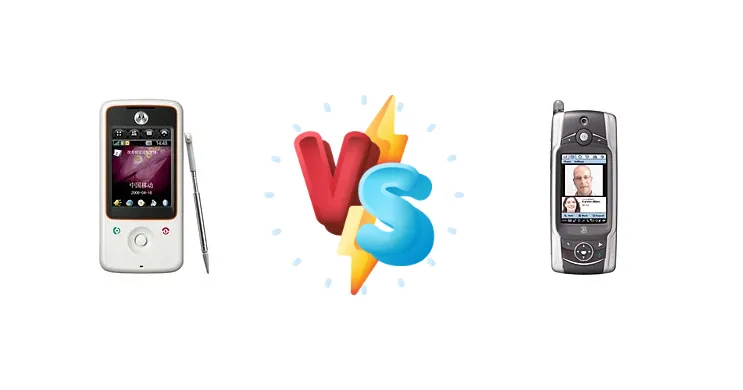
Relive the early days of mobile technology with a comparison of two Motorola classics: the A810 and the A925. These phones represent a fascinating era of innovation, but which one holds up better today? Let's dive in and see which retro device deserves your attention.
🏆 Quick Verdict
The Motorola A925 edges out the A810 thanks to its known TI OMAP 1510 chipset and 168 MHz ARM925T CPU, offering a slightly more capable performance. While the A810's specs are unknown, the A925's documented hardware gives it a clear advantage for those seeking a functional vintage device.
| Network |
|---|
| 2G bands | GSM 900 / 1800 / 1900 | GSM 900 / 1800 / 1900 |
| 3G bands | - | UMTS 2100 |
| EDGE | Class 10 | - |
| GPRS | Class 10 | - |
| Speed | - | Yes, 384 kbps |
| Technology | GSM | GSM / UMTS |
| Launch |
|---|
| Announced | 2008, June. Released 2008, August | 2003, Q4 |
| Status | Discontinued | Discontinued |
| Body |
|---|
| Dimensions | 105 x 51 x 14 mm (4.13 x 2.01 x 0.55 in) | 148 x 60 x 24 mm, 175 cc (5.83 x 2.36 x 0.94 in) |
| SIM | Mini-SIM | Mini-SIM |
| Weight | 100 g (3.53 oz) | 210 g (7.41 oz) |
| Display |
|---|
| Resolution | 240 x 320 pixels, 4:3 ratio (~182 ppi density) | 208 x 320 pixels, 3:2 ratio |
| Size | 2.2 inches, 15.0 cm2 (~28.0% screen-to-body ratio) | - |
| Type | TFT resistive touchscreen, 256K colors | TFT resistive touchscreen, 65K colors |
| | Handwriting recognition | - |
| Platform |
|---|
| CPU | - | 168 MHz ARM925T |
| Chipset | - | TI OMAP 1510 |
| OS | - | Symbian 7.0, UIQ 2.0 |
| Memory |
|---|
| Call records | 30 dialed, 30 received, 30 missed calls | - |
| Card slot | microSD (dedicated slot) | MMC/SD, 32 MB SD included |
| Internal | - | 12MB |
| Phonebook | Yes, Photo call | - |
| Main Camera |
|---|
| Single | 2 MP | VGA |
| Video | Yes | Yes |
| Selfie camera |
|---|
| Single | - | Yes |
| | No | - |
| Sound |
|---|
| 3.5mm jack | Yes | No |
| 35mm jack | Yes | No |
| Alert types | Vibration; Downloadable polyphonic, MP3 ringtones | Vibration; Downloadable polyphonic, MP3 , WAV ringtones |
| Loudspeaker | Yes | No |
| Comms |
|---|
| Bluetooth | 1.2, A2DP | 1.1 |
| Infrared port | - | Yes |
| Positioning | No | GPS |
| Radio | Stereo FM radio | No |
| USB | 2.0 | Proprietary |
| WLAN | No | No |
| Features |
|---|
| Browser | WAP 2.0/xHTML, HTML (Opera v8.5) | WAP 2.0/xHTML |
| Games | Yes | - |
| Java | Yes, MIDP 2.0 | - |
| Messaging | SMS, MMS, Email | - |
| | MP3/WAV/WMA/AAC+ player
Voice memo | MP3/MP4 player
Organizer
Predictive text input
Sync ML
Voice memo |
| Battery |
|---|
| Stand-by | Up to 150 h | Up to 160 h |
| Talk time | Up to 4 h | Up to 2 h |
| Type | Removable Li-Ion 910 mAh battery | Removable Li-Po 1050 mAh battery (BA680) |
| Misc |
|---|
| Colors | Excellent Black and White Shang-chi | - |
| Price | About 60 EUR | - |
| SAR | 1.41 W/kg (head) 0.25 W/kg (body) | - |
Motorola A810
- Potentially rare and collectible
- Represents a unique piece of Motorola history
- Unknown specifications
- Likely limited functionality
- Difficult to find information
- Battery replacement challenges
Motorola A925
- Known chipset and CPU (TI OMAP 1510, ARM925T)
- Slightly better performance than an unknown device
- More information available online
- Potentially functional vintage device
- Limited functionality by modern standards
- Low-resolution display
- Rudimentary camera
- Battery replacement challenges
Display Comparison
Display information for both devices is scarce. Both likely featured small, low-resolution LCD screens typical of their era. Expect limited color accuracy and viewing angles. The A925 might have a marginally better display due to potentially slightly newer technology, but differences would be minimal.
Camera Comparison
Both phones likely featured rudimentary cameras, if any at all. Image quality would be extremely low by modern standards. Expect grainy, low-resolution photos. Neither phone is likely to be a strong contender for photography.
Performance
The A925's TI OMAP 1510 chipset and 168 MHz ARM925T CPU provide a known baseline for performance. The A810's performance is entirely unknown, making direct comparison difficult. However, the A925's processor was considered decent for its time, allowing for basic web browsing and application usage. The A810's performance could be significantly better or worse.
Battery Life
Battery life was a significant constraint in the early 2000s. Both devices likely offered a few hours of talk time and limited standby time. Battery replacement may be difficult or impossible due to the age of the devices.
Buying Guide
The Motorola A810 is for collectors seeking a rare and potentially unique piece of Motorola history. The Motorola A925 is for enthusiasts interested in experiencing early smartphone functionality and a slightly more reliable vintage device, given its known specifications.
Frequently Asked Questions
❓ Are these phones usable in 2024?
While technically possible, using these phones in 2024 is extremely limited. They lack modern features, have poor connectivity, and are incompatible with current apps and networks. They are primarily collector's items.
❓ Where can I find replacement batteries?
Finding replacement batteries for these phones is difficult. Generic lithium-ion batteries of similar voltage and capacity might work, but compatibility is not guaranteed. Proceed with caution and research thoroughly.