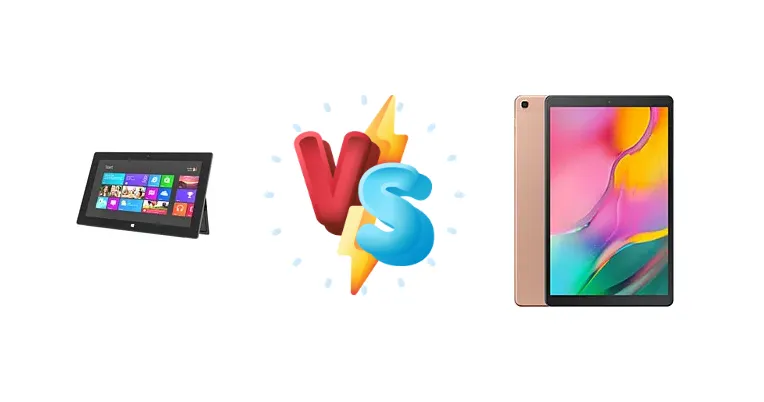
The Microsoft Surface, a pioneer in the 2-in-1 space, represents an early attempt at bridging the gap between laptops and tablets. The Samsung Galaxy Tab A 10.1 (2019), on the other hand, is a more conventional Android tablet aimed at providing a functional experience at an accessible price point. This comparison examines how these two devices, separated by a significant technological gap, stack up in today's market.
🏆 Quick Verdict
For the average user in 2024, the Samsung Galaxy Tab A 10.1 (2019) is the more practical choice. While the Surface was innovative, its aging Nvidia Tegra 3 chipset struggles with modern workloads, while the Tab A 10.1’s Exynos 7904 offers a significantly smoother experience for everyday tasks and media consumption.
| Network |
|---|
| 2G bands | N/A | GSM 850 / 900 / 1800 / 1900 |
| 3G bands | - | HSDPA 850 / 900 / 1700(AWS) / 1900 / 2100 |
| 4G bands | - | 1, 2, 3, 4, 5, 7, 8, 12, 17, 20, 28, 38, 40, 66 |
| EDGE | No | - |
| GPRS | No | - |
| Speed | - | HSPA, LTE - cellular model only |
| Technology | No cellular connectivity | GSM / HSPA / LTE |
| Launch |
|---|
| Announced | 2012, October. Released 2012, November | 2019, February 15. Released 2019, April |
| Status | Discontinued | Discontinued |
| Body |
|---|
| Build | - | Glass front, aluminum back, aluminum frame |
| Dimensions | 274.6 x 172 x 9.4 mm (10.81 x 6.77 x 0.37 in) | 245.2 x 149.4 x 7.5 mm (9.65 x 5.88 x 0.30 in) |
| SIM | No | Nano-SIM (cellular model only) |
| Weight | 680.4 g (1.50 lb) | 469 g (1.03 lb) |
| | Built-in kickstand | - |
| Display |
|---|
| Resolution | 1366 x 768 pixels, 16:9 ratio (~148 ppi density) | 1200 x 1920 pixels, 16:10 ratio (~224 ppi density) |
| Size | 10.6 inches, 309.7 cm2 (~65.6% screen-to-body ratio) | 10.1 inches, 295.8 cm2 (~80.7% screen-to-body ratio) |
| Type | TFT | TFT LCD |
| | ClearType technology | - |
| Platform |
|---|
| CPU | Quad-core 1.3 GHz Cortex-A9 | Octa-core (2x1.8 GHz Cortex-A73 & 6x1.6 GHz Cortex-A53) |
| Chipset | Nvidia Tegra 3 T30 | Exynos 7904 (14 nm) |
| GPU | ULP GeForce | Mali-G71 MP2 |
| OS | Microsoft Windows RT | Android 9.0 (Pie), upgradable to Android 11, One UI 3.0 |
| Memory |
|---|
| Card slot | microSDXC (dedicated slot) | microSDXC (dedicated slot) |
| Internal | 32GB 2GB RAM, 64GB 2GB RAM | 16GB 2GB RAM, 32GB 2GB RAM, 32GB 3GB RAM, 64GB 3GB RAM, 128GB 3GB RAM |
| | - | eMMC 5.1 |
| Main Camera |
|---|
| Features | - | Panorama |
| Single | 1.2 MP | 8 MP, f/2.0, AF |
| Video | 720p | 1080p@30fps |
| Selfie camera |
|---|
| Single | 1.2 MP | 5 MP, f/2.2 |
| Video | 720p@30fps | 1080p@30fps |
| Sound |
|---|
| 3.5mm jack | Yes | Yes |
| 35mm jack | Yes | Yes |
| Loudspeaker | Yes, with stereo speakers | Yes, with stereo speakers |
| Comms |
|---|
| Bluetooth | 4.0, A2DP | 5.0, A2DP, LE |
| NFC | No | No |
| Positioning | No | GPS, GLONASS, GALILEO, BDS - cellular model only |
| Radio | No | No |
| USB | USB 2.0, OTG | USB Type-C 2.0 |
| WLAN | Wi-Fi 802.11 a/b/g/n, dual-band, Wi-Fi Direct | Wi-Fi 802.11 a/b/g/n/ac, dual-band, Wi-Fi Direct |
| Features |
|---|
| Sensors | Accelerometer, gyro, compass | Accelerometer, gyro, compass |
| | TV-out
MP4/DivX/XviD/WMV/H.264 player
MP3/WAV/eAAC+/FLAC player
Photo viewer/editor
Microsoft Office 2013 RT | ANT+ |
| Battery |
|---|
| Stand-by | Up to 360 h | - |
| Talk time | Up to 8 h | - |
| Type | Li-Ion battery, non-removable (31.5 Wh) | Li-Po 6150 mAh, non-removable |
| Misc |
|---|
| Colors | Dark Titanium | Black, Gold, Silver |
| Models | - | SM-T515, SM-T510 |
| Price | About 260 EUR | About 220 EUR |
| SAR | - | 0.92 W/kg (body) |
| SAR EU | - | 1.36 W/kg (body) |
| Tests |
|---|
| Audio quality |
Noise -82.6dB / Crosstalk -81.7dB | - |
| Display |
Contrast ratio: 1324:1 (nominal) | - |
Microsoft Surface
- Pioneering 2-in-1 design
- Unique form factor and kickstand
- Historical significance
- Outdated Nvidia Tegra 3 processor
- Limited software support (Windows RT)
- Poor performance with modern apps
Samsung Galaxy Tab A 10.1 (2019)
- More powerful Exynos 7904 processor
- Modern Android operating system
- Affordable price point
- Basic camera capabilities
- Lower build quality compared to the Surface
- Limited storage options
Display Comparison
The Microsoft Surface boasts a contrast ratio of 1324:1, a respectable figure for its time, but lacks specifics on resolution or panel technology. The Samsung Galaxy Tab A 10.1 (2019) doesn’t publish contrast ratio data, but its 10.1-inch display size suggests a lower pixel density than many modern tablets. The Surface’s display was designed for a premium experience, but the Tab A 10.1 prioritizes affordability, likely resulting in a less vibrant and detailed image. The Surface’s aspect ratio was also unique, geared towards productivity, while the Tab A 10.1 follows a more standard 16:10 format better suited for video.
Camera Comparison
Neither device was designed with photography as a primary focus. The Surface’s camera specifications are unavailable, but early tablets generally featured low-quality cameras. The Samsung Galaxy Tab A 10.1 (2019) also lacks detailed camera information, suggesting basic functionality suitable for video calls and occasional snapshots. Image quality on both devices will be subpar compared to modern smartphones and tablets.
Performance
The core difference lies in the chipsets. The Surface’s Nvidia Tegra 3 T30, with its quad-core 1.3 GHz Cortex-A9 CPU, is significantly outmatched by the Samsung Galaxy Tab A 10.1 (2019)’s Exynos 7904. The Exynos 7904 utilizes an octa-core configuration (2x1.8 GHz Cortex-A73 & 6x1.6 GHz Cortex-A53) built on a 14nm process, offering substantially more processing power and efficiency. The Cortex-A73 cores in the Tab A 10.1 provide a noticeable performance uplift in multi-threaded tasks, while the Cortex-A53 cores handle background processes efficiently. The Surface will struggle with modern web browsing and app usage, while the Tab A 10.1 provides a reasonably smooth experience for everyday tasks.
Battery Life
Battery capacity data for both devices is unavailable. However, the Exynos 7904’s 14nm manufacturing process is more power-efficient than the Tegra 3’s older architecture. This suggests the Tab A 10.1 will likely offer longer battery life despite potentially having a similar capacity. The Surface, running Windows RT, may also suffer from less optimized power management compared to Android on the Tab A 10.1.
Buying Guide
Buy the Microsoft Surface if you are a collector of tech history or specifically need a device running Windows RT for legacy software compatibility. Its appeal is largely nostalgic. Buy the Samsung Galaxy Tab A 10.1 (2019) if you prioritize a functional, affordable Android tablet for basic productivity, media streaming, and casual gaming. It offers a far more usable experience for the price.
Frequently Asked Questions
❓ Will the Surface be able to run modern Android apps?
No, the Microsoft Surface runs Windows RT, a version of Windows designed for ARM processors. It is not compatible with standard Windows applications or Android apps without emulation, which would likely result in extremely poor performance given the Tegra 3’s limitations.
❓ Does the Exynos 7904 chip overheat during extended use?
The Exynos 7904 is a relatively efficient chip. While it can get warm during prolonged gaming or video encoding, it is unlikely to overheat significantly under normal usage conditions. Its 14nm process helps to manage thermal output effectively.
❓ Is the Samsung Galaxy Tab A 10.1 (2019) suitable for playing demanding games like PUBG?
The Tab A 10.1 (2019) can run PUBG Mobile, but you’ll likely need to lower the graphics settings to medium or low to achieve a playable frame rate. It’s not a gaming powerhouse, but it can handle casual gaming sessions.
❓ Can I upgrade the storage on either of these tablets?
Neither the Microsoft Surface nor the Samsung Galaxy Tab A 10.1 (2019) offer user-upgradeable storage. You are limited to the internal storage capacity purchased at the time of purchase. The Tab A 10.1 does support microSD card expansion, offering some flexibility.