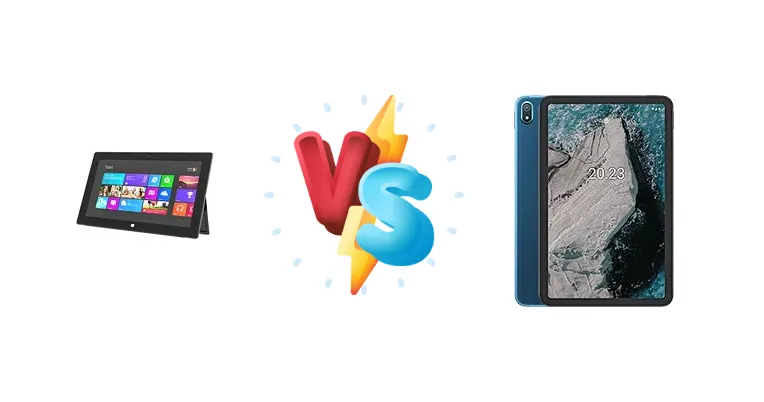
The tablet market offers a wide range of options, from premium productivity devices to affordable media consumption slates. We're pitting the Microsoft Surface, a veteran of the Windows tablet space, against the Nokia T20, a budget-friendly Android contender, to determine which offers the best value and performance for different user needs.
🏆 Quick Verdict
For users prioritizing a more modern, efficient processor and a brighter display, the Nokia T20 emerges as the better choice. While the Surface boasts a respectable contrast ratio, its aging Tegra 3 chipset is significantly outpaced by the Unisoc T610 in multi-core performance, making the T20 more suitable for everyday tasks and multitasking.
| Network |
|---|
| 2G bands | N/A | GSM 850 / 900 / 1800 / 1900 |
| 3G bands | - | HSDPA 850 / 900 / 1700(AWS) / 1900 / 2100 - US, LATAM |
| 4G bands | - | 1, 2, 3, 4, 5, 7, 8, 12, 13, 17, 20, 28, 40, 66 - US, LATAM |
| EDGE | No | - |
| GPRS | No | - |
| Speed | - | HSPA, LTE Cat4 150/50 Mbps - cellular model only |
| Technology | No cellular connectivity | GSM / HSPA / LTE |
| | - | 1, 3, 5, 7, 8, 20, 28, 38, 40, 41 - International |
| Launch |
|---|
| Announced | 2012, October. Released 2012, November | 2021, October 06 |
| Status | Discontinued | Available. Released 2021, November 02 |
| Body |
|---|
| Build | - | Glass front, aluminum back |
| Dimensions | 274.6 x 172 x 9.4 mm (10.81 x 6.77 x 0.37 in) | 247.6 x 157.5 x 7.8 mm (9.75 x 6.20 x 0.31 in) |
| SIM | No | Nano-SIM (cellular model only) |
| Weight | 680.4 g (1.50 lb) | 465 g (Wi-Fi), 470 g (LTE) (1.03 lb) |
| | Built-in kickstand | Splash resistant |
| Display |
|---|
| Protection | - | Scratch-resistant glass |
| Resolution | 1366 x 768 pixels, 16:9 ratio (~148 ppi density) | 1200 x 2000 pixels, 5:3 ratio (~224 ppi density) |
| Size | 10.6 inches, 309.7 cm2 (~65.6% screen-to-body ratio) | 10.4 inches, 307.9 cm2 (~78.9% screen-to-body ratio) |
| Type | TFT | IPS LCD, 400 nits (typ) |
| | ClearType technology | - |
| Platform |
|---|
| CPU | Quad-core 1.3 GHz Cortex-A9 | Octa-core (2x1.8 GHz Cortex-A75 & 6x1.8 GHz Cortex-A55) |
| Chipset | Nvidia Tegra 3 T30 | Unisoc T610 (12 nm) |
| GPU | ULP GeForce | Mali-G52 MP2 |
| OS | Microsoft Windows RT | Android 11, upgradable to Android 13 |
| Memory |
|---|
| Card slot | microSDXC (dedicated slot) | microSDXC (dedicated slot) |
| Internal | 32GB 2GB RAM, 64GB 2GB RAM | 32GB 3GB RAM, 64GB 4GB RAM |
| | - | eMMC 5.1 |
| Main Camera |
|---|
| Features | - | LED flash |
| Single | 1.2 MP | 8 MP, AF |
| Video | 720p | 1080p@30fps |
| Selfie camera |
|---|
| Single | 1.2 MP | 5 MP |
| Video | 720p@30fps | Yes |
| Sound |
|---|
| 3.5mm jack | Yes | Yes |
| 35mm jack | Yes | Yes |
| Loudspeaker | Yes, with stereo speakers | Yes, with stereo speakers |
| Comms |
|---|
| Bluetooth | 4.0, A2DP | 5.0, A2DP, LE |
| NFC | No | No |
| Positioning | No | GPS - cellular model only |
| Radio | No | FM radio |
| USB | USB 2.0, OTG | USB Type-C 2.0 |
| WLAN | Wi-Fi 802.11 a/b/g/n, dual-band, Wi-Fi Direct | Wi-Fi 802.11 a/b/g/n/ac, dual-band |
| Features |
|---|
| Sensors | Accelerometer, gyro, compass | Accelerometer |
| | TV-out
MP4/DivX/XviD/WMV/H.264 player
MP3/WAV/eAAC+/FLAC player
Photo viewer/editor
Microsoft Office 2013 RT | - |
| Battery |
|---|
| Charging | - | 15W wired |
| Stand-by | Up to 360 h | - |
| Talk time | Up to 8 h | - |
| Type | Li-Ion battery, non-removable (31.5 Wh) | Li-Po 8200 mAh |
| Misc |
|---|
| Colors | Dark Titanium | Deep Ocean |
| Models | - | TA-1397, TA-1394, TA-1392 |
| Price | About 260 EUR | About 200 EUR |
| SAR | - | 1.34 W/kg (body) |
| SAR EU | - | 1.35 W/kg (body) |
| Tests |
|---|
| Audio quality |
Noise -82.6dB / Crosstalk -81.7dB | - |
| Display |
Contrast ratio: 1324:1 (nominal) | - |
Microsoft Surface
- Higher contrast ratio (1324:1) offers good black levels.
- Windows operating system provides software compatibility.
- Established ecosystem and brand recognition.
- Outdated Tegra 3 chipset limits performance.
- Display brightness is likely lower than the Nokia T20.
- Charging speed and battery life are likely inferior.
Nokia T20
- Modern Unisoc T610 chipset delivers superior performance.
- Brighter display (422 nits) for better outdoor visibility.
- Higher contrast ratio (1786:1) for a more vibrant image.
- Android operating system may not suit all users.
- 15W charging is relatively slow.
- Build quality may not match the premium feel of the Surface.
Display Comparison
The Nokia T20 boasts a significant advantage in display brightness, achieving a measured 422 nits compared to the Surface’s unspecified brightness. More importantly, the T20’s 1786:1 contrast ratio surpasses the Surface’s 1324:1, resulting in deeper blacks and a more vibrant image. While the Surface’s contrast is still acceptable, the T20’s superior metrics translate to a better viewing experience, particularly in brightly lit environments. The lack of information regarding the Surface’s panel technology (IPS, OLED, etc.) makes a direct comparison difficult, but the T20’s specifications clearly indicate a more modern and visually appealing display.
Camera Comparison
Neither tablet is positioned as a photography powerhouse, and detailed camera specifications are unavailable for the Surface. However, given its age and target market, it's unlikely to compete with even a basic modern tablet camera. The Nokia T20’s camera specifications are also limited, but the focus here is on video conferencing and basic image capture, not high-resolution photography. The absence of detailed camera information for the Surface makes a meaningful comparison impossible, but the T20’s modern chipset likely offers improved image processing capabilities.
Performance
The performance gap between these tablets is substantial. The Nokia T20’s Unisoc T610, built on a 12nm process, features an octa-core configuration (2x1.8 GHz Cortex-A75 & 6x1.8 GHz Cortex-A55) offering significantly improved multi-core performance compared to the Microsoft Surface’s quad-core 1.3 GHz Cortex-A9 processor and Nvidia Tegra 3 T30 chipset. The Cortex-A75 cores in the T20 provide a noticeable boost in responsiveness for demanding applications and multitasking. The Tegra 3, while capable in its time, is now showing its age, struggling with modern workloads. The 12nm process of the Unisoc T610 also contributes to better power efficiency, potentially leading to longer battery life.
Battery Life
The Nokia T20’s 15W wired charging is a standard offering for budget tablets. While not exceptionally fast, it’s adequate for topping up the battery overnight. The Surface’s charging specifications are unavailable, but given its age, it likely supports slower charging speeds. The Unisoc T610’s 12nm process contributes to improved power efficiency, potentially allowing the Nokia T20 to achieve longer battery life than the Surface, despite potentially having a similar battery capacity (specifications unavailable for the Surface).
Buying Guide
Buy the Microsoft Surface if you require a Windows-based tablet for legacy software compatibility or specific professional applications. Its established ecosystem and higher contrast ratio may appeal to users focused on visual fidelity. Buy the Nokia T20 if you prioritize a modern Android experience, longer battery life due to the more efficient chipset, and a brighter, more visible display in outdoor conditions, all at a more accessible price point.
Frequently Asked Questions
❓ Is the Unisoc T610 in the Nokia T20 powerful enough for demanding apps like video editing?
While the Unisoc T610 isn't a flagship processor, it's capable of handling moderate video editing tasks, particularly 1080p footage. However, complex projects with numerous effects or 4K video may experience slowdowns. It's a significant step up from the Surface's Tegra 3 and provides a smoother experience for everyday multitasking and content creation.
❓ Does the Microsoft Surface support modern Windows features like Windows Hello or touch gestures?
The original Microsoft Surface, given its age, likely supports basic touch gestures but may lack support for newer Windows features like Windows Hello facial recognition. Compatibility with the latest Windows 11 is also questionable, potentially limiting access to future software updates and security patches.
❓ What kind of storage options are available on the Nokia T20, and is it expandable?
The Nokia T20 typically comes with 32GB or 64GB of internal storage and supports microSD card expansion up to 512GB. This provides ample space for storing apps, media, and files, making it a versatile option for users who need to store a large amount of data.
❓ How does the build quality of the Nokia T20 compare to the more premium Microsoft Surface?
The Microsoft Surface generally features a more premium build quality with materials like magnesium alloy. The Nokia T20 utilizes a plastic construction to keep costs down. While the T20 is still reasonably well-built, it doesn't offer the same level of rigidity or luxurious feel as the Surface.