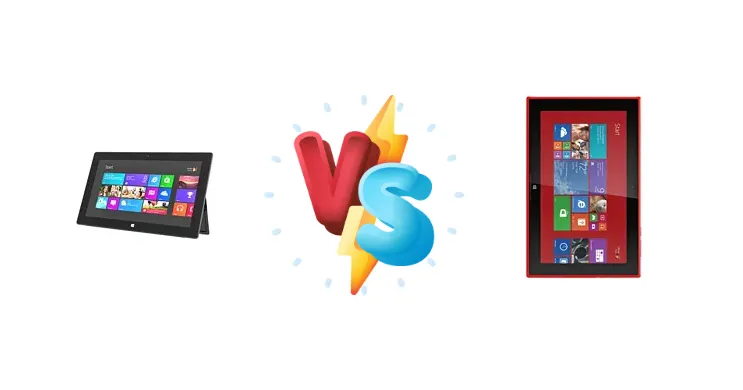
Released in different eras of Windows RT, the Microsoft Surface and Nokia Lumia 2520 represent distinct approaches to the tablet market. The Surface, Microsoft’s first-party attempt, aimed to redefine personal computing, while the Lumia 2520 leveraged Nokia’s hardware expertise to create a more conventional, yet powerful, tablet experience. This comparison dissects their core components to determine which device holds up better today.
🏆 Quick Verdict
For users prioritizing raw performance and future-proofing, the Nokia Lumia 2520 is the clear winner. Its Qualcomm Snapdragon 800 chipset significantly outperforms the Surface’s Nvidia Tegra 3, offering a smoother experience for demanding tasks. However, the Surface’s initial impact and unique form factor still hold historical significance.
| Network |
|---|
| 2G bands | N/A | GSM 850 / 900 / 1800 / 1900 - all versions |
| 3G bands | - | HSDPA 850 / 900 / 1800 / 1900 / 2100 - RX-113 |
| 4G bands | - | 3, 7, 20 - RX-113 |
| EDGE | No | - |
| GPRS | No | - |
| Speed | - | HSPA 42.2/11.5 Mbps, LTE Cat4 150/50 Mbps |
| Technology | No cellular connectivity | GSM / HSPA / LTE |
| | - | 4, 13 - RX-114v |
| Launch |
|---|
| Announced | 2012, October. Released 2012, November | 2013, October. Released 2013, December |
| Status | Discontinued | Discontinued |
| Body |
|---|
| Dimensions | 274.6 x 172 x 9.4 mm (10.81 x 6.77 x 0.37 in) | 267 x 168 x 8.9 mm (10.51 x 6.61 x 0.35 in) |
| SIM | No | Micro-SIM |
| Weight | 680.4 g (1.50 lb) | 615 g (1.36 lb) |
| | Built-in kickstand | - |
| Display |
|---|
| Protection | - | Corning Gorilla Glass 2 |
| Resolution | 1366 x 768 pixels, 16:9 ratio (~148 ppi density) | 1080 x 1920 pixels, 16:9 ratio (~218 ppi density) |
| Size | 10.6 inches, 309.7 cm2 (~65.6% screen-to-body ratio) | 10.1 inches, 281.2 cm2 (~62.7% screen-to-body ratio) |
| Type | TFT | IPS LCD |
| | ClearType technology | ClearBlack display |
| Platform |
|---|
| CPU | Quad-core 1.3 GHz Cortex-A9 | Quad-core 2.2 GHz Krait 400 |
| Chipset | Nvidia Tegra 3 T30 | Qualcomm MSM8974 Snapdragon 800 (28 nm) |
| GPU | ULP GeForce | Adreno 330 |
| OS | Microsoft Windows RT | Microsoft Windows RT |
| Memory |
|---|
| Card slot | microSDXC (dedicated slot) | microSDXC (dedicated slot) |
| Internal | 32GB 2GB RAM, 64GB 2GB RAM | 32GB 2GB RAM |
| | - | eMMC 4.5 |
| Main Camera |
|---|
| Features | - | Carl Zeiss optics |
| Single | 1.2 MP | 6.7 MP, 1/3.4", AF |
| Video | 720p | 1080p@30fps |
| Selfie camera |
|---|
| Single | 1.2 MP | 2 MP |
| Video | 720p@30fps | 720p@30fps |
| Sound |
|---|
| 3.5mm jack | Yes | Yes |
| 35mm jack | Yes | Yes |
| Loudspeaker | Yes, with stereo speakers | Yes, with stereo speakers |
| Comms |
|---|
| Bluetooth | 4.0, A2DP | 4.0, A2DP |
| NFC | No | Yes |
| Positioning | No | GPS, GLONASS |
| Radio | No | No |
| USB | USB 2.0, OTG | USB 3.0, OTG |
| WLAN | Wi-Fi 802.11 a/b/g/n, dual-band, Wi-Fi Direct | Wi-Fi 802.11 a/b/g/n, dual-band, hotspot |
| Features |
|---|
| Sensors | Accelerometer, gyro, compass | Accelerometer, gyro, proximity, compass |
| | TV-out
MP4/DivX/XviD/WMV/H.264 player
MP3/WAV/eAAC+/FLAC player
Photo viewer/editor
Microsoft Office 2013 RT | HDMI port
MP4/DivX/Xvid/H.264 player
MP3/WAV/eAAC+ player
Photo viewer/editor
Document editor/viewer |
| Battery |
|---|
| Stand-by | Up to 360 h | Up to 600 h |
| Talk time | Up to 8 h | Up to 10 h |
| Type | Li-Ion battery, non-removable (31.5 Wh) | Li-Ion 8120 mAh, non-removable |
| Misc |
|---|
| Colors | Dark Titanium | Cyan , Red, Black, White |
| Price | About 260 EUR | About 360 EUR |
| SAR EU | - | 1.77 W/kg (body) |
| Tests |
|---|
| Audio quality |
Noise -82.6dB / Crosstalk -81.7dB |
Noise -93.5dB / Crosstalk -94.2dB |
| Display |
Contrast ratio: 1324:1 (nominal) | - |
Microsoft Surface
- Pioneering Windows RT device
- Integrated Surface Pen support
- Unique kickstand design
- Outdated Nvidia Tegra 3 chipset
- Limited app ecosystem for Windows RT
- Lower overall performance
Nokia Lumia 2520
- Powerful Qualcomm Snapdragon 800 chipset
- More efficient power consumption
- Better graphics performance
- Windows RT operating system limitations
- Less iconic design compared to the Surface
- Limited availability now
Display Comparison
Both tablets share a similar focus on portability, but detailed display specifications are limited. The Microsoft Surface boasts a contrast ratio of 1324:1 (nominal), suggesting decent black levels for the time. However, without knowing the panel type (IPS, TFT) or resolution, a direct comparison is difficult. The Lumia 2520’s display specs are unavailable, but Nokia typically prioritized color accuracy in its displays, potentially offering a more vibrant viewing experience. The Surface’s aspect ratio, geared towards productivity, may be preferable for document editing, while the Lumia 2520 likely adopted a more standard widescreen format.
Camera Comparison
Camera specifications for both devices are not provided in the context data. Given Nokia’s reputation for mobile photography, the Lumia 2520 likely features a superior camera system with better image processing capabilities. The Surface, being primarily a productivity device, likely prioritized functionality over camera quality. Without specific details, it’s reasonable to assume the Lumia 2520 offers a more versatile and capable camera experience.
Performance
The performance gap between these devices is substantial. The Nokia Lumia 2520’s Qualcomm MSM8974 Snapdragon 800, built on a 28nm process, features a quad-core 2.2 GHz Krait 400 CPU. This architecture is significantly more efficient and powerful than the Microsoft Surface’s Nvidia Tegra 3 T30, with its quad-core 1.3 GHz Cortex-A9 CPU. The Snapdragon 800’s Adreno 330 GPU also provides a considerable advantage in graphics performance, making the Lumia 2520 better suited for gaming and graphically intensive applications. The Tegra 3, while capable, struggles with modern workloads and exhibits noticeable slowdowns in multitasking.
Battery Life
Battery capacity data is unavailable for both devices. However, the Snapdragon 800’s 28nm manufacturing process is more power-efficient than the Tegra 3’s older process node. This translates to potentially longer battery life for the Lumia 2520, even with a similar battery capacity. Furthermore, Qualcomm’s Quick Charge technology, common in devices with the Snapdragon 800, likely offers faster charging speeds compared to the Surface’s charging capabilities.
Buying Guide
Buy the Microsoft Surface if you are a collector interested in the pioneering hardware that launched Windows RT, or if you specifically need the Surface Pen support for creative tasks. Buy the Nokia Lumia 2520 if you prioritize a responsive user experience, faster application loading times, and better overall performance for everyday tasks and light gaming, especially given its more modern chipset.
Frequently Asked Questions
❓ Is the Nvidia Tegra 3 in the Microsoft Surface capable of running modern Windows applications?
No, the Microsoft Surface runs Windows RT, a separate operating system incompatible with standard Windows applications. The Tegra 3 is optimized for this specific environment, but its performance is limited compared to modern processors, and Windows RT is no longer supported by Microsoft.
❓ Does the Nokia Lumia 2520 benefit from any specific Qualcomm features beyond the Snapdragon 800 chipset?
The Snapdragon 800 in the Lumia 2520 likely supports Qualcomm’s Quick Charge technology, enabling faster charging speeds compared to the Surface. Additionally, the Adreno 330 GPU benefits from Qualcomm’s optimizations for mobile gaming and multimedia playback.
❓ Given the age of both devices, are software updates still available?
Neither the Microsoft Surface nor the Nokia Lumia 2520 receive official software updates from Microsoft or Nokia. Both devices are running outdated versions of Windows RT, leaving them vulnerable to security risks and lacking modern features.