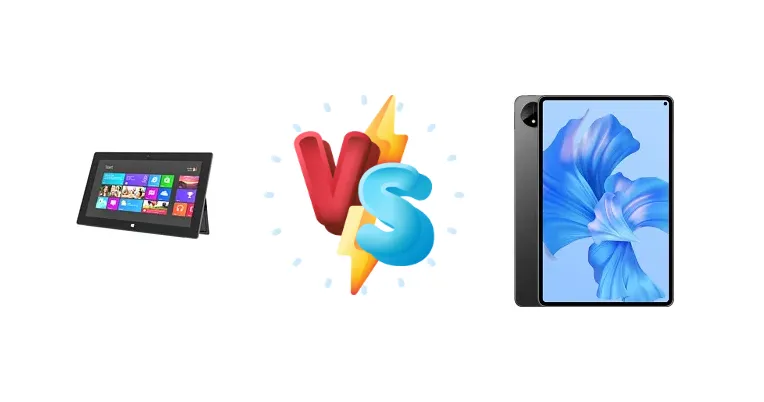
The tablet landscape has evolved dramatically since the original Microsoft Surface launched. Now, a contender like the Huawei MatePad Pro 11 (2022) arrives with significantly more modern silicon. This comparison dissects the core differences between these two devices, examining whether the Surface’s established software and ecosystem can withstand the MatePad Pro 11’s raw performance advantage.
🏆 Quick Verdict
For the average user prioritizing performance and future-proofing, the Huawei MatePad Pro 11 (2022) is the clear winner. Its Snapdragon 870 or 888 chipset delivers a substantial leap in processing power compared to the Surface’s aging Tegra 3. However, the Surface remains a viable option for those deeply invested in the Windows ecosystem.
| Network |
|---|
| 2G bands | N/A | GSM 850 / 900 / 1800 / 1900 |
| 3G bands | - | HSDPA 800 / 850 / 900 / 1700(AWS) / 1900 / 2100 |
| 4G bands | - | LTE |
| EDGE | No | - |
| GPRS | No | - |
| Speed | - | HSPA, LTE - cellular model only |
| Technology | No cellular connectivity | GSM / HSPA / LTE |
| Launch |
|---|
| Announced | 2012, October. Released 2012, November | 2022, July 27 |
| Status | Discontinued | Available. Released 2022, August 10 |
| Body |
|---|
| Dimensions | 274.6 x 172 x 9.4 mm (10.81 x 6.77 x 0.37 in) | 249.2 x 160.4 x 5.9 mm (9.81 x 6.31 x 0.23 in) |
| SIM | No | Nano-SIM (cellular model only) |
| Weight | 680.4 g (1.50 lb) | 449 g (455 g cellular model) (15.84 oz) |
| | Built-in kickstand | Stylus support |
| Display |
|---|
| Resolution | 1366 x 768 pixels, 16:9 ratio (~148 ppi density) | 2560 x 1600 pixels, 16:10 ratio (~274 ppi density) |
| Size | 10.6 inches, 309.7 cm2 (~65.6% screen-to-body ratio) | 11.0 inches, 350.9 cm2 (~87.8% screen-to-body ratio) |
| Type | TFT | OLED, 1B colors, 120Hz, 600 nits (typ) |
| | ClearType technology | - |
| Platform |
|---|
| CPU | Quad-core 1.3 GHz Cortex-A9 | Octa-core (1x3.2 GHz Kryo 585 & 3x2.42 GHz Kryo 585 & 4x1.80 GHz Kryo 585) - GOT-W29Octa-core (1x2.84 GHz Cortex-X1 & 3x2.42 GHz Cortex-A78 & 4x1.80 GHz Cortex-A55) - GOT-W09, GOT-AL09, GOT-AL19 |
| Chipset | Nvidia Tegra 3 T30 | Qualcomm SM8250-AC Snapdragon 870 5G (7 nm) - GOT-W29Qualcomm SM8350 Snapdragon 888 (5 nm) - GOT-W09, GOT-AL09, GOT-AL19 |
| GPU | ULP GeForce | Adreno 650 - GOT-W29Adreno 660 - GOT-W09, GOT-AL09, GOT-AL19 |
| OS | Microsoft Windows RT | HarmonyOS 3.0 |
| Memory |
|---|
| Card slot | microSDXC (dedicated slot) | No |
| Internal | 32GB 2GB RAM, 64GB 2GB RAM | 128GB 8GB RAM, 256GB 8GB RAM, 512GB 12GB RAM |
| | - | UFS 3.1 |
| Main Camera |
|---|
| Dual | - | 13 MP, f/1.8, (wide), PDAF
8 MP, f/2.2, (ultrawide) |
| Features | - | LED flash, HDR, panorama |
| Single | 1.2 MP | 16 MP, f/2.2 |
| Video | 720p | 4K@30fps, 1080p@30fps |
| Selfie camera |
|---|
| Single | 1.2 MP | 16 MP, f/2.2 |
| Video | 720p@30fps | 1080p@30fps |
| Sound |
|---|
| 3.5mm jack | Yes | No |
| 35mm jack | Yes | No |
| Loudspeaker | Yes, with stereo speakers | Yes, with stereo speakers (6 speakers) |
| Comms |
|---|
| Bluetooth | 4.0, A2DP | 5.2, (5.1 for GOT-W29), A2DP, LE |
| NFC | No | No |
| Positioning | No | GPS, GLONASS, BDS, GALILEO, QZSS - cellular model only |
| Radio | No | No |
| USB | USB 2.0, OTG | USB Type-C 3.1, OTG |
| WLAN | Wi-Fi 802.11 a/b/g/n, dual-band, Wi-Fi Direct | Wi-Fi 802.11 a/b/g/n/ac/6, tri-band (dual-band for GOT-W29), Wi-Fi Direct |
| Features |
|---|
| Sensors | Accelerometer, gyro, compass | Accelerometer, gyro, proximity, compass |
| | TV-out
MP4/DivX/XviD/WMV/H.264 player
MP3/WAV/eAAC+/FLAC player
Photo viewer/editor
Microsoft Office 2013 RT | - |
| Battery |
|---|
| Charging | - | 66W wired (GOT-W09, GOT-AL09, GOT-AL19)
40W wired (GOT-W29)
Reverse wired |
| Stand-by | Up to 360 h | - |
| Talk time | Up to 8 h | - |
| Type | Li-Ion battery, non-removable (31.5 Wh) | Li-Po 8300 mAh |
| Misc |
|---|
| Colors | Dark Titanium | Golden Black, Galaxy Blue, Crystal White, Brocade White |
| Models | - | GOT-W09, GOT-W29, GOT-AL09, GOT-AL19 |
| Price | About 260 EUR | About 500 EUR |
| Tests |
|---|
| Audio quality |
Noise -82.6dB / Crosstalk -81.7dB | - |
| Display |
Contrast ratio: 1324:1 (nominal) |
Contrast ratio: Infinite (nominal) |
| Loudspeaker | - |
-23.5 LUFS (Very good)
|
| Performance | - |
AnTuTu: 780161 (v9)
GeekBench: 3685 (v5.1)
GFXBench: 37fps (ES 3.1 onscreen) |
Microsoft Surface
- Established Windows ecosystem
- Familiar software for Windows users
- Potential for legacy software compatibility
- Outdated Tegra 3 processor
- Limited performance for modern tasks
- Likely lower display brightness and quality
Huawei MatePad Pro 11 (2022)
- Powerful Snapdragon 870/888 processor
- Fast 66W/40W charging
- Brighter and potentially higher-quality display
- Runs Android, not Windows
- Potential software fragmentation
- Ecosystem less integrated than Microsoft's
Display Comparison
The Huawei MatePad Pro 11 (2022) boasts a significantly brighter display, reaching a measured 591 nits, compared to the Surface’s nominal 1324:1 contrast ratio which doesn’t specify brightness. While the Surface’s contrast ratio is respectable, the MatePad Pro 11’s higher brightness translates to better visibility in outdoor conditions. The MatePad Pro 11 also claims an 'Infinite' contrast ratio, suggesting a true black level, likely due to its OLED panel (not explicitly stated in the data, but a common feature at this price point). The Surface’s display technology is not specified, but given its age, it’s likely an LCD. This difference in panel technology impacts color vibrancy and viewing angles.
Camera Comparison
Camera details are limited for both devices. However, given the Surface’s age and focus on productivity, its camera is likely basic. The MatePad Pro 11’s camera specifications are not provided, but Huawei generally prioritizes camera quality in its tablets. The absence of detailed camera specs suggests neither device is a primary choice for photography enthusiasts. The focus remains on the core tablet experience.
Performance
The performance gap is substantial. The Microsoft Surface relies on the Nvidia Tegra 3 T30, a quad-core 1.3 GHz Cortex-A9 processor. This is a chip from 2012. In contrast, the Huawei MatePad Pro 11 (2022) offers two chipset options: the Qualcomm Snapdragon 870 5G (7nm) and the Snapdragon 888 (5nm). The Snapdragon 870 features an octa-core configuration with a prime Kryo 585 core clocked at 3.2 GHz, while the 888 boasts a Cortex-X1 prime core at 2.84 GHz. The move to a 7nm or 5nm process node in the Snapdragon chips provides significantly improved power efficiency and thermal performance, allowing for sustained higher clock speeds. This translates to a dramatically faster and more responsive experience on the MatePad Pro 11, especially for demanding applications and multitasking.
Battery Life
Battery capacity isn’t specified for either device. However, the MatePad Pro 11 (2022) offers a significant advantage with its 66W wired charging (on some models) or 40W wired charging, enabling much faster charging times compared to the Surface, which lacks any charging speed information. The MatePad Pro 11 also supports reverse wired charging, adding to its versatility. This faster charging capability is crucial for users who rely on their tablets throughout the day.
Buying Guide
Buy the Microsoft Surface if you absolutely require Windows and its specific software compatibility, or if you are heavily invested in the Microsoft ecosystem. Buy the Huawei MatePad Pro 11 (2022) if you prioritize performance for demanding tasks like gaming or video editing, value fast charging, and prefer the Android operating system. The MatePad Pro 11 offers a more modern tablet experience for the price.
Frequently Asked Questions
❓ Does the Snapdragon 870/888 in the MatePad Pro 11 experience throttling under sustained load?
The Snapdragon 870 and 888 are both well-regarded for their thermal management. While some throttling is inevitable under prolonged, intensive tasks like gaming, the 7nm and 5nm manufacturing processes, respectively, contribute to better efficiency and reduced heat generation compared to the Surface’s Tegra 3. The MatePad Pro 11 is likely to maintain higher performance levels for longer periods.
❓ Is the Huawei MatePad Pro 11 (2022) a good replacement for a laptop for basic productivity tasks?
For tasks like email, document editing, and web browsing, the MatePad Pro 11 (2022) is a capable alternative to a laptop, especially when paired with a keyboard accessory (sold separately). However, the Android operating system may have limitations with certain specialized software that requires Windows compatibility. The Snapdragon 870/888 provides ample power for these tasks.
❓ What is the software support like for the Huawei MatePad Pro 11 (2022) given the ongoing geopolitical situation?
Huawei's software support has been evolving. The MatePad Pro 11 (2022) runs HarmonyOS, Huawei's own operating system. While it lacks full Google Mobile Services (GMS), Huawei has been actively developing its HarmonyOS ecosystem with its own app store (AppGallery) and workarounds for accessing popular apps. Software updates are still being released, but the frequency and long-term support remain a consideration.