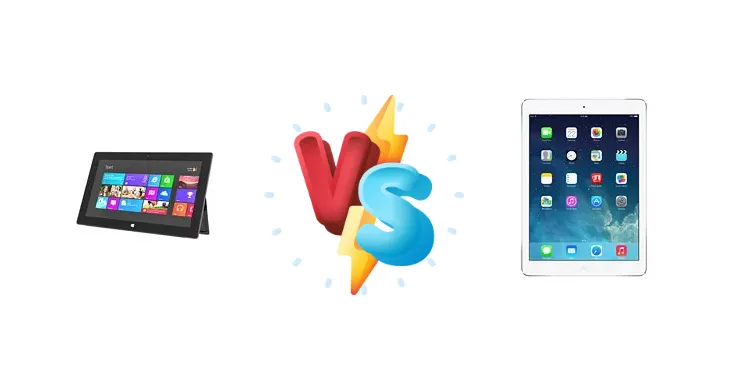
The Microsoft Surface and Apple iPad Air represent pivotal moments in the tablet landscape. Released in different eras, both devices aimed to redefine mobile computing, but took vastly different approaches. This comparison revisits these devices, analyzing their strengths and weaknesses through a modern lens, focusing on their original intent and capabilities.
🏆 Quick Verdict
For the user seeking a slightly more visually contrasted display and a more open operating system, the Microsoft Surface holds a slight edge. However, the iPad Air’s Apple A7 chipset and camera functionality provide a more refined and versatile experience, making it the better all-around choice for most users.
| Network |
|---|
| 2G bands | N/A | GSM 850 / 900 / 1800 / 1900 |
| 3G bands | - | HSDPA 850 / 900 / 1700(AWS) / 1900 / 2100 |
| 4G bands | - | 1, 2, 3, 4, 5, 7, 8, 13, 17, 18, 19, 20, 25, 26 |
| EDGE | No | - |
| GPRS | No | - |
| Speed | - | HSPA 42.2/5.76 Mbps, LTE Cat3 100/50 Mbps, EV-DO Rev.A 3.1 Mbps - cellular model only |
| Technology | No cellular connectivity | GSM / CDMA / HSPA / EVDO / LTE |
| | - | CDMA2000 1xEV-DO |
| Launch |
|---|
| Announced | 2012, October. Released 2012, November | 2013, October 22. Released 2013, November 01 |
| Status | Discontinued | Discontinued |
| Body |
|---|
| Build | - | Glass front, aluminum back, aluminum frame |
| Dimensions | 274.6 x 172 x 9.4 mm (10.81 x 6.77 x 0.37 in) | 240 x 169.5 x 7.5 mm (9.45 x 6.67 x 0.30 in) |
| SIM | No | Nano-SIM (cellular model only) |
| Weight | 680.4 g (1.50 lb) | 469 g (Wi-Fi) / 478 g (3G/LTE) (1.03 lb) |
| | Built-in kickstand | - |
| Display |
|---|
| Protection | - | Scratch-resistant glass, oleophobic coating |
| Resolution | 1366 x 768 pixels, 16:9 ratio (~148 ppi density) | 1536 x 2048 pixels, 4:3 ratio (~264 ppi density) |
| Size | 10.6 inches, 309.7 cm2 (~65.6% screen-to-body ratio) | 9.7 inches, 291.4 cm2 (~71.6% screen-to-body ratio) |
| Type | TFT | IPS LCD |
| | ClearType technology | - |
| Platform |
|---|
| CPU | Quad-core 1.3 GHz Cortex-A9 | Dual-core 1.3 GHz Cyclone (ARM v8-based) |
| Chipset | Nvidia Tegra 3 T30 | Apple A7 (28 nm) |
| GPU | ULP GeForce | PowerVR G6430 (quad-core graphics) |
| OS | Microsoft Windows RT | iOS 7, upgradable to iPadOS 12.5.7 |
| Memory |
|---|
| Card slot | microSDXC (dedicated slot) | No |
| Internal | 32GB 2GB RAM, 64GB 2GB RAM | 16GB 1GB RAM, 32GB 1GB RAM, 64GB 1GB RAM, 128GB 1GB RAM |
| Main Camera |
|---|
| Features | - | HDR |
| Single | 1.2 MP | 5 MP, f/2.4, 33mm (standard), AF |
| Video | 720p | 1080p@30fps |
| Selfie camera |
|---|
| Features | - | face detection, FaceTime over Wi-Fi or Cellular |
| Single | 1.2 MP | 1.2 MP |
| Video | 720p@30fps | 720p@30fps |
| Sound |
|---|
| 3.5mm jack | Yes | Yes |
| 35mm jack | Yes | Yes |
| Loudspeaker | Yes, with stereo speakers | Yes, with stereo speakers |
| Comms |
|---|
| Bluetooth | 4.0, A2DP | 4.0, A2DP, EDR |
| NFC | No | No |
| Positioning | No | GPS, GLONASS - cellular model only |
| Radio | No | No |
| USB | USB 2.0, OTG | Lightning, USB 2.0 |
| WLAN | Wi-Fi 802.11 a/b/g/n, dual-band, Wi-Fi Direct | Wi-Fi 802.11 a/b/g/n, dual-band, hotspot |
| Features |
|---|
| Sensors | Accelerometer, gyro, compass | Accelerometer, gyro, compass |
| | TV-out
MP4/DivX/XviD/WMV/H.264 player
MP3/WAV/eAAC+/FLAC player
Photo viewer/editor
Microsoft Office 2013 RT | - |
| Battery |
|---|
| Stand-by | Up to 360 h | - |
| Talk time | Up to 8 h | Up to 10 h (multimedia) |
| Type | Li-Ion battery, non-removable (31.5 Wh) | Li-Po 8600 mAh, non-removable (32.4 Wh) |
| Misc |
|---|
| Colors | Dark Titanium | Space Gray, Silver |
| Models | - | A1474, A1475, A1476, iPad4,1, iPad4,2, iPad4,3 |
| Price | About 260 EUR | About 350 EUR |
| SAR | - | 1.18 W/kg (body) |
| SAR EU | - | 0.99 W/kg (body) |
| Tests |
|---|
| Audio quality |
Noise -82.6dB / Crosstalk -81.7dB |
Noise -93.9dB / Crosstalk -89.9dB |
| Camera | - |
Photo / Video |
| Display |
Contrast ratio: 1324:1 (nominal) |
Contrast ratio: 968:1 (nominal) / 2.504:1 (sunlight) |
| Loudspeaker | - |
Voice 67dB / Noise 65dB / Ring 76dB
|
| Performance | - |
Basemark X: 13597 |
Microsoft Surface
- Higher contrast ratio for improved indoor viewing.
- Full Windows operating system offers greater software compatibility.
- Potentially more open ecosystem for customization.
- Less power-efficient Tegra 3 chipset.
- Lacks integrated camera functionality.
- Older architecture compared to the A7.
Apple iPad Air
- More efficient Apple A7 chipset for longer battery life.
- Integrated camera for photo and video capture.
- Superior outdoor visibility with higher sunlight contrast ratio.
- Lower nominal contrast ratio compared to the Surface.
- Less flexible operating system (iOS).
- Dual-core CPU may struggle with demanding multitasking.
Display Comparison
The Microsoft Surface boasts a contrast ratio of 1324:1, significantly higher than the iPad Air’s 968:1 in nominal conditions. However, the iPad Air’s display shines in direct sunlight, achieving a contrast ratio of 2504:1, suggesting superior outdoor visibility. Both devices lack modern display features like high refresh rates or HDR support, but the Surface’s higher nominal contrast provides richer blacks and more vibrant colors indoors. The lack of detailed information on panel technology (IPS, TFT) for either device makes a deeper analysis of color accuracy difficult.
Camera Comparison
The iPad Air distinguishes itself with integrated photo and video capabilities, a feature absent in the provided specifications for the Microsoft Surface. While the resolution and sensor size are not specified, the presence of a camera adds a layer of versatility to the iPad Air, enabling casual photography and video conferencing. The Surface’s lack of camera functionality limits its use cases to primarily content consumption and productivity tasks.
Performance
The core difference lies in the chipset architecture. The Surface utilizes an Nvidia Tegra 3 T30 with a quad-core 1.3 GHz Cortex-A9 CPU, while the iPad Air features Apple’s A7, a dual-core 1.3 GHz Cyclone CPU based on the ARM v8 architecture. While clock speeds are similar, the A7’s ARM v8 architecture offers significant improvements in instruction set efficiency and performance per watt. The A7’s 28nm manufacturing process also contributes to better power efficiency compared to the Tegra 3. This translates to potentially smoother multitasking and longer battery life for the iPad Air, despite having fewer cores.
Battery Life
Without battery capacity (mAh) data, a direct comparison is impossible. However, the Apple A7’s superior power efficiency, stemming from its ARM v8 architecture and 28nm process, likely results in longer battery life for the iPad Air. Charging wattage is also unknown for both devices, making it difficult to assess 0-100% charging times. The Surface’s Tegra 3, while powerful, is known to be less efficient, potentially leading to shorter runtimes.
Buying Guide
Buy the Microsoft Surface if you prioritize a higher contrast ratio for media consumption and require the flexibility of a full Windows operating system. This is ideal for users comfortable with desktop-class software and potentially tinkering with older hardware. Buy the Apple iPad Air if you value a more streamlined user experience, integrated camera capabilities, and the efficiency of the Apple A7 architecture, making it suitable for casual users and those invested in the Apple ecosystem.
Frequently Asked Questions
❓ Is the Nvidia Tegra 3 in the Surface capable of running modern Android apps through emulation?
While technically possible, running modern Android apps on the Surface via emulation is likely to be a suboptimal experience. The Tegra 3, despite being a capable processor for its time, lacks the processing power and architectural optimizations needed for smooth emulation of newer Android versions. Expect significant performance limitations and potential compatibility issues.
❓ How does the Apple A7’s ARM v8 architecture impact real-world performance compared to the Cortex-A9 in the Surface?
The A7’s ARM v8 architecture represents a significant leap forward in CPU design. It features a 64-bit instruction set, improved branch prediction, and a more efficient pipeline, resulting in better performance per clock cycle and lower power consumption compared to the Cortex-A9. This translates to snappier app launches, smoother multitasking, and longer battery life for the iPad Air.
❓ Given the age of both devices, what is the biggest concern regarding long-term usability?
The primary concern for both devices is software support. Updates for the operating systems (Windows 8/RT for the Surface, older versions of iOS for the iPad Air) have ceased, leaving them vulnerable to security risks and potentially incompatible with newer apps and services. Battery degradation is also a significant factor, as the original batteries are likely nearing the end of their lifespan.