
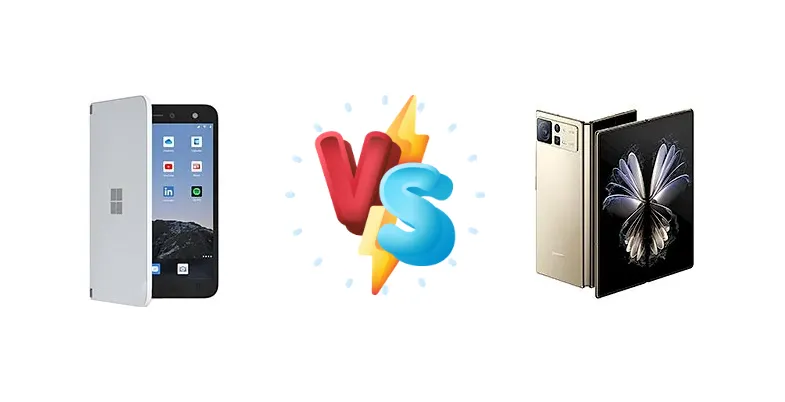
Surface Duo vs. Xiaomi Mix Fold 2: A Detailed Comparison of Two Foldable Approaches
| Phones Images | |||||
|---|---|---|---|---|---|
|
🏆 Quick Verdict
For most users, the Xiaomi Mix Fold 2 is the superior device. Its Snapdragon 8+ Gen 1 chipset delivers significantly faster performance, while 67W charging drastically reduces downtime. While the Surface Duo offers a distinctive dual-screen experience, its aging hardware limits its overall utility.
| PHONES | ||
|---|---|---|
| Phone Names | Microsoft Surface Duo | Xiaomi Mix Fold 2 |
| Network | ||
|---|---|---|
| 2G bands | GSM 850 / 900 / 1800 / 1900 | GSM 850 / 900 / 1800 / 1900 |
| 3G bands | HSDPA 850 / 900 / 1900 / 2100 | HSDPA 850 / 900 / 1700(AWS) / 1900 / 2100 |
| 4G bands | 1, 2, 3, 4, 5, 7, 8, 12, 13, 14, 19 20, 25, 26, 28, 29, 30, 38, 39, 40, 41, 46, 66 | 1, 2, 3, 4, 5, 7, 8, 12, 17, 18, 19, 20, 26, 28, 34, 38, 39, 40, 41, 42 |
| 5G bands | - | 1, 3, 5, 8, 20, 28, 38, 40, 41, 77, 78, 79 SA/NSA |
| Speed | HSPA 42.2/5.76 Mbps, LTE Cat18 1200/150 Mbps | HSPA, LTE, 5G |
| Technology | GSM / HSPA / LTE | GSM / CDMA / HSPA / EVDO / LTE / 5G |
| - | CDMA2000 1xEV-DO | |
| Launch | ||
|---|---|---|
| Announced | 2020, August 12. Released 2020, September 10 | 2022, August 11 |
| Status | Discontinued | Available. Released 2022, August 26 |
| Body | ||
|---|---|---|
| Build | Glass front (Gorilla Glass 5), glass back (Gorilla Glass 5) | - |
| Dimensions | Unfolded: 186.9 x 145.2 x 4.8 mm Folded: 145.2 x 93.3 x 9.9 mm | Unfolded: 161.1 x 144.7 x 5.4 mm Folded: 161.1 x 73.9 x 11.2 mm |
| SIM | Nano-SIM + eSIM | Nano-SIM + Nano-SIM |
| Weight | 250 g (8.82 oz) | 262 g (9.24 oz) |
| Stylus support | - | |
| Display | ||
|---|---|---|
| Protection | Corning Gorilla Glass 5 | Schott UTG glass |
| Resolution | 1800 x 2700 pixels, 3:2 ratio (~401 ppi density) | 1914 x 2160 pixels (~360 ppi density) |
| Size | 8.1 inches, 195.4 cm2 (~144.2% screen-to-body ratio) | 8.02 inches, 206.0 cm2 (~88.4% screen-to-body ratio) |
| Type | AMOLED | Foldable LTPO2 OLED, 1B colors, 120Hz, HDR10+, Dolby Vision, 1000 nits (HBM), 1300 nits (peak) |
| Folded position display: 5.6 inches, AMOLED, 1350 x 1800 pixels (4:3) | Cover display: AMOLED, 120Hz, HDR10+, Dolby Vision, 1000 nits (HBM), 1300 nits (peak) 6.56 inches, 1080 x 2520 pixels, 21:9 ratio Corning Gorilla Glass Victus | |
| Platform | ||
|---|---|---|
| CPU | Octa-core (1x2.84 GHz Kryo 485 & 3x2.42 GHz Kryo 485 & 4x1.78 GHz Kryo 485) | Octa-core (1x3.19 GHz Cortex-X2 & 3x2.75 GHz Cortex-A710 & 4x1.80 GHz Cortex-A510) |
| Chipset | Qualcomm SM8150 Snapdragon 855 (7 nm) | Qualcomm SM8475 Snapdragon 8+ Gen 1 (4 nm) |
| GPU | Adreno 640 | Adreno 730 |
| OS | Android 10, upgradable to Android 12 | Android 12, MIUI Fold 13 |
| Memory | ||
|---|---|---|
| Card slot | No | No |
| Internal | 128GB 6GB RAM, 256GB 6GB RAM | 256GB 12GB RAM, 512GB 12GB RAM, 1TB 12GB RAM |
| UFS 3.0 | UFS 3.1 | |
| Main Camera | ||
|---|---|---|
| Features | HDR, panorama | Color spectrum sensor, Dual-LED flash, HDR, panorama, Leica lenses |
| Single | 11 MP, f/2.0, 23mm (wide), 1.0µm, PDAF | - |
| Triple | - | 50 MP, f/1.8, (wide), 1/1.56", 1.0µm, PDAF, OIS 8 MP, f/2.6, 45mm (telephoto), dual pixel PDAF, 2x optical zoom 13 MP, f/2.4, 15mm, 123˚ (ultrawide), 1.12µm, AF |
| Video | 4K@30/60fps, 1080p@30/60/120/240fps, gyro-EIS, HDR | 8K@24fps, 4K@30/60fps, 1080p@30/60/120/240/960fps, gyro-EIS |
| Selfie camera | ||
|---|---|---|
| Features | HDR, panorama | HDR, panorama |
| Single | Uses main camera | 20 MP, f/2.4, 23mm (wide) |
| Video | 4K@30/60fps, 1080p@30/60fps, gyro-EIS, HDR | 1080p@30/60fps, 720p@120fps |
| Sound | ||
|---|---|---|
| 3.5mm jack | No | No |
| 35mm jack | No | No |
| Loudspeaker | Yes | Yes, with stereo speakers |
| - | 24-bit/192kHz audio Tuned by Harman Kardon | |
| Comms | ||
|---|---|---|
| Bluetooth | 5.0, A2DP, LE, aptX Adaptive | 5.2, A2DP, LE, aptX HD, aptX Adaptive |
| Infrared port | - | Yes |
| NFC | No | Yes |
| Positioning | GPS | GPS (L1+L5), GLONASS (L1), BDS (B1I+B1c+B2a), GALILEO (E1+E5a), QZSS (L1+L5), NavIC (L5) |
| Radio | No | No |
| USB | USB Type-C 3.1 | USB Type-C |
| WLAN | Wi-Fi 802.11 a/b/g/n/ac, dual-band, Wi-Fi Direct | Wi-Fi 802.11 a/b/g/n/ac/6e, dual-band, Wi-Fi Direct |
| Features | ||
|---|---|---|
| Sensors | Fingerprint (side-mounted), dual accelerometer, dual gyro, proximity, dual compass | Fingerprint (side-mounted), accelerometer, gyro, proximity, compass, barometer |
| Battery | ||
|---|---|---|
| Charging | 18W wired | 67W wired, PD3.0, QC4, 100% in 40 min |
| Type | Li-Po 3577 mAh | Li-Po 4500 mAh |
| Misc | ||
|---|---|---|
| Colors | White | Black, Gold |
| Models | - | 22061218C |
| Price | About 650 EUR | About 1300 EUR |
| Tests | ||
|---|---|---|
| Battery life | - | Endurance rating 82h |
| Camera | - | Photo / Video |
| Display | - | Contrast ratio: Infinite (nominal) |
| Loudspeaker | - | -26.2 LUFS (Good) |
| Performance | - | AnTuTu: 1050139 (v9) GeekBench: 4368 (v5.1) GFXBench: 52fps (ES 3.1 onscreen) |
Microsoft Surface Duo
- Unique dual-screen experience for multitasking
- Compact and relatively lightweight design
- Familiar Android interface
- Outdated Snapdragon 855 chipset
- Slow 18W charging
- Limited camera capabilities
Xiaomi Mix Fold 2
- Flagship Snapdragon 8+ Gen 1 performance
- Ultra-fast 67W charging
- Bright and vibrant foldable display
- Foldable design may be less durable
- Software optimization for foldables can be buggy
- Potentially higher price point
Display Comparison
The Xiaomi Mix Fold 2 boasts a significantly brighter display, reaching a measured 1054 nits, compared to the Surface Duo’s unspecified peak brightness. This translates to better outdoor visibility. While both are foldable, the Mix Fold 2’s design aims for a more seamless crease, a common issue in early foldable generations. The Surface Duo’s dual-screen approach, however, offers a unique 8.3-inch combined screen real estate, potentially beneficial for side-by-side app usage, though with a visible seam between the two displays. Contrast ratio is infinite (nominal) on the Mix Fold 2, suggesting deep blacks, while the Surface Duo’s contrast is not specified, likely being lower.
Camera Comparison
Both devices feature photo and video capabilities, but detailed camera specifications are limited. The Mix Fold 2 likely benefits from a more modern image signal processor (ISP) integrated within the Snapdragon 8+ Gen 1, resulting in improved image quality and processing speeds. Given Xiaomi’s camera focus, it’s reasonable to expect a more sophisticated camera system with features like optical image stabilization (OIS) and advanced computational photography. The Surface Duo’s camera performance is likely adequate but won’t compete with flagship-level foldable cameras.
Performance
The performance gap is substantial. The Xiaomi Mix Fold 2’s Snapdragon 8+ Gen 1 (4nm) is a generational leap over the Surface Duo’s Snapdragon 855 (7nm). The 8+ Gen 1’s Cortex-X2 prime core, clocked at 3.19 GHz, provides a significant single-core performance boost, crucial for responsive app launches and smooth multitasking. The Mix Fold 2’s CPU architecture (Cortex-A710 and A510) is also more efficient, leading to better sustained performance and thermal management. The Surface Duo, while capable for basic tasks, will struggle with demanding games and applications. The 4nm process node of the Snapdragon 8+ Gen 1 also contributes to improved power efficiency.
Battery Life
Both devices achieve an endurance rating of 82 hours, suggesting comparable overall battery life despite the Surface Duo’s unspecified battery capacity. However, the Mix Fold 2’s 67W wired charging with PD3.0 and QC4 support is a game-changer, achieving a full charge in just 40 minutes. The Surface Duo’s 18W charging is comparatively slow, requiring significantly longer to replenish the battery. This difference in charging speed dramatically impacts usability, especially for users who rely heavily on their phones throughout the day.
Buying Guide
Buy the Microsoft Surface Duo if you prioritize a truly dual-screen experience for enhanced multitasking and reading, and are comfortable with the trade-offs in processing power and battery charging speed. Buy the Xiaomi Mix Fold 2 if you demand flagship performance, a vibrant display, and incredibly fast charging, making it ideal for power users and multimedia enthusiasts.