
Surface Duo vs. Mi 11 Ultra: A Tale of Two Flagships
| Phones Images | |||||
|---|---|---|---|---|---|
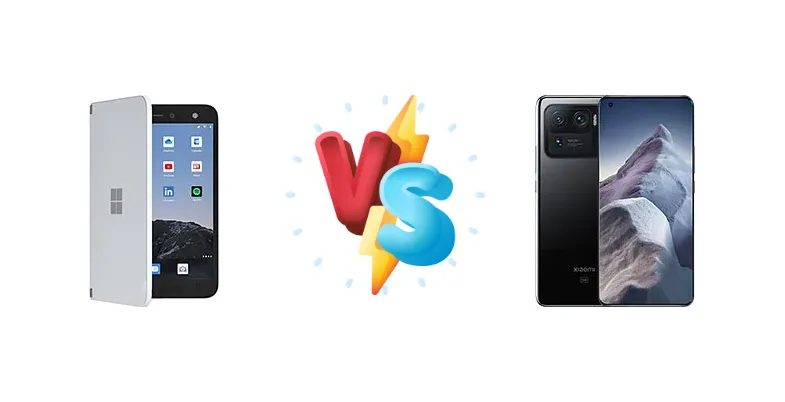
|
🏆 Quick Verdict
For the average user prioritizing camera capabilities and battery longevity, the Xiaomi Mi 11 Ultra is the clear winner. Its Snapdragon 888 chipset, coupled with 67W wired and wireless charging, provides a significantly more powerful and convenient experience. However, the Surface Duo remains a compelling option for those seeking a unique, productivity-focused dual-screen experience.
| PHONES | ||
|---|---|---|
| Phone Names | Microsoft Surface Duo | Xiaomi Mi 11 Ultra |
| Network | ||
|---|---|---|
| 2G bands | GSM 850 / 900 / 1800 / 1900 | GSM 850 / 900 / 1800 / 1900 |
| 3G bands | HSDPA 850 / 900 / 1900 / 2100 | HSDPA 850 / 900 / 1700(AWS) / 1900 / 2100 |
| 4G bands | 1, 2, 3, 4, 5, 7, 8, 12, 13, 14, 19 20, 25, 26, 28, 29, 30, 38, 39, 40, 41, 46, 66 | 1, 2, 3, 4, 5, 7, 8, 12, 17, 20, 28, 32, 38, 40, 41, 42, 66 - International |
| 5G bands | - | 1, 3, 5, 7, 8, 20, 28, 38, 40, 41, 77, 78, 79 SA/NSA - International |
| Speed | HSPA 42.2/5.76 Mbps, LTE Cat18 1200/150 Mbps | HSPA, LTE, 5G |
| Technology | GSM / HSPA / LTE | GSM / CDMA / HSPA / EVDO / LTE / 5G |
| - | 1, 3, 28, 41, 77, 78, 79 SA/NSA - China | |
| Launch | ||
|---|---|---|
| Announced | 2020, August 12. Released 2020, September 10 | 2021, March 29 |
| Status | Discontinued | Available. Released 2021, April 02 |
| Body | ||
|---|---|---|
| Build | Glass front (Gorilla Glass 5), glass back (Gorilla Glass 5) | Glass front (Gorilla Glass Victus), ceramic back, aluminum frame |
| Dimensions | Unfolded: 186.9 x 145.2 x 4.8 mm Folded: 145.2 x 93.3 x 9.9 mm | 164.3 x 74.6 x 8.4 mm (6.47 x 2.94 x 0.33 in) |
| SIM | Nano-SIM + eSIM | Nano-SIM + Nano-SIM |
| Weight | 250 g (8.82 oz) | 234 g (8.25 oz) |
| Stylus support | IP68 dust/water resistant (up to 1.5m for 30 min) | |
| Display | ||
|---|---|---|
| Protection | Corning Gorilla Glass 5 | Corning Gorilla Glass Victus |
| Resolution | 1800 x 2700 pixels, 3:2 ratio (~401 ppi density) | 1440 x 3200 pixels, 20:9 ratio (~515 ppi density) |
| Size | 8.1 inches, 195.4 cm2 (~144.2% screen-to-body ratio) | 6.81 inches, 112.0 cm2 (~91.4% screen-to-body ratio) |
| Type | AMOLED | AMOLED, 1B colors, 120Hz, HDR10+, Dolby Vision, 900 nits (HBM), 1700 nits (peak) |
| Folded position display: 5.6 inches, AMOLED, 1350 x 1800 pixels (4:3) | - | |
| Platform | ||
|---|---|---|
| CPU | Octa-core (1x2.84 GHz Kryo 485 & 3x2.42 GHz Kryo 485 & 4x1.78 GHz Kryo 485) | Octa-core (1x2.84 GHz Cortex-X1 & 3x2.42 GHz Cortex-A78 & 4x1.80 GHz Cortex-A55) |
| Chipset | Qualcomm SM8150 Snapdragon 855 (7 nm) | Qualcomm SM8350 Snapdragon 888 5G (5 nm) |
| GPU | Adreno 640 | Adreno 660 |
| OS | Android 10, upgradable to Android 12 | Android 11, upgradable to Android 13, MIUI 14 |
| Memory | ||
|---|---|---|
| Card slot | No | No |
| Internal | 128GB 6GB RAM, 256GB 6GB RAM | 256GB 8GB RAM, 256GB 12GB RAM, 512GB 12GB RAM |
| UFS 3.0 | UFS 3.1 | |
| Main Camera | ||
|---|---|---|
| Features | HDR, panorama | Laser AF, color spectrum sensor, Dual-LED flash, HDR, panorama, 1.1” AMOLED selfie display |
| Single | 11 MP, f/2.0, 23mm (wide), 1.0µm, PDAF | 20 MP, f/2.2, 27mm (wide), 1/3.4", 0.8µm |
| Triple | - | 50 MP, f/2.0, 24mm (wide), 1/1.12", 1.4µm, dual pixel PDAF, OIS 48 MP, f/4.1, 120mm (periscope telephoto), 1/2.0", 0.8µm, PDAF, OIS, 5x optical zoom 48 MP, f/2.2, 12mm, 128˚ (ultrawide), 1/2.0", 0.8µm, PDAF |
| Video | 4K@30/60fps, 1080p@30/60/120/240fps, gyro-EIS, HDR | 8K@24fps, 4K@30/60fps, 1080p@30/60/120/240/960/1920fps, gyro-EIS, HDR10+ rec. |
| Selfie camera | ||
|---|---|---|
| Features | HDR, panorama | HDR, panorama |
| Single | Uses main camera | 20 MP, f/2.2, 27mm (wide), 1/3.4", 0.8µm |
| Video | 4K@30/60fps, 1080p@30/60fps, gyro-EIS, HDR | 1080p@30/60fps, 720p@120fps, gyro-EIS |
| Sound | ||
|---|---|---|
| 3.5mm jack | No | No |
| 35mm jack | No | No |
| Loudspeaker | Yes | Yes, with stereo speakers |
| - | 24-bit/192kHz audio Tuned by Harman Kardon | |
| Comms | ||
|---|---|---|
| Bluetooth | 5.0, A2DP, LE, aptX Adaptive | 5.2, A2DP, LE, aptX HD, aptX Adaptive |
| Infrared port | - | Yes |
| NFC | No | Yes |
| Positioning | GPS | GPS (L1+L5), GLONASS (L1), BDS (B1I+B1c+B2a), GALILEO (E1+E5a), QZSS (L1+L5), NavIC (L5) |
| Radio | No | No |
| USB | USB Type-C 3.1 | USB Type-C 2.0, OTG |
| WLAN | Wi-Fi 802.11 a/b/g/n/ac, dual-band, Wi-Fi Direct | Wi-Fi 802.11 a/b/g/n/ac/6e, dual-band, Wi-Fi Direct, DLNA |
| Features | ||
|---|---|---|
| Sensors | Fingerprint (side-mounted), dual accelerometer, dual gyro, proximity, dual compass | Fingerprint (under display, optical), accelerometer, gyro, compass |
| - | Virtual proximity sensing | |
| Battery | ||
|---|---|---|
| Charging | 18W wired | 67W wired, PD3.0, QC4, 100% in 36 min 67W wireless, 100% in 39 min 10W reverse wireless |
| Type | Li-Po 3577 mAh | Li-Po 5000 mAh |
| Misc | ||
|---|---|---|
| Colors | White | Ceramic White (Cosmic White), Ceramic Black (Cosmic Black) |
| Models | - | M2102K1G, M2102K1C |
| Price | About 650 EUR | About 1500 EUR |
| SAR | - | 1.08 W/kg (head) 0.81 W/kg (body) |
| SAR EU | - | 0.55 W/kg (head) 0.99 W/kg (body) |
| Tests | ||
|---|---|---|
| Battery life | - | Endurance rating 95h |
| Camera | - | Photo / Video |
| Display | - | Contrast ratio: Infinite (nominal) |
| Loudspeaker | - | -24.3 LUFS (Very good) |
| Performance | - | AnTuTu: 688720 (v8) GeekBench: 3191 (v5.1) GFXBench: 33fps (ES 3.1 onscreen) |
Microsoft Surface Duo
- Unique dual-screen form factor for multitasking
- Compact and portable design
- Software optimized for dual-screen use
- Outdated Snapdragon 855 chipset
- Slow 18W charging
- Inferior camera system compared to competitors
Xiaomi Mi 11 Ultra
- Powerful Snapdragon 888 5G chipset
- Industry-leading camera system
- Ultra-fast 67W wired and wireless charging
- Larger and heavier design
- Traditional smartphone form factor
- Potentially higher price point
Display Comparison
The Surface Duo features two 5.6-inch displays, creating a combined 8.3-inch experience, but lacks the high refresh rates and peak brightness of the Mi 11 Ultra’s single 6.81-inch display. The Mi 11 Ultra boasts a measured peak brightness of 943 nits, ensuring excellent visibility even in direct sunlight. While the Surface Duo’s flexible hinge is innovative, it doesn’t offer the infinite contrast ratio found in the Mi 11 Ultra’s AMOLED panel. The Duo’s display tech is adequate, but it’s a generation behind the Mi 11 Ultra in terms of visual fidelity and outdoor usability.
Camera Comparison
The Mi 11 Ultra’s camera system is its defining feature. While details on specific sensor sizes are missing, the 'Photo / Video' designation indicates a focus on image quality and versatility. The Mi 11 Ultra’s camera system is known for its large main sensor and excellent low-light performance. The Surface Duo, lacking a dedicated camera system description, likely relies on more standard smartphone camera technology, and will not compete with the Mi 11 Ultra’s photographic capabilities. The Mi 11 Ultra’s image processing is geared towards vibrant, detailed photos, while the Surface Duo’s is likely more balanced.
Performance
The Xiaomi Mi 11 Ultra’s Snapdragon 888 5G (5nm) represents a significant leap in performance over the Surface Duo’s Snapdragon 855 (7nm). The 888’s Cortex-X1 prime core delivers faster single-core performance, while its Adreno 660 GPU provides a substantial boost in graphics processing. The 5nm fabrication process also contributes to improved thermal efficiency, reducing the likelihood of throttling during demanding tasks. The Surface Duo’s Snapdragon 855, while still capable, will struggle with the latest graphically intensive games and applications compared to the Mi 11 Ultra.
Battery Life
Both devices achieve an endurance rating of 95 hours, suggesting comparable overall battery life despite differing capacities. However, the Mi 11 Ultra’s charging capabilities are vastly superior. Its 67W wired charging can replenish the battery to 100% in just 36 minutes, and the 67W wireless charging takes only 39 minutes. The Surface Duo’s 18W wired charging is significantly slower, requiring considerably more time to fully charge. The Mi 11 Ultra also offers 10W reverse wireless charging, a feature absent on the Surface Duo.
Buying Guide
Buy the Microsoft Surface Duo if you need a portable workstation for multitasking, reading long documents, and appreciate a unique form factor that prioritizes software optimization for dual-screen use. Buy the Xiaomi Mi 11 Ultra if you prefer a traditional smartphone experience with an industry-leading camera system, exceptionally fast charging, and a vibrant, bright display for content consumption and photography.