
Surface Duo vs. Galaxy Z Fold4: Which Folding Phone Reigns Supreme?
| Phones Images | |||||
|---|---|---|---|---|---|
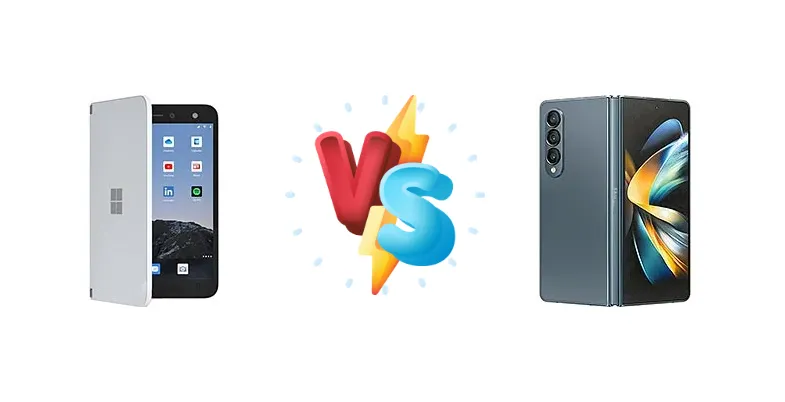
|
🏆 Quick Verdict
For most users, the Samsung Galaxy Z Fold4 is the superior choice. Its significantly more powerful Snapdragon 8+ Gen 1 chipset, coupled with faster charging and a more refined software experience, outweighs the Surface Duo’s unique dual-screen form factor. However, the Duo remains a compelling option for those prioritizing a lightweight, productivity-focused device.
| PHONES | ||
|---|---|---|
| Phone Names | Microsoft Surface Duo | Samsung Galaxy Z Fold4 |
| Network | ||
|---|---|---|
| 2G bands | GSM 850 / 900 / 1800 / 1900 | GSM 850 / 900 / 1800 / 1900 |
| 3G bands | HSDPA 850 / 900 / 1900 / 2100 | HSDPA 850 / 900 / 1700(AWS) / 1900 / 2100 |
| 4G bands | 1, 2, 3, 4, 5, 7, 8, 12, 13, 14, 19 20, 25, 26, 28, 29, 30, 38, 39, 40, 41, 46, 66 | 1, 2, 3, 4, 5, 7, 8, 12, 13, 17, 18, 19, 20, 25, 26, 28, 32, 38, 39, 40, 41, 66 - International |
| 5G bands | - | 1, 2, 3, 5, 7, 8, 12, 20, 25, 28, 38, 40, 41, 66, 75, 77, 78 SA/NSA/Sub6 - International |
| Speed | HSPA 42.2/5.76 Mbps, LTE Cat18 1200/150 Mbps | HSPA 42.2/5.76 Mbps, LTE (7CA) Cat20 2000/200 Mbps, 5G |
| Technology | GSM / HSPA / LTE | GSM / CDMA / HSPA / EVDO / LTE / 5G |
| - | CDMA2000 1xEV-DO | |
| Launch | ||
|---|---|---|
| Announced | 2020, August 12. Released 2020, September 10 | 2022, August 10 |
| Status | Discontinued | Available. Released 2022, August 25 |
| Body | ||
|---|---|---|
| Build | Glass front (Gorilla Glass 5), glass back (Gorilla Glass 5) | Glass front (Gorilla Glass Victus+) (folded), plastic front (unfolded), glass back (Gorilla Glass Victus+), aluminum frame |
| Dimensions | Unfolded: 186.9 x 145.2 x 4.8 mm Folded: 145.2 x 93.3 x 9.9 mm | Unfolded: 155.1 x 130.1 x 6.3 mmFolded: 155.1 x 67.1 x 14.2-15.8 mm |
| SIM | Nano-SIM + eSIM | · Nano-SIM + eSIM· Nano-SIM + Nano-SIM + eSIM (max 2 at a time) |
| Weight | 250 g (8.82 oz) | 263 g (9.28 oz) |
| Stylus support | IPX8 water resistant (up to 1.5m for 30 min) Armor aluminum frame with tougher drop and scratch resistance (advertised) Stylus support | |
| Display | ||
|---|---|---|
| Protection | Corning Gorilla Glass 5 | - |
| Resolution | 1800 x 2700 pixels, 3:2 ratio (~401 ppi density) | 1812 x 2176 pixels (~373 ppi density) |
| Size | 8.1 inches, 195.4 cm2 (~144.2% screen-to-body ratio) | 7.6 inches, 183.2 cm2 (~90.9% screen-to-body ratio) |
| Type | AMOLED | Foldable Dynamic AMOLED 2X, 120Hz, HDR10+, 1200 nits (peak) |
| Folded position display: 5.6 inches, AMOLED, 1350 x 1800 pixels (4:3) | Cover display: Dynamic AMOLED 2X, 120Hz, Corning Gorilla Glass Victus+ 6.2 inches, 904 x 2316 pixels, 23.1:9 ratio | |
| Platform | ||
|---|---|---|
| CPU | Octa-core (1x2.84 GHz Kryo 485 & 3x2.42 GHz Kryo 485 & 4x1.78 GHz Kryo 485) | Octa-core (1x3.19 GHz Cortex-X2 & 3x2.75 GHz Cortex-A710 & 4x1.80 GHz Cortex-A510) |
| Chipset | Qualcomm SM8150 Snapdragon 855 (7 nm) | Qualcomm SM8475 Snapdragon 8+ Gen 1 (4 nm) |
| GPU | Adreno 640 | Adreno 730 |
| OS | Android 10, upgradable to Android 12 | Android 12L, up to 4 major Android upgrades, One UI 6.1.1 |
| Memory | ||
|---|---|---|
| Card slot | No | No |
| Internal | 128GB 6GB RAM, 256GB 6GB RAM | 256GB 12GB RAM, 512GB 12GB RAM, 1TB 12GB RAM |
| UFS 3.0 | UFS 3.1 | |
| Main Camera | ||
|---|---|---|
| Features | HDR, panorama | LED flash, HDR, panorama |
| Single | 11 MP, f/2.0, 23mm (wide), 1.0µm, PDAF | - |
| Triple | - | 50 MP, f/1.8, 23mm (wide), 1/1.56", 1.0µm, dual pixel PDAF, OIS 10 MP, f/2.4, 66mm (telephoto), 1/3.94", 1.0µm, PDAF, OIS, 3x optical zoom 12 MP, f/2.2, 12mm, 123˚ (ultrawide), 1/3.06", 1.12µm |
| Video | 4K@30/60fps, 1080p@30/60/120/240fps, gyro-EIS, HDR | 8K@24fps, 4K@60fps, 1080p@60/240fps (gyro-EIS), HDR10+ |
| Selfie camera | ||
|---|---|---|
| Features | HDR, panorama | HDR |
| Single | Uses main camera | 4 MP, f/1.8, 26mm (wide), 1/3.0", 2.0µm, under display Cover camera: 10 MP, f/2.2, 24mm (wide), 1/3.0", 1.22µm |
| Video | 4K@30/60fps, 1080p@30/60fps, gyro-EIS, HDR | 4K@30/60fps, 1080p@30/60fps, gyro-EIS |
| Sound | ||
|---|---|---|
| 3.5mm jack | No | No |
| 35mm jack | No | No |
| Loudspeaker | Yes | Yes, with stereo speakers |
| - | 32-bit/384kHz audio Tuned by AKG | |
| Comms | ||
|---|---|---|
| Bluetooth | 5.0, A2DP, LE, aptX Adaptive | 5.2, A2DP, LE, aptX HD |
| NFC | No | Yes |
| Positioning | GPS | GPS, GLONASS, GALILEO, BDS |
| Radio | No | No |
| USB | USB Type-C 3.1 | USB Type-C 3.2, OTG |
| WLAN | Wi-Fi 802.11 a/b/g/n/ac, dual-band, Wi-Fi Direct | Wi-Fi 802.11 a/b/g/n/ac/6e, dual-band, Wi-Fi Direct |
| Features | ||
|---|---|---|
| Sensors | Fingerprint (side-mounted), dual accelerometer, dual gyro, proximity, dual compass | Fingerprint (side-mounted), accelerometer, gyro, proximity, compass, barometer |
| - | Bixby natural language commands and dictation Samsung DeX (desktop experience support) Samsung Pay (Visa, MasterCard certified) Ultra Wideband (UWB) support | |
| Battery | ||
|---|---|---|
| Charging | 18W wired | 25W wired, 50% in 30 min 15W wireless 4.5W reverse wireless |
| Type | Li-Po 3577 mAh | Li-Po 4400 mAh |
| Misc | ||
|---|---|---|
| Colors | White | Graygreen, Phantom Black, Beige, Burgundy |
| Models | - | SM-F936B, SM-F936B/DS, SM-F936U, SM-F936U1, SM-F936N, SM-F936W, SM-F9360 |
| Price | About 650 EUR | $ 457.00 / € 511.80 / £ 485.00 / ₹ 73,899 |
| SAR | - | 0.96 W/kg (head) 0.92 W/kg (body) |
| SAR EU | - | 1.30 W/kg (head) 1.51 W/kg (body) |
| Tests | ||
|---|---|---|
| Battery life | - | Endurance rating 101h |
| Camera | - | Photo / Video |
| Display | - | Contrast ratio: Infinite (nominal) |
| Loudspeaker | - | -28.3 LUFS (Average) |
| Performance | - | AnTuTu: 964530 (v9) GeekBench: 3981 (v5.1) GFXBench: 43fps (ES 3.1 onscreen) |
Microsoft Surface Duo
- Unique dual-screen form factor for enhanced multitasking
- Lightweight and portable design
- Focus on productivity and reading
- Outdated Snapdragon 855 processor
- Slower charging speeds (18W)
- Less refined camera system
Samsung Galaxy Z Fold4
- Powerful Snapdragon 8+ Gen 1 processor
- Fast 25W wired charging with wireless options
- Versatile camera system with advanced features
- Higher price point
- Bulkier and heavier than the Surface Duo
- Software can be complex
Display Comparison
The Z Fold4 boasts a 1000 nit peak brightness, ensuring excellent visibility even in direct sunlight, a feature the Surface Duo’s specifications don’t detail. While both offer large displays when unfolded, the Z Fold4’s single, flexible display provides a more seamless experience. The Surface Duo’s two separate screens, while offering unique multitasking possibilities, introduce a visible bezel where the screens meet. Contrast ratio is infinite (nominal) on the Z Fold4, suggesting deeper blacks and more vibrant colors, a detail absent from the Duo’s specifications. The Z Fold4 likely utilizes LTPO technology for variable refresh rates, improving battery efficiency, a feature not confirmed for the Surface Duo.
Camera Comparison
Both devices feature photo and video capabilities, but the Z Fold4 is expected to offer a far more comprehensive camera system. While specific sensor details are missing for both, Samsung’s history suggests a multi-lens setup with features like optical image stabilization (OIS) and advanced image processing. The Surface Duo’s camera is likely more basic, focusing on functionality rather than photographic excellence. The Z Fold4’s superior processing power also aids in faster image processing and better low-light performance.
Performance
The performance gap is substantial. The Galaxy Z Fold4’s Snapdragon 8+ Gen 1 (4nm) is a generational leap over the Surface Duo’s Snapdragon 855 (7nm). The 8+ Gen 1’s Cortex-X2 prime core, clocked at 3.19 GHz, delivers significantly faster single-core performance, crucial for responsive app launches and smooth operation. The Z Fold4’s more efficient 4nm process also translates to better thermal management, reducing throttling during sustained workloads. The Surface Duo, while capable for everyday tasks, will struggle with demanding games and intensive applications compared to the Z Fold4.
Battery Life
Both phones achieve an endurance rating of 101 hours, suggesting comparable battery life despite the Z Fold4’s more powerful processor. However, the Z Fold4’s 25W wired charging, capable of reaching 50% charge in just 30 minutes, is a significant advantage over the Surface Duo’s slower 18W charging. The Z Fold4 also adds 15W wireless and 4.5W reverse wireless charging, offering greater convenience. While the Duo’s battery life is respectable, the Z Fold4’s faster charging mitigates any potential disadvantage from its more power-hungry chipset.
Buying Guide
Buy the Microsoft Surface Duo if you need a highly portable, dual-screen device for focused multitasking and reading, and are willing to compromise on raw processing power and camera quality. Buy the Samsung Galaxy Z Fold4 if you prefer a more conventional smartphone experience that unfolds into a tablet, demanding top-tier performance, a versatile camera system, and faster charging speeds.