
Surface Duo vs. Galaxy S22 Ultra: A Deep Dive into Two Very Different Android Experiences
| Phones Images | |||||
|---|---|---|---|---|---|
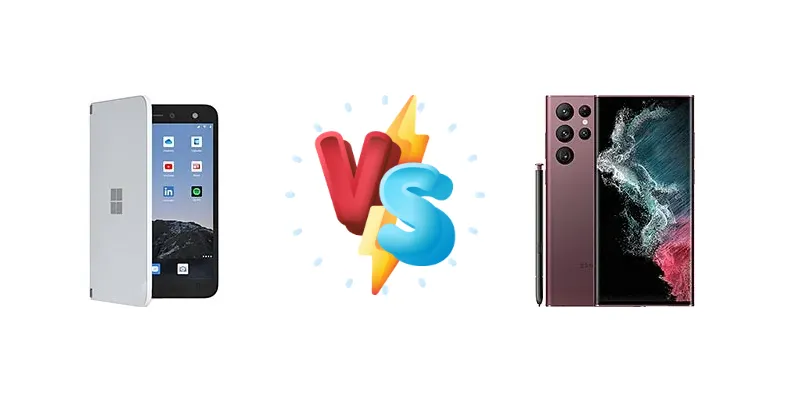
|
🏆 Quick Verdict
For the average user, the Samsung Galaxy S22 Ultra is the superior choice. Its significantly more powerful processor, exceptional camera system, and faster charging outweigh the Surface Duo’s niche dual-screen appeal. However, users prioritizing portability and unique multitasking workflows may find the Duo compelling.
| PHONES | ||
|---|---|---|
| Phone Names | Microsoft Surface Duo | Samsung Galaxy S22 Ultra 5G |
| Network | ||
|---|---|---|
| 2G bands | GSM 850 / 900 / 1800 / 1900 | GSM 850 / 900 / 1800 / 1900 |
| 3G bands | HSDPA 850 / 900 / 1900 / 2100 | HSDPA 850 / 900 / 1700(AWS) / 1900 / 2100 |
| 4G bands | 1, 2, 3, 4, 5, 7, 8, 12, 13, 14, 19 20, 25, 26, 28, 29, 30, 38, 39, 40, 41, 46, 66 | 1, 2, 3, 4, 5, 7, 8, 12, 13, 17, 18, 19, 20, 25, 26, 28, 32, 38, 39, 40, 41, 66 - International |
| 5G bands | - | 1, 2, 3, 5, 7, 8, 12, 20, 25, 28, 38, 40, 41, 66, 75, 77, 78 SA/NSA/Sub6 - International |
| Speed | HSPA 42.2/5.76 Mbps, LTE Cat18 1200/150 Mbps | HSPA 42.2/5.76 Mbps, LTE (7CA) Cat20 2000/200 Mbps, 5G (5+ Gbps DL) |
| Technology | GSM / HSPA / LTE | GSM / CDMA / HSPA / EVDO / LTE / 5G |
| - | 1, 3, 5, 7, 8, 20, 28, 38, 41, 66, 71, 260, 261 SA/NSA/Sub6/mmWave - USA | |
| Launch | ||
|---|---|---|
| Announced | 2020, August 12. Released 2020, September 10 | 2022, February 09 |
| Status | Discontinued | Available. Released 2022, February 25 |
| Body | ||
|---|---|---|
| Build | Glass front (Gorilla Glass 5), glass back (Gorilla Glass 5) | Glass front (Gorilla Glass Victus+), glass back (Gorilla Glass Victus+), aluminum frame |
| Dimensions | Unfolded: 186.9 x 145.2 x 4.8 mm Folded: 145.2 x 93.3 x 9.9 mm | 163.3 x 77.9 x 8.9 mm (6.43 x 3.07 x 0.35 in) |
| SIM | Nano-SIM + eSIM | · Nano-SIM + eSIM· Nano-SIM + Nano-SIM + eSIM (max 2 at a time) |
| Weight | 250 g (8.82 oz) | 228 g / 229 g (mmWave) (8.04 oz) |
| Stylus support | IP68 dust/water resistant (up to 1.5m for 30 min) Armor aluminum frame with tougher drop and scratch resistance (advertised) Stylus, 2.8ms latency (Bluetooth integration, accelerometer, gyro) | |
| Display | ||
|---|---|---|
| Protection | Corning Gorilla Glass 5 | Corning Gorilla Glass Victus+ |
| Resolution | 1800 x 2700 pixels, 3:2 ratio (~401 ppi density) | 1440 x 3088 pixels, 19.3:9 ratio (~500 ppi density) |
| Size | 8.1 inches, 195.4 cm2 (~144.2% screen-to-body ratio) | 6.8 inches, 114.7 cm2 (~90.2% screen-to-body ratio) |
| Type | AMOLED | Dynamic AMOLED 2X, 120Hz, HDR10+, 1750 nits (peak) |
| Folded position display: 5.6 inches, AMOLED, 1350 x 1800 pixels (4:3) | Always-on display | |
| Platform | ||
|---|---|---|
| CPU | Octa-core (1x2.84 GHz Kryo 485 & 3x2.42 GHz Kryo 485 & 4x1.78 GHz Kryo 485) | Octa-core (1x2.8 GHz Cortex-X2 & 3x2.50 GHz Cortex-A710 & 4x1.8 GHz Cortex-A510) - EuropeOcta-core (1x3.00 GHz Cortex-X2 & 3x2.50 GHz Cortex-A710 & 4x1.80 GHz Cortex-A510) - ROW |
| Chipset | Qualcomm SM8150 Snapdragon 855 (7 nm) | Exynos 2200 (4 nm) - EuropeQualcomm SM8450 Snapdragon 8 Gen 1 (4 nm) - ROW |
| GPU | Adreno 640 | Xclipse 920 - EuropeAdreno 730 - ROW |
| OS | Android 10, upgradable to Android 12 | Android 12, up to 4 major Android upgrades, One UI 8 |
| Memory | ||
|---|---|---|
| Card slot | No | No |
| Internal | 128GB 6GB RAM, 256GB 6GB RAM | 128GB 8GB RAM, 256GB 12GB RAM, 512GB 12GB RAM, 1TB 12GB RAM |
| UFS 3.0 | UFS 3.1 | |
| Main Camera | ||
|---|---|---|
| Features | HDR, panorama | Laser AF, LED flash, auto-HDR, panorama |
| Quad | - | 108 MP, f/1.8, 23mm (wide), 1/1.33", 0.8µm, PDAF, OIS 10 MP, f/2.4, 70mm (telephoto), 1/3.52", 1.12µm, PDAF, OIS, 3x optical zoom 10 MP, f/4.9, 230mm (periscope telephoto), 1/3.52", 1.12µm, PDAF, OIS, 10x optical zoom 12 MP, f/2.2, 13mm, 120˚ (ultrawide), 1/2.55", 1.4µm, dual pixel PDAF, Super Steady video |
| Single | 11 MP, f/2.0, 23mm (wide), 1.0µm, PDAF | - |
| Video | 4K@30/60fps, 1080p@30/60/120/240fps, gyro-EIS, HDR | 8K@24fps, 4K@30/60fps, 1080p@30/60/120/240fps, HDR10+, stereo sound rec., gyro-EIS |
| Selfie camera | ||
|---|---|---|
| Features | HDR, panorama | HDR |
| Single | Uses main camera | 40 MP, f/2.2, 26mm (wide), 1/2.82", 0.7µm, PDAF |
| Video | 4K@30/60fps, 1080p@30/60fps, gyro-EIS, HDR | 4K@30/60fps, 1080p@30fps |
| Sound | ||
|---|---|---|
| 3.5mm jack | No | No |
| 35mm jack | No | No |
| Loudspeaker | Yes | Yes, with stereo speakers |
| - | 32-bit/384kHz audio Tuned by AKG | |
| Comms | ||
|---|---|---|
| Bluetooth | 5.0, A2DP, LE, aptX Adaptive | 5.2, A2DP, LE |
| NFC | No | Yes |
| Positioning | GPS | GPS, GLONASS, BDS, GALILEO |
| Radio | No | No |
| USB | USB Type-C 3.1 | USB Type-C 3.2, OTG |
| WLAN | Wi-Fi 802.11 a/b/g/n/ac, dual-band, Wi-Fi Direct | Wi-Fi 802.11 a/b/g/n/ac/6e, dual-band, Wi-Fi Direct |
| Features | ||
|---|---|---|
| Sensors | Fingerprint (side-mounted), dual accelerometer, dual gyro, proximity, dual compass | Fingerprint (under display, ultrasonic), accelerometer, gyro, proximity, compass, barometer |
| - | Samsung DeX, Samsung Wireless DeX (desktop experience support) Bixby natural language commands and dictation Samsung Pay (Visa, MasterCard certified) Ultra Wideband (UWB) support | |
| Battery | ||
|---|---|---|
| Charging | 18W wired | 45W wired, PD3.0 15W wireless (Qi) 4.5W reverse wireless |
| Type | Li-Po 3577 mAh | Li-Ion 5000 mAh |
| Misc | ||
|---|---|---|
| Colors | White | Phantom Black, White, Burgundy, Green, Graphite, Red, Sky Blue, Bora Purple |
| Models | - | SM-S908B, SM-S908B/DS, SM-S908U, SM-S908U1, SM-S908W, SM-S908N, SM-S9080, SM-S908E, SM-S908E/DS |
| Price | About 650 EUR | € 397.07 / $ 269.98 / £ 304.99 / ₹ 63,899 |
| SAR | - | 1.18 W/kg (head) 0.98 W/kg (body) |
| SAR EU | - | 1.05 W/kg (head) 1.58 W/kg (body) |
| Tests | ||
|---|---|---|
| Battery life | - | Endurance rating 108h |
| Camera | - | Photo / Video |
| Display | - | Contrast ratio: Infinite (nominal) |
| Loudspeaker | - | -27.3 LUFS (Good) |
| Performance | - | AnTuTu: 968359 (v9) GeekBench: 3657 (v5.1) GFXBench: 37fps (ES 3.1 onscreen) |
Microsoft Surface Duo
- Unique dual-screen form factor for multitasking
- Highly portable and lightweight design
- Excellent for reading and note-taking
- Outdated processor (Snapdragon 855)
- Inferior camera system
- Slow charging speed (18W)
Samsung Galaxy S22 Ultra 5G
- Powerful processor (Exynos 2200/Snapdragon 8 Gen 1)
- Exceptional camera system with versatile features
- Fast charging (45W wired, 15W wireless)
- Larger and heavier than the Surface Duo
- More expensive
- Software can be bloated with Samsung features
Display Comparison
The S22 Ultra’s 6.8-inch Dynamic AMOLED 2X display dominates with a measured peak brightness of 1266 nits, offering excellent visibility even in direct sunlight. In contrast, the Surface Duo utilizes two 5.6-inch displays, totaling 11.3 inches of screen real estate when unfolded. While the Duo’s dual-screen setup is novel, it lacks the color accuracy and brightness of the S22 Ultra’s single panel. The S22 Ultra’s infinite contrast ratio further enhances visual fidelity, a feature absent in the Surface Duo’s display technology. The S22 Ultra also benefits from an adaptive refresh rate (LTPO) for smoother scrolling and improved power efficiency.
Camera Comparison
Samsung’s S22 Ultra excels in photography and videography. While specific sensor details are not provided, the S22 Ultra’s camera system is renowned for its versatility and image quality. The S22 Ultra’s advanced image processing algorithms and optical image stabilization (OIS) deliver consistently sharp and detailed photos, even in low-light conditions. The Surface Duo’s camera capabilities are comparatively limited, lacking the advanced features and image quality of the S22 Ultra. The Duo’s reliance on software processing to compensate for its less capable hardware results in images that often lack detail and dynamic range. The S22 Ultra’s video recording capabilities are also far superior, offering higher resolutions and frame rates.
Performance
The performance gap is substantial. The Galaxy S22 Ultra, equipped with either the Exynos 2200 (Europe) or Snapdragon 8 Gen 1 (ROW) built on a 4nm process, delivers significantly faster processing speeds than the Surface Duo’s aging Snapdragon 855 (7nm). The S22 Ultra’s Cortex-X2 prime core, clocked at 2.8GHz (or 3.0GHz in ROW variants), provides a noticeable boost in single-core performance. The Duo’s Snapdragon 855, while capable for everyday tasks, struggles with demanding games and applications. The S22 Ultra’s LPDDR5x RAM further contributes to faster data access and overall system responsiveness. Thermal management is also a key differentiator; the 4nm process of the S22 Ultra’s chipset allows for better heat dissipation, reducing throttling during sustained workloads.
Battery Life
The Galaxy S22 Ultra boasts an endurance rating of 108 hours, indicating excellent battery life. Its 45W wired charging with PD3.0 support allows for rapid charging, significantly faster than the Surface Duo’s 18W wired charging. The S22 Ultra also supports 15W wireless charging and 4.5W reverse wireless charging, adding to its convenience. While the Surface Duo’s battery capacity isn’t specified, its older chipset and dual-screen setup likely result in shorter battery life. The slower charging speed of the Duo means longer downtime between uses.
Buying Guide
Buy the Microsoft Surface Duo if you need a highly portable device for extensive reading, note-taking, and multitasking across two apps simultaneously, and are willing to compromise on processing power and camera quality. Buy the Samsung Galaxy S22 Ultra 5G if you prioritize top-tier performance for gaming and demanding applications, a versatile and high-resolution camera system, and a vibrant, bright display with fast charging capabilities.