
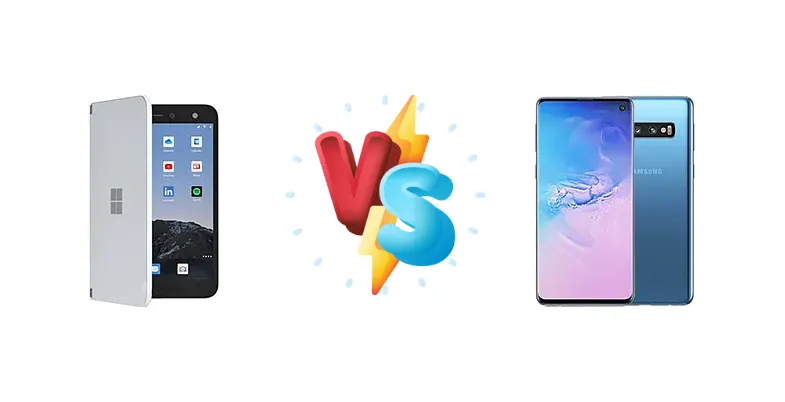
Surface Duo vs. Galaxy S10: A Tale of Two Approaches to Mobile
| Phones Images | |||||
|---|---|---|---|---|---|
|
🏆 Quick Verdict
For the average user seeking a reliable, well-rounded smartphone, the Samsung Galaxy S10 remains a compelling choice, particularly at its current price point. While the Surface Duo offers a novel experience, its aging chipset and limited software support hinder its overall usability compared to the S10’s mature ecosystem.
| PHONES | ||
|---|---|---|
| Phone Names | Microsoft Surface Duo | Samsung Galaxy S10 |
| Network | ||
|---|---|---|
| 2G bands | GSM 850 / 900 / 1800 / 1900 | GSM 850 / 900 / 1800 / 1900 |
| 3G bands | HSDPA 850 / 900 / 1900 / 2100 | HSDPA 850 / 900 / 1700(AWS) / 1900 / 2100 - Global, USA |
| 4G bands | 1, 2, 3, 4, 5, 7, 8, 12, 13, 14, 19 20, 25, 26, 28, 29, 30, 38, 39, 40, 41, 46, 66 | 1, 2, 3, 4, 5, 7, 8, 12, 13, 17, 18, 19, 20, 25, 26, 28, 32, 38, 39, 40, 41, 66 - Global |
| Speed | HSPA 42.2/5.76 Mbps, LTE Cat18 1200/150 Mbps | HSPA 42.2/5.76 Mbps, LTE (7CA) Cat20 2000/150 Mbps |
| Technology | GSM / HSPA / LTE | GSM / CDMA / HSPA / EVDO / LTE |
| - | 1, 2, 3, 4, 5, 7, 8, 12, 13, 14, 17, 18, 19, 20, 25, 26, 28, 29, 30, 38, 39, 40, 41, 46, 66, 71 - USA | |
| Launch | ||
|---|---|---|
| Announced | 2020, August 12. Released 2020, September 10 | 2019, February 20. Released 2019, March 08 |
| Status | Discontinued | Discontinued |
| Body | ||
|---|---|---|
| Build | Glass front (Gorilla Glass 5), glass back (Gorilla Glass 5) | Glass front (Gorilla Glass 6), glass back (Gorilla Glass 5), aluminum frame |
| Dimensions | Unfolded: 186.9 x 145.2 x 4.8 mm Folded: 145.2 x 93.3 x 9.9 mm | 149.9 x 70.4 x 7.8 mm (5.90 x 2.77 x 0.31 in) |
| SIM | Nano-SIM + eSIM | · Nano-SIM· Nano-SIM + Nano-SIM |
| Weight | 250 g (8.82 oz) | 157 g (5.54 oz) |
| Stylus support | IP68 dust/water resistant (up to 1.5m for 30 min) | |
| Display | ||
|---|---|---|
| Protection | Corning Gorilla Glass 5 | Corning Gorilla Glass 6 |
| Resolution | 1800 x 2700 pixels, 3:2 ratio (~401 ppi density) | 1440 x 3040 pixels, 19:9 ratio (~550 ppi density) |
| Size | 8.1 inches, 195.4 cm2 (~144.2% screen-to-body ratio) | 6.1 inches, 93.2 cm2 (~88.3% screen-to-body ratio) |
| Type | AMOLED | Dynamic AMOLED, HDR10+ |
| Folded position display: 5.6 inches, AMOLED, 1350 x 1800 pixels (4:3) | Always-on display | |
| Platform | ||
|---|---|---|
| CPU | Octa-core (1x2.84 GHz Kryo 485 & 3x2.42 GHz Kryo 485 & 4x1.78 GHz Kryo 485) | Octa-core (2x2.73 GHz Mongoose M4 & 2x2.31 GHz Cortex-A75 & 4x1.95 GHz Cortex-A55) - EMEA/LATAMOcta-core (1x2.84 GHz Kryo 485 & 3x2.42 GHz Kryo 485 & 4x1.78 GHz Kryo 485) - USA/China |
| Chipset | Qualcomm SM8150 Snapdragon 855 (7 nm) | Exynos 9820 (8 nm) - EMEA/LATAMQualcomm SM8150 Snapdragon 855 (7 nm) - USA/China |
| GPU | Adreno 640 | Mali-G76 MP12 - EMEA/LATAMAdreno 640 - USA/China |
| OS | Android 10, upgradable to Android 12 | Android 9.0 (Pie), upgradable to Android 12, One UI 4.1 |
| Memory | ||
|---|---|---|
| Card slot | No | microSDXC (uses shared SIM slot) - dual SIM model only |
| Internal | 128GB 6GB RAM, 256GB 6GB RAM | 128GB 6GB RAM, 128GB 8GB RAM, 512GB 8GB RAM |
| UFS 3.0 | UFS 2.1 | |
| Main Camera | ||
|---|---|---|
| Features | HDR, panorama | LED flash, auto-HDR, panorama |
| Single | 11 MP, f/2.0, 23mm (wide), 1.0µm, PDAF | - |
| Triple | - | 12 MP, f/1.5-2.4, 26mm (wide), 1/2.55", 1.4µm, dual pixel PDAF, OIS 12 MP, f/2.4, 52mm (telephoto), 1/3.6", 1.0µm, AF, OIS, 2x optical zoom 16 MP, f/2.2, 12mm (ultrawide), 1/3.1", 1.0µm, Super Steady video |
| Video | 4K@30/60fps, 1080p@30/60/120/240fps, gyro-EIS, HDR | 4K@60fps (no EIS), 4K@30fps, 1080p@30/60/240fps, 720p@960fps, HDR10+, stereo sound rec., gyro-EIS & OIS |
| Selfie camera | ||
|---|---|---|
| Features | HDR, panorama | HDR |
| Single | Uses main camera | 10 MP, f/1.9, 26mm (wide), 1/3", 1.22µm, dual pixel PDAF |
| Video | 4K@30/60fps, 1080p@30/60fps, gyro-EIS, HDR | 4K@30/60fps, 1080p@30fps |
| Sound | ||
|---|---|---|
| 3.5mm jack | No | Yes |
| 35mm jack | No | Yes |
| Loudspeaker | Yes | Yes, with stereo speakers |
| - | 32-bit/384kHz audio Tuned by AKG | |
| Comms | ||
|---|---|---|
| Bluetooth | 5.0, A2DP, LE, aptX Adaptive | 5.0, A2DP, LE, aptX |
| NFC | No | Yes |
| Positioning | GPS | GPS, GLONASS, BDS, GALILEO |
| Radio | No | FM radio (USA & Canada only) |
| USB | USB Type-C 3.1 | USB Type-C 3.1, OTG, DisplayPort |
| WLAN | Wi-Fi 802.11 a/b/g/n/ac, dual-band, Wi-Fi Direct | Wi-Fi 802.11 a/b/g/n/ac/6, dual-band, Wi-Fi Direct |
| Features | ||
|---|---|---|
| Sensors | Fingerprint (side-mounted), dual accelerometer, dual gyro, proximity, dual compass | Fingerprint (under display, ultrasonic), accelerometer, gyro, proximity, compass, barometer, heart rate, SpO2 |
| - | ANT+ Bixby natural language commands and dictation Samsung DeX (desktop experience support) Samsung Pay (Visa, MasterCard certified) | |
| Battery | ||
|---|---|---|
| Charging | 18W wired | 15W wired, PD2.0 15W wireless (Qi) 4.5W reverse wireless |
| Type | Li-Po 3577 mAh | Li-Ion 3400 mAh, non-removable |
| Misc | ||
|---|---|---|
| Colors | White | Prism White, Prism Black, Prism Green, Prism Blue, Canary Yellow, Flamingo Pink, Cardinal Red, Smoke Blue |
| Models | - | SM-G973F, SM-G973U, SM-G973W, SM-G973U1, SM-G9730, SM-G973N, SM-G973X, SCV41, SM-G973C |
| Price | About 650 EUR | About 150 EUR |
| SAR | - | 0.93 W/kg (head) 0.79 W/kg (body) |
| SAR EU | - | 0.48 W/kg (head) 1.59 W/kg (body) |
| Tests | ||
|---|---|---|
| Audio quality | - | Noise -92.2dB / Crosstalk -92.7dB |
| Battery life | - | Endurance rating 79h |
| Camera | - | Photo / Video |
| Display | - | Contrast ratio: Infinite (nominal), 4.498 (sunlight) |
| Loudspeaker | - | Voice 82dB / Noise 74dB / Ring 85dB |
| Performance | - | AnTuTu: 328366 (v7) GeekBench: 10174 (v4.4) GFXBench: 23fps (ES 3.1 onscreen) |
Microsoft Surface Duo
- Unique dual-screen multitasking experience
- Portable and lightweight design
- Good for reading and note-taking
- Aging Snapdragon 855 chipset
- Limited software support
- Inferior camera system
Samsung Galaxy S10
- Powerful Snapdragon 855 or Exynos 9820
- Excellent battery life (79h endurance)
- Versatile camera system
- Smaller display compared to Surface Duo's combined screen area
- No longer the latest flagship
- Software updates are slowing down
Display Comparison
The Galaxy S10 boasts an 'Infinite' display with a contrast ratio of 4.498 in sunlight, indicating excellent outdoor visibility. While the Surface Duo features two separate 5.6-inch displays, the lack of a unified, high-contrast panel impacts media consumption. The S10’s Dynamic AMOLED panel delivers richer colors and deeper blacks, a significant advantage for visual experiences. The Surface Duo’s display, while functional, prioritizes screen real estate over image quality.
Camera Comparison
The Galaxy S10’s camera system, while details are limited in the provided data, was a flagship contender in its time, offering versatile photo and video capabilities. The Surface Duo’s camera specifications are not provided, but its focus is clearly not on photographic excellence. The S10’s superior image processing and likely larger sensor size (based on market positioning) deliver better image quality, especially in low-light conditions. The S10’s camera benefits from Samsung’s established computational photography expertise.
Performance
Both devices utilize the Qualcomm Snapdragon 855 in certain regions (USA/China for the S10). However, the EMEA/LATAM S10 variant uses the Exynos 9820. The Snapdragon 855, a 7nm process node, is a capable chip, but it's several generations behind current flagships. The Surface Duo’s Snapdragon 855, paired with a likely lower thermal budget due to its form factor, may experience more throttling under sustained load than the S10. The Exynos 9820, while competitive, generally trails the Snapdragon 855 in GPU performance. Both phones feature octa-core CPUs, but the architectural differences – Kryo 485 vs. Mongoose M4/Cortex-A75/A55 – impact real-world performance characteristics.
Battery Life
The Galaxy S10 achieves an impressive 79-hour endurance rating, suggesting excellent battery life for its 3100mAh capacity. The Surface Duo, with its dual displays and older chipset, likely struggles to match this endurance. The S10 supports 15W wired charging, PD2.0, 15W wireless charging, and even 4.5W reverse wireless charging – a feature absent on the Surface Duo’s 18W wired charging. The S10’s charging versatility and superior endurance provide a more convenient user experience.
Buying Guide
Buy the Microsoft Surface Duo if you prioritize multitasking and a large, portable screen for reading and note-taking, and are comfortable with a slightly older processor and potential software limitations. Buy the Samsung Galaxy S10 if you prefer a compact, powerful, and consistently updated flagship experience with a superior camera system and reliable performance for everyday tasks.