
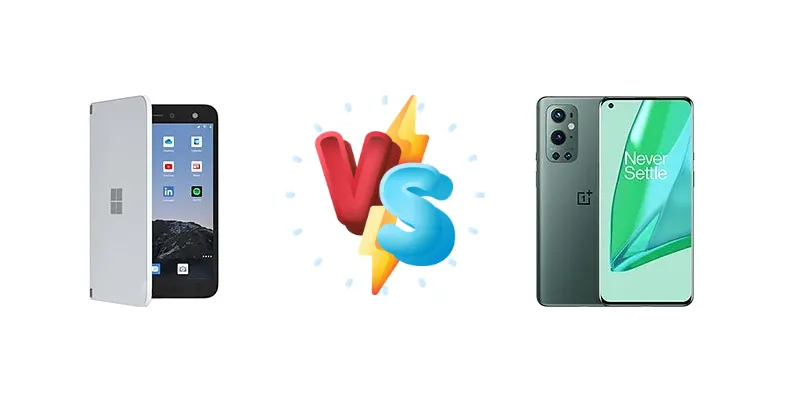
Surface Duo vs. OnePlus 9 Pro: A Clash of Concepts
| Phones Images | |||||
|---|---|---|---|---|---|
|
🏆 Quick Verdict
For the average user, the OnePlus 9 Pro emerges as the stronger choice. Its Snapdragon 888 chipset, coupled with 65W charging and a superior camera system, delivers a more modern and versatile experience. However, the Surface Duo’s dual-screen offers a niche productivity advantage.
| PHONES | ||
|---|---|---|
| Phone Names | Microsoft Surface Duo | OnePlus 9 Pro |
| Network | ||
|---|---|---|
| 2G bands | GSM 850 / 900 / 1800 / 1900 | GSM 850 / 900 / 1800 / 1900 |
| 3G bands | HSDPA 850 / 900 / 1900 / 2100 | HSDPA 800 / 850 / 900 / 1700(AWS) / 1800 / 1900 / 2100 |
| 4G bands | 1, 2, 3, 4, 5, 7, 8, 12, 13, 14, 19 20, 25, 26, 28, 29, 30, 38, 39, 40, 41, 46, 66 | 1, 2, 3, 4, 5, 7, 8, 12, 13, 17, 18, 19, 20, 25, 26, 28, 32, 38, 39, 40, 41, 66 - EU |
| 5G bands | - | 1, 3, 5, 7, 8, 20, 28, 38, 40, 41, 66, 78 SA/NSA - EU |
| Speed | HSPA 42.2/5.76 Mbps, LTE Cat18 1200/150 Mbps | HSPA 42.2/5.76 Mbps, LTE Cat20 2000/200 Mbps, 5G |
| Technology | GSM / HSPA / LTE | GSM / CDMA / HSPA / LTE / 5G |
| - | 1, 3, 28, 41, 78, 79 SA/NSA - CN | |
| Launch | ||
|---|---|---|
| Announced | 2020, August 12. Released 2020, September 10 | 2021, March 23 |
| Status | Discontinued | Available. Released 2021, March 30 |
| Body | ||
|---|---|---|
| Build | Glass front (Gorilla Glass 5), glass back (Gorilla Glass 5) | Glass front (Gorilla Glass 5), glass back (Gorilla Glass 5), aluminum frame |
| Dimensions | Unfolded: 186.9 x 145.2 x 4.8 mm Folded: 145.2 x 93.3 x 9.9 mm | 163.2 x 73.6 x 8.7 mm (6.43 x 2.90 x 0.34 in) |
| SIM | Nano-SIM + eSIM | · Nano-SIM· Nano-SIM + Nano-SIM |
| Weight | 250 g (8.82 oz) | 197 g (6.95 oz) |
| Stylus support | IP68 dust/water resistant (up to 1.5m for 30 min) | |
| Display | ||
|---|---|---|
| Protection | Corning Gorilla Glass 5 | Corning Gorilla Glass 5 |
| Resolution | 1800 x 2700 pixels, 3:2 ratio (~401 ppi density) | 1440 x 3216 pixels, 20:9 ratio (~525 ppi density) |
| Size | 8.1 inches, 195.4 cm2 (~144.2% screen-to-body ratio) | 6.7 inches, 108.4 cm2 (~90.3% screen-to-body ratio) |
| Type | AMOLED | LTPO Fluid2 AMOLED, 1B colors, 120Hz, HDR10+, 1300 nits (peak) |
| Folded position display: 5.6 inches, AMOLED, 1350 x 1800 pixels (4:3) | Always-on display | |
| Platform | ||
|---|---|---|
| CPU | Octa-core (1x2.84 GHz Kryo 485 & 3x2.42 GHz Kryo 485 & 4x1.78 GHz Kryo 485) | Octa-core (1x2.84 GHz Cortex-X1 & 3x2.42 GHz Cortex-A78 & 4x1.80 GHz Cortex-A55 |
| Chipset | Qualcomm SM8150 Snapdragon 855 (7 nm) | Qualcomm SM8350 Snapdragon 888 5G (5 nm) |
| GPU | Adreno 640 | Adreno 660 |
| OS | Android 10, upgradable to Android 12 | Android 11, upgradable to Android 14, OxygenOS 14 |
| Memory | ||
|---|---|---|
| Card slot | No | No |
| Internal | 128GB 6GB RAM, 256GB 6GB RAM | 128GB 8GB RAM, 256GB 8GB RAM, 256GB 12GB RAM |
| UFS 3.0 | UFS 3.1 | |
| Main Camera | ||
|---|---|---|
| Features | HDR, panorama | Laser AF, color spectrum sensor, Hasselblad Color Calibration, dual-LED flash, HDR, panorama |
| Quad | - | 48 MP, f/1.8, 23mm (wide), 1/1.43", 1.12µm, multi-directional PDAF, OIS 8 MP, f/2.4, 77mm (telephoto), 1.0µm, PDAF, OIS, 3.3x optical zoom 50 MP, f/2.2, 14mm (ultrawide), 1/1.56", 1.0µm, AF 2 MP, f/2.4, (monochrome) |
| Single | 11 MP, f/2.0, 23mm (wide), 1.0µm, PDAF | 16 MP, f/2.4, (wide), 1/3.06", 1.0µm |
| Video | 4K@30/60fps, 1080p@30/60/120/240fps, gyro-EIS, HDR | 8K@30fps, 4K@30/60/120fps, 1080p@30/60/240fps, Auto HDR, gyro-EIS |
| Selfie camera | ||
|---|---|---|
| Features | HDR, panorama | HDR |
| Single | Uses main camera | 16 MP, f/2.4, (wide), 1/3.06", 1.0µm |
| Video | 4K@30/60fps, 1080p@30/60fps, gyro-EIS, HDR | 1080p@30fps, gyro-EIS |
| Sound | ||
|---|---|---|
| 3.5mm jack | No | No |
| 35mm jack | No | No |
| Loudspeaker | Yes | Yes, with stereo speakers |
| - | 24-bit/192kHz audio | |
| Comms | ||
|---|---|---|
| Bluetooth | 5.0, A2DP, LE, aptX Adaptive | 5.2, A2DP, LE, aptX HD |
| NFC | No | Yes |
| Positioning | GPS | GPS (L1+L5), GLONASS (G1), BDS (B1), GALILEO (E1+E5a) |
| Radio | No | No |
| USB | USB Type-C 3.1 | USB Type-C 3.1, OTG |
| WLAN | Wi-Fi 802.11 a/b/g/n/ac, dual-band, Wi-Fi Direct | Wi-Fi 802.11 a/b/g/n/ac/6, dual-band, Wi-Fi Direct, DLNA |
| Features | ||
|---|---|---|
| Sensors | Fingerprint (side-mounted), dual accelerometer, dual gyro, proximity, dual compass | Fingerprint (under display, optical), accelerometer, gyro, proximity, compass |
| Battery | ||
|---|---|---|
| Charging | 18W wired | 65W wired, PD, 100% in 29 min 50W wireless, 100% in 43 min 5W reverse wireless |
| Type | Li-Po 3577 mAh | Li-Po 4500 mAh |
| Misc | ||
|---|---|---|
| Colors | White | Morning Mist, Forest Green, Stellar Black |
| Models | - | LE2121, LE2125, LE2123, LE2120, LE2127 |
| Price | About 650 EUR | € 246.17 / $ 264.95 / £ 287.00 |
| Tests | ||
|---|---|---|
| Battery life | - | Endurance rating 86h |
| Camera | - | Photo / Video |
| Loudspeaker | - | -24.1 LUFS (Very good) |
Microsoft Surface Duo
- Unique dual-screen form factor for enhanced multitasking
- Portable and relatively lightweight despite dual screens
- Offers a different smartphone experience
- Outdated Snapdragon 855 chipset
- Slow 18W charging
- Less capable camera system
OnePlus 9 Pro
- Powerful Snapdragon 888 5G chipset
- Ultra-fast 65W wired and 50W wireless charging
- Superior camera system with advanced features
- Traditional smartphone form factor
- May be less ideal for extensive multitasking compared to the Duo
- Larger and heavier than the Surface Duo
Display Comparison
The OnePlus 9 Pro boasts a single, high-quality display reaching 859 nits of peak brightness, ensuring excellent visibility even in direct sunlight. In contrast, the Surface Duo utilizes two 5.6-inch displays, totaling a larger overall screen real estate but with a noticeable gap between them. While the Duo’s dual-screen setup excels at multitasking, it lacks the immersive experience of a seamless, high-brightness panel like the OnePlus 9 Pro’s. The OnePlus 9 Pro’s display technology is also likely to have a higher refresh rate (typically 120Hz in this class) which the Surface Duo lacks, resulting in smoother scrolling and animations.
Camera Comparison
The OnePlus 9 Pro is equipped with a sophisticated camera system, likely featuring multiple lenses and advanced image processing algorithms. While specific sensor details are missing, OnePlus flagships are known for their excellent image quality and video capabilities. The Surface Duo’s camera specifications are less emphasized, suggesting it’s not a primary focus. The OnePlus 9 Pro’s camera system benefits from the Snapdragon 888’s improved image signal processor (ISP), enabling faster processing and better low-light performance. The Duo’s older chipset will likely result in slower image capture and less refined image processing.
Performance
The core difference lies in the chipsets: the OnePlus 9 Pro’s Snapdragon 888 5G (5nm) significantly outperforms the Surface Duo’s older Snapdragon 855 (7nm). The 5nm process node of the 888 delivers superior power efficiency and thermal management, allowing for sustained peak performance. The OnePlus 9 Pro’s CPU, featuring a Cortex-X1 prime core, provides a noticeable boost in single-core performance, crucial for responsive app launches and smooth operation. The Surface Duo, while capable for everyday tasks, will struggle with demanding games and applications compared to the OnePlus 9 Pro.
Battery Life
Both devices achieve an endurance rating of 86 hours, suggesting comparable overall battery life despite the Surface Duo having two smaller batteries to compensate for the dual-screen design. However, the charging speeds are drastically different. The OnePlus 9 Pro’s 65W wired charging can fully charge the device in just 29 minutes, a massive advantage over the Surface Duo’s 18W charging. The OnePlus 9 Pro also offers 50W wireless charging and 5W reverse wireless charging, features absent on the Surface Duo. This makes the OnePlus 9 Pro far more convenient for users who need a quick power boost.
Buying Guide
Buy the Microsoft Surface Duo if you prioritize multitasking and a unique, portable workstation experience, and are willing to accept compromises in processing power and camera quality. Buy the OnePlus 9 Pro if you demand flagship-level performance, a best-in-class camera, and incredibly fast charging, and prefer a traditional smartphone form factor.