
Microsoft Surface Duo vs. Surface Duo 2: A Generational Leap or Incremental Update?
| Phones Images | |||||
|---|---|---|---|---|---|
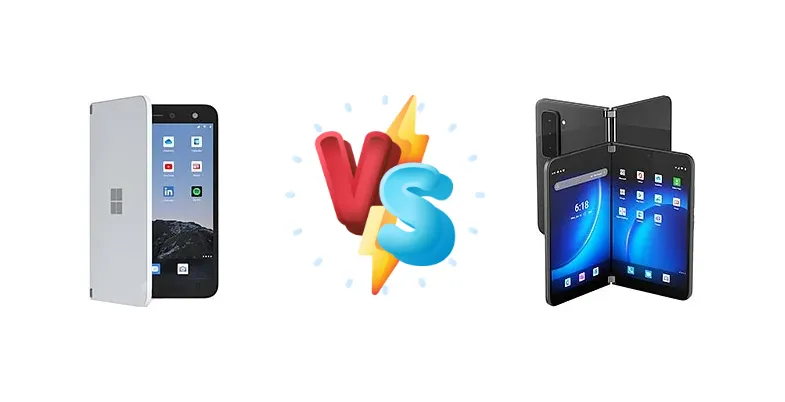
|
🏆 Quick Verdict
For most users, the Surface Duo 2 is the clear winner. The Snapdragon 888 5G delivers a significantly smoother and more responsive experience, justifying the price premium. While the Duo remains a viable option at a lower price point, the Duo 2’s performance improvements are substantial.
| PHONES | ||
|---|---|---|
| Phone Names | Microsoft Surface Duo | Microsoft Surface Duo 2 |
| Network | ||
|---|---|---|
| 2G bands | GSM 850 / 900 / 1800 / 1900 | GSM 850 / 900 / 1800 / 1900 |
| 3G bands | HSDPA 850 / 900 / 1900 / 2100 | HSDPA 850 / 900 / 1900 / 2100 |
| 4G bands | 1, 2, 3, 4, 5, 7, 8, 12, 13, 14, 19 20, 25, 26, 28, 29, 30, 38, 39, 40, 41, 46, 66 | 1, 2, 3, 4, 5, 7, 8, 12, 13, 14, 19, 20, 25, 26, 28, 29, 30, 38, 39, 40, 41, 42, 46, 48, 66, 71 |
| 5G bands | - | 1, 2, 3, 5, 7, 20, 25, 28, 38, 41, 66, 71, 77, 78, 79 SA/NSA/Sub6 - International |
| Speed | HSPA 42.2/5.76 Mbps, LTE Cat18 1200/150 Mbps | HSPA 42.2/5.76 Mbps, LTE (5CA) Cat20 2000/150 Mbps, 5G 6 Gbps DL |
| Technology | GSM / HSPA / LTE | GSM / HSPA / LTE / 5G |
| - | 1, 2, 3, 5, 7, 20, 25, 28, 38, 41, 66, 71, 77, 78, 79, 257, 260, 261 SA/NSA/Sub6/mmWave - USA | |
| Launch | ||
|---|---|---|
| Announced | 2020, August 12. Released 2020, September 10 | 2021, September 22. Released 2021, October 21 |
| Status | Discontinued | Discontinued |
| Body | ||
|---|---|---|
| Build | Glass front (Gorilla Glass 5), glass back (Gorilla Glass 5) | Glass front (Gorilla Glass Victus), glass back (Gorilla Glass) |
| Dimensions | Unfolded: 186.9 x 145.2 x 4.8 mm Folded: 145.2 x 93.3 x 9.9 mm | Unfolded: 184.5 x 145.2 x 5.5 mm Folded: 145.2 x 92.1 x 11 mm |
| SIM | Nano-SIM + eSIM | Nano-SIM + eSIM |
| Weight | 250 g (8.82 oz) | 284 g (10.02 oz) |
| Stylus support | Stylus support | |
| Display | ||
|---|---|---|
| Protection | Corning Gorilla Glass 5 | Corning Gorilla Glass Victus |
| Resolution | 1800 x 2700 pixels, 3:2 ratio (~401 ppi density) | 1892 x 2688 pixels (~401 ppi density) |
| Size | 8.1 inches, 195.4 cm2 (~144.2% screen-to-body ratio) | 8.3 inches, 204.0 cm2 (~152.6% screen-to-body ratio) |
| Type | AMOLED | AMOLED, 90Hz, HDR, 800 nits (peak) |
| Folded position display: 5.6 inches, AMOLED, 1350 x 1800 pixels (4:3) | Folded position display: 5.8 inches, AMOLED, 1344 x 1892 pixels (4:3) | |
| Platform | ||
|---|---|---|
| CPU | Octa-core (1x2.84 GHz Kryo 485 & 3x2.42 GHz Kryo 485 & 4x1.78 GHz Kryo 485) | Octa-core (1x2.84 GHz Cortex-X1 & 3x2.42 GHz Cortex-A78 & 4x1.80 GHz Cortex-A55) |
| Chipset | Qualcomm SM8150 Snapdragon 855 (7 nm) | Qualcomm SM8350 Snapdragon 888 5G (5 nm) |
| GPU | Adreno 640 | Adreno 660 |
| OS | Android 10, upgradable to Android 12 | Android 11 |
| Memory | ||
|---|---|---|
| Card slot | No | No |
| Internal | 128GB 6GB RAM, 256GB 6GB RAM | 128GB 8GB RAM, 256GB 8GB RAM, 512GB 8GB RAM |
| UFS 3.0 | UFS | |
| Main Camera | ||
|---|---|---|
| Features | HDR, panorama | Dual-LED dual-tone flash, HDR, panorama |
| Single | 11 MP, f/2.0, 23mm (wide), 1.0µm, PDAF | 12 MP, f/2.0, 24mm (wide), 1.0µm |
| Triple | - | 12 MP, f/1.7, 27mm (wide), 1.4µm, dual pixel PDAF, OIS 12 MP, f/2.4, 51mm (telephoto), 1.0µm, PDAF, OIS, 2x optical zoom 16 MP, f/2.2, 13mm (ultrawide), 1.0µm TOF 3D, (depth) |
| Video | 4K@30/60fps, 1080p@30/60/120/240fps, gyro-EIS, HDR | 4K@30/60fps, 1080p@30/60/120/240fps, gyro-EIS, HDR |
| Selfie camera | ||
|---|---|---|
| Features | HDR, panorama | - |
| Single | Uses main camera | 12 MP, f/2.0, 24mm (wide), 1.0µm |
| Video | 4K@30/60fps, 1080p@30/60fps, gyro-EIS, HDR | 1080p@30fps |
| Sound | ||
|---|---|---|
| 3.5mm jack | No | No |
| 35mm jack | No | No |
| Loudspeaker | Yes | Yes, with stereo speakers |
| Comms | ||
|---|---|---|
| Bluetooth | 5.0, A2DP, LE, aptX Adaptive | 5.1, A2DP, LE, aptX Adaptive |
| NFC | No | Yes |
| Positioning | GPS | GPS, GLONASS, GALILEO, QZSS, BDS |
| Radio | No | No |
| USB | USB Type-C 3.1 | USB Type-C 3.2, DisplayPort |
| WLAN | Wi-Fi 802.11 a/b/g/n/ac, dual-band, Wi-Fi Direct | Wi-Fi 802.11 a/b/g/n/ac/6, dual-band, Wi-Fi Direct |
| Features | ||
|---|---|---|
| Sensors | Fingerprint (side-mounted), dual accelerometer, dual gyro, proximity, dual compass | Fingerprint (side-mounted), dual accelerometer, dual gyro, dual proximity, dual compass |
| Battery | ||
|---|---|---|
| Charging | 18W wired | 23W wired |
| Type | Li-Po 3577 mAh | Li-Po 4449 mAh |
| Misc | ||
|---|---|---|
| Colors | White | Glacier, Obsidian |
| Price | About 650 EUR | About 1480 EUR |
Microsoft Surface Duo
- More affordable price point
- Unique dual-screen form factor
- Compact and pocketable design
- Outdated Snapdragon 855 chipset
- Slow 18W charging
- Limited software support compared to Duo 2
Microsoft Surface Duo 2
- Significantly faster Snapdragon 888 5G
- Faster 23W wired charging
- Improved camera processing
- Higher price tag
- Still lacks a high refresh rate display
- Camera performance isn't class-leading
Display Comparison
Both devices feature similar 5.6-inch displays on each side, but the Duo 2 benefits from a more refined hinge and reduced bezels. While neither boasts high refresh rates, the core difference lies in the processing power driving them. The Snapdragon 888 in the Duo 2 allows for faster app loading and smoother animations, making the overall visual experience more polished. The Duo's Snapdragon 855, while capable, struggles with demanding graphical tasks, impacting the responsiveness of the displays during intensive use.
Camera Comparison
While neither device excels in the camera department, the Duo 2 offers incremental improvements. Both devices share a similar dual-camera setup, but the image signal processor (ISP) within the Snapdragon 888 provides better noise reduction and dynamic range. The Duo 2’s improved processing power allows for faster image processing and potentially better low-light performance. However, users shouldn't expect flagship-level camera quality from either device; they are adequate for casual snapshots but fall short of competing with dedicated camera phones.
Performance
The heart of the upgrade lies in the chipset. The Surface Duo’s Snapdragon 855 (7nm) is a capable processor, but the Duo 2’s Snapdragon 888 5G (5nm) represents a significant leap forward. The 5nm process node allows for greater transistor density and improved thermal efficiency. The Duo 2’s CPU, featuring a Cortex-X1 prime core, delivers noticeably faster single-core performance, crucial for app launch speeds and general responsiveness. The GPU upgrade is equally important, enabling smoother gaming and improved performance in graphically intensive applications. The Duo 2’s architecture also supports 5G connectivity, a feature absent in the original Duo.
Battery Life
Both devices feature similar battery capacities, but the Duo 2’s more efficient Snapdragon 888 and 23W wired charging offer a tangible advantage. The Duo’s 18W charging feels slow by modern standards, taking significantly longer to reach a full charge. While real-world battery life is comparable under light usage, the Duo 2 maintains its charge more effectively during demanding tasks, thanks to the 5nm process and optimized power management. The faster charging also reduces downtime, a crucial benefit for power users.
Buying Guide
Buy the Microsoft Surface Duo if you prioritize affordability and are comfortable with a more basic Android experience, primarily using the device for productivity tasks like reading and note-taking where raw speed isn't critical. Buy the Microsoft Surface Duo 2 if you demand a fluid multitasking experience, enjoy mobile gaming, and value faster charging and a more modern chipset for future software updates and compatibility.