
Surface Duo vs. Lenovo Tab M7: A Tale of Two Android Experiences
| Phones Images | |||||
|---|---|---|---|---|---|
|
🏆 Quick Verdict
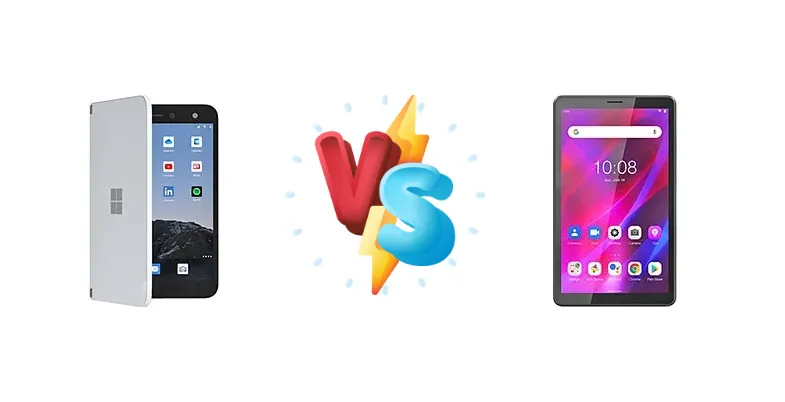
For users prioritizing multitasking and a premium experience, the Surface Duo is the clear winner, despite its higher price. However, the Lenovo Tab M7 offers exceptional value for casual users seeking a basic tablet for media consumption and light tasks.
| PHONES | ||
|---|---|---|
| Phone Names | Microsoft Surface Duo | Lenovo Tab M7 (3rd Gen) |
| Network | ||
|---|---|---|
| 2G bands | GSM 850 / 900 / 1800 / 1900 | GSM 850 / 900 / 1800 / 1900 |
| 3G bands | HSDPA 850 / 900 / 1900 / 2100 | HSDPA 850 / 900 / 1900 / 2100 |
| 4G bands | 1, 2, 3, 4, 5, 7, 8, 12, 13, 14, 19 20, 25, 26, 28, 29, 30, 38, 39, 40, 41, 46, 66 | 1, 2, 3, 4, 5, 7, 8, 19, 20, 28, 38, 40, 41 |
| Speed | HSPA 42.2/5.76 Mbps, LTE Cat18 1200/150 Mbps | HSPA, LTE - cellular model only |
| Technology | GSM / HSPA / LTE | GSM / HSPA / LTE |
| Launch | ||
|---|---|---|
| Announced | 2020, August 12. Released 2020, September 10 | 2021, June 28 |
| Status | Discontinued | Available. Released 2021, June 31 |
| Body | ||
|---|---|---|
| Build | Glass front (Gorilla Glass 5), glass back (Gorilla Glass 5) | Glass front, aluminum back, aluminum frame |
| Dimensions | Unfolded: 186.9 x 145.2 x 4.8 mm Folded: 145.2 x 93.3 x 9.9 mm | 176.2 x 102.3 x 8.3 mm (6.94 x 4.03 x 0.33 in) |
| SIM | Nano-SIM + eSIM | Nano-SIM (cellular model only) |
| Weight | 250 g (8.82 oz) | 237 g (8.36 oz) |
| Stylus support | - | |
| Display | ||
|---|---|---|
| Protection | Corning Gorilla Glass 5 | - |
| Resolution | 1800 x 2700 pixels, 3:2 ratio (~401 ppi density) | 600 x 1024 pixels, 16:9 ratio (~170 ppi density) |
| Size | 8.1 inches, 195.4 cm2 (~144.2% screen-to-body ratio) | 7.0 inches, 137.9 cm2 (~76.5% screen-to-body ratio) |
| Type | AMOLED | TDDI IPS LCD, 350 nits (typ) |
| Folded position display: 5.6 inches, AMOLED, 1350 x 1800 pixels (4:3) | - | |
| Platform | ||
|---|---|---|
| CPU | Octa-core (1x2.84 GHz Kryo 485 & 3x2.42 GHz Kryo 485 & 4x1.78 GHz Kryo 485) | Octa-core 2.0 GHz |
| Chipset | Qualcomm SM8150 Snapdragon 855 (7 nm) | Mediatek MT8166 - Wi-Fi versionMediatek MT8766 - LTE version |
| GPU | Adreno 640 | - |
| OS | Android 10, upgradable to Android 12 | Android 11 (Go edition) |
| Memory | ||
|---|---|---|
| Card slot | No | microSDHC (dedicated slot) |
| Internal | 128GB 6GB RAM, 256GB 6GB RAM | 32GB 2GB RAM |
| UFS 3.0 | eMMC 5.1 | |
| Main Camera | ||
|---|---|---|
| Features | HDR, panorama | - |
| Single | 11 MP, f/2.0, 23mm (wide), 1.0µm, PDAF | 2 MP |
| Video | 4K@30/60fps, 1080p@30/60/120/240fps, gyro-EIS, HDR | 720p |
| Selfie camera | ||
|---|---|---|
| Features | HDR, panorama | - |
| Single | Uses main camera | 2 MP |
| Video | 4K@30/60fps, 1080p@30/60fps, gyro-EIS, HDR | 720p |
| Sound | ||
|---|---|---|
| 3.5mm jack | No | Yes |
| 35mm jack | No | Yes |
| Loudspeaker | Yes | Yes |
| Comms | ||
|---|---|---|
| Bluetooth | 5.0, A2DP, LE, aptX Adaptive | 5.0, A2DP, LE |
| NFC | No | No |
| Positioning | GPS | GPS - cellular model only |
| Radio | No | FM radio |
| USB | USB Type-C 3.1 | microUSB 2.0, OTG |
| WLAN | Wi-Fi 802.11 a/b/g/n/ac, dual-band, Wi-Fi Direct | Wi-Fi 802.11 a/b/g/n/ac, dual-band, Wi-Fi Direct |
| Features | ||
|---|---|---|
| Sensors | Fingerprint (side-mounted), dual accelerometer, dual gyro, proximity, dual compass | Accelerometer |
| Battery | ||
|---|---|---|
| Charging | 18W wired | - |
| Type | Li-Po 3577 mAh | Li-Po 3750 mAh |
| Misc | ||
|---|---|---|
| Colors | White | Iron Grey |
| Models | - | ZA8C0027US, TB-7306X |
| Price | About 650 EUR | About 120 EUR |
Microsoft Surface Duo
- Unique dual-screen form factor enhances multitasking.
- Powerful Snapdragon 855 processor delivers excellent performance.
- Premium build quality and design.
- High price point.
- Slow 18W charging.
- Potential for crease visibility on the displays.
Lenovo Tab M7 (3rd Gen)
- Extremely affordable price.
- Compact and lightweight design.
- Decent battery life for basic tasks.
- Weak Mediatek MT8166/MT8766 processor.
- Limited multitasking capabilities.
- Basic camera performance.
Display Comparison
The Surface Duo's dual 5.6-inch displays, when unfolded, create an 8.3-inch experience, though with a noticeable crease. While the resolution isn't specified, the Duo's displays are designed for productivity. The Lenovo Tab M7 (3rd Gen) features a single 7-inch display. The Duo's panel likely boasts superior color accuracy and brightness, given its price point, but the Tab M7's smaller size makes it more easily pocketable. The absence of refresh rate data for both devices suggests neither prioritizes smooth scrolling or gaming visuals.
Camera Comparison
Camera details for the Surface Duo are not provided, but given its focus on productivity, the camera is likely a secondary consideration. The Lenovo Tab M7's camera specifications are also limited, suggesting basic image capture capabilities. Without detailed sensor information, it's safe to assume neither device excels in photography, and users should rely on their smartphone for higher-quality images. The absence of OIS on either device further reinforces this point.
Performance
The Surface Duo's Qualcomm Snapdragon 855 (7nm) chipset is a significant leap ahead of the Lenovo Tab M7's Mediatek MT8166 or MT8766. The 855's octa-core CPU, with its Kryo 485 architecture, delivers substantially faster processing speeds and improved efficiency. The Tab M7's 2.0 GHz octa-core CPU is adequate for basic tasks, but will struggle with demanding applications or multitasking. The 7nm process node of the Snapdragon 855 also translates to better thermal management, reducing the likelihood of performance throttling during sustained use. The Surface Duo is built for running multiple apps simultaneously, a task the Tab M7 would find challenging.
Battery Life
The Surface Duo's 18W wired charging is relatively slow compared to modern standards, but its dual-screen design likely necessitates a larger battery capacity (not specified) to maintain reasonable battery life. The Lenovo Tab M7's battery capacity is also unspecified, but its less demanding chipset and smaller display likely result in longer battery life for similar usage patterns. However, the Tab M7's charging speed is also likely limited, potentially offsetting any gains in capacity.
Buying Guide
Buy the Microsoft Surface Duo if you need a truly portable workstation capable of running demanding applications and benefiting from a unique dual-screen workflow. It's ideal for professionals and power users. Buy the Lenovo Tab M7 (3rd Gen) if you prefer a lightweight, affordable tablet for reading, streaming videos, and basic web browsing – perfect for students or families on a budget.