
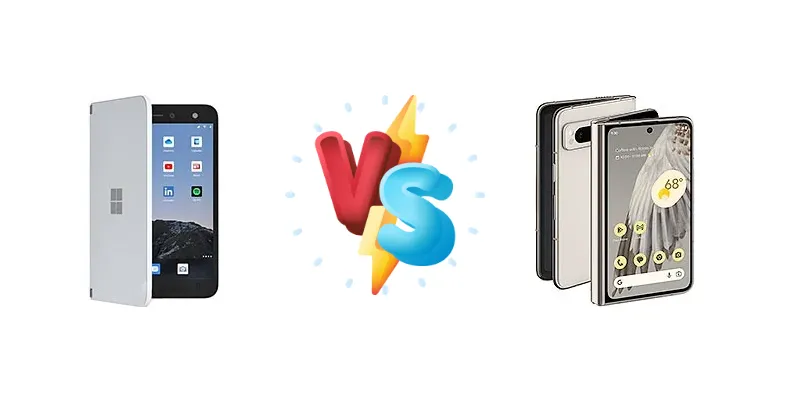
Surface Duo vs. Pixel Fold: A Deep Dive into Microsoft's Original vs. Google's Refinement
| Phones Images | |||||
|---|---|---|---|---|---|
|
🏆 Quick Verdict
For the average user, the Google Pixel Fold is the superior choice. While the Surface Duo offered a novel approach, the Pixel Fold’s modern Tensor G2 chipset, improved camera system, and more refined software experience outweigh the Duo’s unique dual-screen form factor. The Duo remains a niche option for productivity enthusiasts.
| PHONES | ||
|---|---|---|
| Phone Names | Microsoft Surface Duo | Google Pixel Fold |
| Network | ||
|---|---|---|
| 2G bands | GSM 850 / 900 / 1800 / 1900 | GSM 850 / 900 / 1800 / 1900 |
| 3G bands | HSDPA 850 / 900 / 1900 / 2100 | HSDPA 800 / 850 / 900 / 1700(AWS) / 1900 / 2100 |
| 4G bands | 1, 2, 3, 4, 5, 7, 8, 12, 13, 14, 19 20, 25, 26, 28, 29, 30, 38, 39, 40, 41, 46, 66 | 1, 2, 3, 4, 5, 7, 8, 12, 13, 14, 17, 18, 19, 20, 21, 25, 26, 28, 29, 30, 32, 38, 39, 40, 41, 42, 46, 48, 66, 71 |
| 5G bands | - | 1, 2, 3, 5, 7, 8, 12, 14, 20, 25, 28, 30, 38, 40, 41, 48, 66, 71, 75, 76, 77, 78, 79, 257, 258, 260, 261 SA/NSA/Sub6/mmWave |
| Speed | HSPA 42.2/5.76 Mbps, LTE Cat18 1200/150 Mbps | HSPA, LTE, 5G |
| Technology | GSM / HSPA / LTE | GSM / CDMA / HSPA / EVDO / LTE / 5G |
| - | CDMA2000 1xEV-DO | |
| Launch | ||
|---|---|---|
| Announced | 2020, August 12. Released 2020, September 10 | 2023, May 10 |
| Status | Discontinued | Available. Released 2023, June 27 |
| Body | ||
|---|---|---|
| Build | Glass front (Gorilla Glass 5), glass back (Gorilla Glass 5) | Glass front (Gorilla Glass Victus) (folded), plastic front (unfolded), glass back (Gorilla Glass Victus), aluminum frame |
| Dimensions | Unfolded: 186.9 x 145.2 x 4.8 mm Folded: 145.2 x 93.3 x 9.9 mm | Unfolded: 139.7 x 158.7 x 5.8 mmFolded: 139.7 x 79.5 x 12.1 mm |
| SIM | Nano-SIM + eSIM | Nano-SIM + eSIM |
| Weight | 250 g (8.82 oz) | 283 g (9.98 oz) |
| Stylus support | IPX8 water resistant | |
| Display | ||
|---|---|---|
| Protection | Corning Gorilla Glass 5 | - |
| Resolution | 1800 x 2700 pixels, 3:2 ratio (~401 ppi density) | 1840 x 2208 pixels (~378 ppi density) |
| Size | 8.1 inches, 195.4 cm2 (~144.2% screen-to-body ratio) | 7.6 inches, 183.3 cm2 (~82.7% screen-to-body ratio) |
| Type | AMOLED | Foldable OLED, 120Hz, HDR10+, 1000 nits (HBM), 1450 nits (peak) |
| Folded position display: 5.6 inches, AMOLED, 1350 x 1800 pixels (4:3) | Cover display: OLED, 120Hz, HDR, Corning Gorilla Glass Victus 5.8 inches, 1080 x 2092 pixels, 17.4:9 ratio, 408 ppi 1200 nits (HBM), 1550 nits (peak) | |
| Platform | ||
|---|---|---|
| CPU | Octa-core (1x2.84 GHz Kryo 485 & 3x2.42 GHz Kryo 485 & 4x1.78 GHz Kryo 485) | Octa-core (2x2.85 GHz Cortex-X1 & 2x2.35 GHz Cortex-A78 & 4x1.80 GHz Cortex-A55) |
| Chipset | Qualcomm SM8150 Snapdragon 855 (7 nm) | Google Tensor G2 (5 nm) |
| GPU | Adreno 640 | Mali-G710 MP7 |
| OS | Android 10, upgradable to Android 12 | Android 13, upgradable to Android 15, up to 5 major Android upgrades |
| Memory | ||
|---|---|---|
| Card slot | No | No |
| Internal | 128GB 6GB RAM, 256GB 6GB RAM | 256GB 12GB RAM, 512GB 12GB RAM |
| UFS 3.0 | UFS 3.1 | |
| Main Camera | ||
|---|---|---|
| Features | HDR, panorama | Laser AF, Dual-LED flash, HDR, panorama |
| Single | 11 MP, f/2.0, 23mm (wide), 1.0µm, PDAF | - |
| Triple | - | 48 MP, f/1.7, 25mm (wide), 1/2.0", 0.8µm, dual pixel PDAF, OIS 10.8 MP, f/3.1, 112mm (telephoto), 1/3.1", 1.22µm, dual pixel PDAF, OIS, 5x optical zoom 10.8 MP, f/2.2, 121˚, (ultrawide), 1/3.0", 1.25µm |
| Video | 4K@30/60fps, 1080p@30/60/120/240fps, gyro-EIS, HDR | 4K@30/60fps, 1080p@30/60/120/240fps, 10-bit HDR |
| Selfie camera | ||
|---|---|---|
| Features | HDR, panorama | HDR, panorama |
| Single | Uses main camera | 8 MP, f/2.0, 24mm (wide), 1/4.0", 1.12µm Cover camera: 9.5 MP, f/2.2, 24mm (wide), 1.22µm, dual pixel PDAF |
| Video | 4K@30/60fps, 1080p@30/60fps, gyro-EIS, HDR | 4K@30/60fps, 1080p@30/60fps |
| Sound | ||
|---|---|---|
| 3.5mm jack | No | No |
| 35mm jack | No | No |
| Loudspeaker | Yes | Yes, with stereo speakers |
| Comms | ||
|---|---|---|
| Bluetooth | 5.0, A2DP, LE, aptX Adaptive | 5.2, A2DP, LE, aptX HD |
| NFC | No | Yes |
| Positioning | GPS | GPS, GLONASS, GALILEO, BDS |
| Radio | No | No |
| USB | USB Type-C 3.1 | USB Type-C 3.2, OTG |
| WLAN | Wi-Fi 802.11 a/b/g/n/ac, dual-band, Wi-Fi Direct | Wi-Fi 802.11 a/b/g/n/ac/6e, tri-band, Wi-Fi Direct |
| Features | ||
|---|---|---|
| Sensors | Fingerprint (side-mounted), dual accelerometer, dual gyro, proximity, dual compass | Fingerprint (side-mounted), accelerometer, gyro, proximity, compass, barometer |
| - | Ultra Wideband (UWB) support | |
| Battery | ||
|---|---|---|
| Charging | 18W wired | Wired, PD3.0 Wireless |
| Type | Li-Po 3577 mAh | Li-Po 4821 mAh |
| Misc | ||
|---|---|---|
| Colors | White | Porcelain, Obsidian |
| Models | - | G9FPL |
| Price | About 650 EUR | € 670.87 / $ 389.26 / £ 899.99 |
Microsoft Surface Duo
- Unique dual-screen form factor for multitasking
- Lightweight and highly portable
- Pen support for note-taking and creative tasks
- Outdated Snapdragon 855 processor
- Subpar camera system
- Limited battery life
- Slow charging speeds
Google Pixel Fold
- Powerful Google Tensor G2 processor
- Versatile and high-quality camera system
- Fast wired and wireless charging
- Modern foldable design with a cover screen
- Higher price point
- Larger and heavier than the Surface Duo
- Foldable crease may be noticeable
Display Comparison
The Surface Duo features two 5.6-inch displays, creating a combined 10.8-inch experience, while the Pixel Fold boasts a 7.6-inch inner foldable display and a 5.8-inch cover screen. The Duo’s displays, while functional, lack the high refresh rates and LTPO technology found in modern foldable displays like the Pixel Fold’s. This means the Pixel Fold offers smoother scrolling and potentially better power efficiency. While specific nit brightness isn't provided for the Duo, the Pixel Fold benefits from Google’s display calibration expertise, promising more accurate colors and better outdoor visibility.
Camera Comparison
The Surface Duo’s camera system is a known weakness, lacking the sophistication of modern smartphone cameras. The Pixel Fold, leveraging Google’s computational photography prowess, offers a significantly more capable camera system. While specific sensor details aren’t provided for the Duo, it’s safe to assume the Pixel Fold’s sensors are larger and more advanced. The Tensor G2’s image signal processor (ISP) excels at image processing, delivering excellent dynamic range, accurate colors, and impressive low-light performance. The Pixel Fold’s camera is a clear advantage for photography enthusiasts.
Performance
The core difference lies in the chipsets. The Surface Duo utilizes the Qualcomm Snapdragon 855 (7nm), a flagship processor from 2019. While capable, it’s significantly outmatched by the Google Pixel Fold’s Google Tensor G2 (5nm). The Tensor G2’s 5nm process offers superior power efficiency and thermal performance, allowing for sustained performance during demanding tasks. The Tensor G2’s CPU architecture – featuring Cortex-X1 cores – provides a noticeable performance uplift over the Kryo 485 cores in the Snapdragon 855. This translates to faster app loading times, smoother multitasking, and a more responsive overall experience on the Pixel Fold.
Battery Life
The Surface Duo’s 3570 mAh battery, coupled with the less efficient Snapdragon 855, struggles to deliver all-day battery life, especially with heavy use. The Pixel Fold’s battery capacity isn’t specified, but the more efficient Tensor G2 chipset and optimized software contribute to better battery management. Furthermore, the Pixel Fold supports both wired PD3.0 and wireless charging, offering greater convenience compared to the Surface Duo’s 18W wired charging only. The faster charging speeds on the Pixel Fold minimize downtime.
Buying Guide
Buy the Microsoft Surface Duo if you prioritize a lightweight, highly portable dual-screen experience focused on multitasking with traditional Android apps and appreciate a unique, pen-friendly form factor. Buy the Google Pixel Fold if you prefer a more conventional foldable design with a powerful processor, a versatile camera system, and Google’s signature software features, including AI-powered enhancements and long-term software support.