
Surface Duo vs. Pixel 6 Pro: A Deep Dive into Two Very Different Flagships
| Phones Images | |||||
|---|---|---|---|---|---|
|
🏆 Quick Verdict
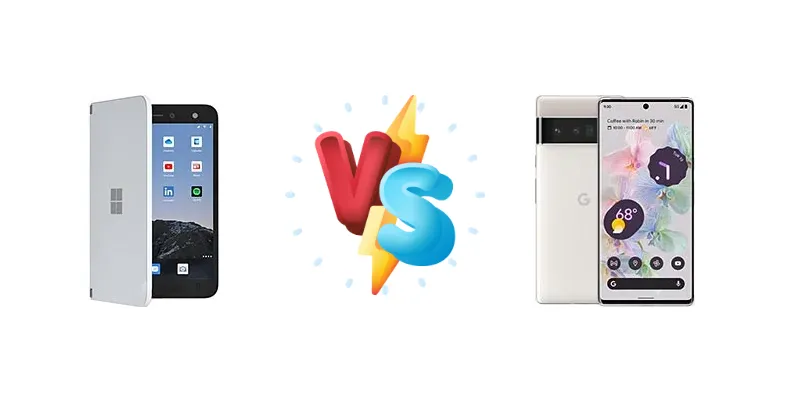
For the average user prioritizing camera quality, long-term software support, and raw processing power, the Google Pixel 6 Pro is the clear winner. However, the Surface Duo’s innovative dual-screen design provides a compelling alternative for those seeking enhanced multitasking and a distinct mobile experience.
| PHONES | ||
|---|---|---|
| Phone Names | Microsoft Surface Duo | Google Pixel 6 Pro |
| Network | ||
|---|---|---|
| 2G bands | GSM 850 / 900 / 1800 / 1900 | GSM 850 / 900 / 1800 / 1900 |
| 3G bands | HSDPA 850 / 900 / 1900 / 2100 | HSDPA 800 / 850 / 900 / 1700(AWS) / 1900 / 2100 |
| 4G bands | 1, 2, 3, 4, 5, 7, 8, 12, 13, 14, 19 20, 25, 26, 28, 29, 30, 38, 39, 40, 41, 46, 66 | 1, 2, 3, 4, 5, 7, 8, 12, 13, 14, 17, 18, 19, 20, 25, 26, 28, 29, 30, 32, 38, 39, 40, 41, 42, 46, 48, 66, 71 - GLUOG, G8VOU |
| 5G bands | - | 1, 2, 3, 5, 7, 8, 12, 14, 20, 25, 28, 30, 38, 40, 41, 48, 66, 71, 77, 78, 257, 258, 260, 261 SA/NSA/Sub6/mmWave - G8VOU |
| Speed | HSPA 42.2/5.76 Mbps, LTE Cat18 1200/150 Mbps | HSPA, LTE, 5G |
| Technology | GSM / HSPA / LTE | GSM / CDMA / HSPA / EVDO / LTE / 5G |
| - | 1, 2, 3, 5, 7, 8, 12, 14, 20, 25, 28, 30, 38, 40, 41, 48, 66, 71, 77, 78 SA/NSA/Sub6 - GLUOG | |
| Launch | ||
|---|---|---|
| Announced | 2020, August 12. Released 2020, September 10 | 2021, October 19 |
| Status | Discontinued | Available. Released 2021, October 28 |
| Body | ||
|---|---|---|
| Build | Glass front (Gorilla Glass 5), glass back (Gorilla Glass 5) | Glass front (Gorilla Glass Victus), glass back (Gorilla Glass Victus), aluminum frame |
| Dimensions | Unfolded: 186.9 x 145.2 x 4.8 mm Folded: 145.2 x 93.3 x 9.9 mm | 163.9 x 75.9 x 8.9 mm (6.45 x 2.99 x 0.35 in) |
| SIM | Nano-SIM + eSIM | Nano-SIM + eSIM |
| Weight | 250 g (8.82 oz) | 210 g (7.41 oz) |
| Stylus support | IP68 dust/water resistant (up to 1.5m for 30 min) | |
| Display | ||
|---|---|---|
| Protection | Corning Gorilla Glass 5 | Corning Gorilla Glass Victus |
| Resolution | 1800 x 2700 pixels, 3:2 ratio (~401 ppi density) | 1440 x 3120 pixels, 19.5:9 ratio (~512 ppi density) |
| Size | 8.1 inches, 195.4 cm2 (~144.2% screen-to-body ratio) | 6.7 inches, 110.6 cm2 (~88.9% screen-to-body ratio) |
| Type | AMOLED | LTPO AMOLED, 120Hz, HDR10+ |
| Folded position display: 5.6 inches, AMOLED, 1350 x 1800 pixels (4:3) | Always-on display | |
| Platform | ||
|---|---|---|
| CPU | Octa-core (1x2.84 GHz Kryo 485 & 3x2.42 GHz Kryo 485 & 4x1.78 GHz Kryo 485) | Octa-core (2x2.80 GHz Cortex-X1 & 2x2.25 GHz Cortex-A76 & 4x1.80 GHz Cortex-A55) |
| Chipset | Qualcomm SM8150 Snapdragon 855 (7 nm) | Google Tensor (5 nm) |
| GPU | Adreno 640 | Mali-G78 MP20 |
| OS | Android 10, upgradable to Android 12 | Android 12, upgradable to Android 15, up to 5 major Android upgrades |
| Memory | ||
|---|---|---|
| Card slot | No | No |
| Internal | 128GB 6GB RAM, 256GB 6GB RAM | 128GB 12GB RAM, 256GB 12GB RAM, 512GB 12GB RAM |
| UFS 3.0 | UFS 3.1 | |
| Main Camera | ||
|---|---|---|
| Features | HDR, panorama | Laser AF, Dual-LED flash, Pixel Shift, Auto-HDR, panorama |
| Single | 11 MP, f/2.0, 23mm (wide), 1.0µm, PDAF | 11.1 MP, f/2.2, 20mm (ultrawide), 1.22µm |
| Triple | - | 50 MP, f/1.9, 25mm (wide), 1/1.31", 1.2µm, dual pixel PDAF, OIS 48 MP, f/3.5, 104mm (periscope telephoto), 1/2.0", 0.8µm, PDAF, OIS, 4x optical zoom 12 MP, f/2.2, 17mm, 114˚ (ultrawide), 1.25µm |
| Video | 4K@30/60fps, 1080p@30/60/120/240fps, gyro-EIS, HDR | 4K@30/60fps, 1080p@30/60/120/240fps; gyro-EIS, OIS |
| Selfie camera | ||
|---|---|---|
| Features | HDR, panorama | HDR, panorama |
| Single | Uses main camera | 11.1 MP, f/2.2, 20mm (ultrawide), 1.22µm |
| Video | 4K@30/60fps, 1080p@30/60fps, gyro-EIS, HDR | 4K@30fps, 1080p@30/60fps |
| Sound | ||
|---|---|---|
| 3.5mm jack | No | No |
| 35mm jack | No | No |
| Loudspeaker | Yes | Yes, with stereo speakers |
| Comms | ||
|---|---|---|
| Bluetooth | 5.0, A2DP, LE, aptX Adaptive | 5.2, A2DP, LE, aptX HD |
| NFC | No | Yes |
| Positioning | GPS | GPS (L1+L5), GLONASS (G1), BDS (B1I+B1c+B2a), GALILEO (E1+E5a), QZSS (L1+L5) |
| Radio | No | No |
| USB | USB Type-C 3.1 | USB Type-C 3.1 |
| WLAN | Wi-Fi 802.11 a/b/g/n/ac, dual-band, Wi-Fi Direct | Wi-Fi 802.11 a/b/g/n/ac/6e, dual-band, Wi-Fi Direct |
| Features | ||
|---|---|---|
| Sensors | Fingerprint (side-mounted), dual accelerometer, dual gyro, proximity, dual compass | Fingerprint (under display, optical), accelerometer, gyro, proximity, compass, barometer |
| - | Ultra Wideband (UWB) support | |
| Battery | ||
|---|---|---|
| Charging | 18W wired | 23W wired, PD3.0, 50% in 30 min 23W wireless Reverse wireless |
| Type | Li-Po 3577 mAh | Li-Ion 5003 mAh |
| Misc | ||
|---|---|---|
| Colors | White | Cloudy White, Sorta Sunny, Stormy Black |
| Models | - | GLUOG, G8VOU, GF5KQ |
| Price | About 650 EUR | € 199.99 / $ 204.99 / £ 275.00 / ₹ 29,699 |
| Tests | ||
|---|---|---|
| Battery life | - | Endurance rating 84h |
| Display | - | Contrast ratio: Infinite (nominal) |
| Performance | - | AnTuTu: 585485 (v8), 719815 (v9) GeekBench: 2831 (v5.1) GFXBench: 39 fps (ES 3.1 onscreen) |
Microsoft Surface Duo
- Unique dual-screen form factor for multitasking
- Compact and portable design when folded
- Excellent for reading and note-taking
- Outdated Snapdragon 855 chipset
- Slower charging speeds
- Less advanced camera system
Google Pixel 6 Pro
- Powerful Google Tensor chip
- Exceptional camera performance
- Fast charging and wireless charging
- Larger and heavier design
- Less unique form factor
- Software updates may be less frequent than some competitors
Display Comparison
The Pixel 6 Pro boasts a significantly brighter display, reaching 846 nits measured, compared to the Surface Duo’s unspecified peak brightness. While the Duo’s dual 5.6-inch displays offer a combined larger canvas, the Pixel 6 Pro’s 6.7-inch LTPO AMOLED panel delivers a smoother 120Hz refresh rate and an infinite contrast ratio. The Duo’s display technology, while functional, feels dated in comparison, and the gap between the two screens can be distracting. The Pixel 6 Pro’s larger single screen is more immersive for media consumption.
Camera Comparison
The Pixel 6 Pro’s camera system is a clear standout. While specific sensor sizes aren’t provided, Google’s computational photography prowess, powered by the Tensor chip, delivers exceptional image quality, particularly in low-light conditions. The Pixel 6 Pro’s image processing excels in dynamic range and detail preservation. The Surface Duo’s camera, while adequate, lacks the advanced features and image quality of the Pixel 6 Pro. Ignoring the Duo’s less impactful secondary cameras, the primary sensor simply cannot compete with Google’s flagship.
Performance
The Google Pixel 6 Pro’s Google Tensor chip, fabricated on a 5nm process, represents a substantial leap in performance and efficiency over the Surface Duo’s Qualcomm Snapdragon 855 (7nm). The Tensor’s octa-core CPU, featuring Cortex-X1 cores, provides faster processing speeds for demanding tasks like video editing and AI-powered features. While the Snapdragon 855 remains capable, it will struggle with the latest graphically intensive games and applications compared to the Pixel 6 Pro. The Pixel 6 Pro’s architecture also benefits from more modern memory standards, likely LPDDR5, further enhancing performance.
Battery Life
Both devices achieve an endurance rating of 84 hours, suggesting similar overall battery life despite differing capacities. However, the Pixel 6 Pro’s 23W wired charging, with a 50% charge in 30 minutes and PD3.0 support, is significantly faster than the Surface Duo’s 18W wired charging. Furthermore, the Pixel 6 Pro adds 23W wireless charging and reverse wireless charging, features absent on the Surface Duo. This faster charging and wireless capabilities give the Pixel 6 Pro a practical advantage for users who need to quickly top up their battery.
Buying Guide
Buy the Microsoft Surface Duo if you prioritize a truly unique form factor for enhanced multitasking, reading, and note-taking, and are comfortable with a slightly older chipset. Buy the Google Pixel 6 Pro if you demand a top-tier camera system, the latest Android features powered by the Tensor chip, and a more conventional, yet refined, smartphone experience with faster charging and longer software support.