
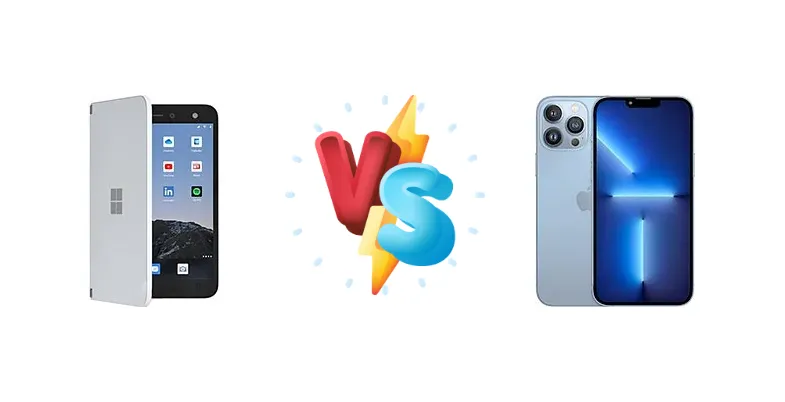
Surface Duo vs. iPhone 13 Pro Max: A Clash of Concepts
| Phones Images | |||||
|---|---|---|---|---|---|
|
🏆 Quick Verdict
For the average user prioritizing a polished experience, exceptional camera performance, and long-term software support, the iPhone 13 Pro Max is the clear winner. However, the Surface Duo offers a unique, albeit imperfect, multitasking experience that may appeal to power users seeking a different mobile workflow.
| PHONES | ||
|---|---|---|
| Phone Names | Microsoft Surface Duo | Apple iPhone 13 Pro Max |
| Network | ||
|---|---|---|
| 2G bands | GSM 850 / 900 / 1800 / 1900 | GSM 850 / 900 / 1800 / 1900 |
| 3G bands | HSDPA 850 / 900 / 1900 / 2100 | HSDPA 850 / 900 / 1700(AWS) / 1900 / 2100 |
| 4G bands | 1, 2, 3, 4, 5, 7, 8, 12, 13, 14, 19 20, 25, 26, 28, 29, 30, 38, 39, 40, 41, 46, 66 | 1, 2, 3, 4, 5, 7, 8, 12, 13, 17, 18, 19, 20, 25, 26, 28, 30, 32, 34, 38, 39, 40, 41, 42, 46, 48, 66 - A2643, A2644, A2645 |
| 5G bands | - | 1, 2, 3, 5, 7, 8, 12, 20, 25, 28, 30, 38, 40, 41, 48, 66, 77, 78, 79 SA/NSA/Sub6 - A2643, A2644 |
| Speed | HSPA 42.2/5.76 Mbps, LTE Cat18 1200/150 Mbps | HSPA, LTE, 5G, EV-DO Rev.A 3.1 Mbps |
| Technology | GSM / HSPA / LTE | GSM / CDMA / HSPA / EVDO / LTE / 5G |
| - | 1, 2, 3, 5, 7, 8, 12, 20, 25, 28, 29, 30, 38, 40, 41, 48, 66, 71, 77, 78, 79 SA/NSA/Sub6 - A2641 | |
| Launch | ||
|---|---|---|
| Announced | 2020, August 12. Released 2020, September 10 | 2021, September 14 |
| Status | Discontinued | Available. Released 2021, September 24 |
| Body | ||
|---|---|---|
| Build | Glass front (Gorilla Glass 5), glass back (Gorilla Glass 5) | Glass front, glass back, stainless steel frame |
| Dimensions | Unfolded: 186.9 x 145.2 x 4.8 mm Folded: 145.2 x 93.3 x 9.9 mm | 160.8 x 78.1 x 7.7 mm (6.33 x 3.07 x 0.30 in) |
| SIM | Nano-SIM + eSIM | · Nano-SIM + eSIM· Nano-SIM + Nano-SIM |
| Weight | 250 g (8.82 oz) | 240 g (8.47 oz) |
| Stylus support | IP68 dust/water resistant (up to 6m for 30 min) Apple Pay (Visa, MasterCard, AMEX certified) | |
| Display | ||
|---|---|---|
| Protection | Corning Gorilla Glass 5 | Ceramic Shield glass |
| Resolution | 1800 x 2700 pixels, 3:2 ratio (~401 ppi density) | 1284 x 2778 pixels, 19.5:9 ratio (~458 ppi density) |
| Size | 8.1 inches, 195.4 cm2 (~144.2% screen-to-body ratio) | 6.7 inches, 109.8 cm2 (~87.4% screen-to-body ratio) |
| Type | AMOLED | Super Retina XDR OLED, 120Hz, HDR10, Dolby Vision, 1000 nits (HBM), 1200 nits (peak) |
| Folded position display: 5.6 inches, AMOLED, 1350 x 1800 pixels (4:3) | - | |
| Platform | ||
|---|---|---|
| CPU | Octa-core (1x2.84 GHz Kryo 485 & 3x2.42 GHz Kryo 485 & 4x1.78 GHz Kryo 485) | Hexa-core (2x3.23 GHz Avalanche + 4x1.82 GHz Blizzard) |
| Chipset | Qualcomm SM8150 Snapdragon 855 (7 nm) | Apple A15 Bionic (5 nm) |
| GPU | Adreno 640 | Apple GPU (5-core graphics) |
| OS | Android 10, upgradable to Android 12 | iOS 15, upgradable to iOS 26.1 |
| Memory | ||
|---|---|---|
| Card slot | No | No |
| Internal | 128GB 6GB RAM, 256GB 6GB RAM | 128GB 6GB RAM, 256GB 6GB RAM, 512GB 6GB RAM, 1TB 6GB RAM |
| UFS 3.0 | NVMe | |
| Main Camera | ||
|---|---|---|
| Features | HDR, panorama | Dual-LED dual-tone flash, HDR (photo/panorama) |
| Single | 11 MP, f/2.0, 23mm (wide), 1.0µm, PDAF | 12 MP, f/2.2, 23mm (wide), 1/3.6" SL 3D, (depth/biometrics sensor) |
| Triple | - | 12 MP, f/1.5, 26mm (wide), 1/1.7", 1.9µm, dual pixel PDAF, sensor-shift OIS 12 MP, f/2.8, 77mm (telephoto), PDAF, 1/3.4", 1.0µm, OIS, 3x optical zoom 12 MP, f/1.8, 13mm, 120˚ (ultrawide), 1/3.4", 1.0µm, PDAF TOF 3D LiDAR scanner (depth) |
| Video | 4K@30/60fps, 1080p@30/60/120/240fps, gyro-EIS, HDR | 4K@24/25/30/60fps, 1080p@25/30/60/120/240fps, 10-bit HDR, Dolby Vision HDR (up to 60fps), ProRes, stereo sound rec. |
| Selfie camera | ||
|---|---|---|
| Features | HDR, panorama | HDR |
| Single | Uses main camera | 12 MP, f/2.2, 23mm (wide), 1/3.6", 1.0µm SL 3D, (depth/biometrics sensor) |
| Video | 4K@30/60fps, 1080p@30/60fps, gyro-EIS, HDR | 4K@24/25/30/60fps, 1080p@25/30/60/120fps, gyro-EIS |
| Sound | ||
|---|---|---|
| 3.5mm jack | No | No |
| 35mm jack | No | No |
| Loudspeaker | Yes | Yes, with stereo speakers |
| Comms | ||
|---|---|---|
| Bluetooth | 5.0, A2DP, LE, aptX Adaptive | 5.0, A2DP, LE |
| NFC | No | Yes |
| Positioning | GPS | GPS, GLONASS, GALILEO, BDS, QZSS |
| Radio | No | No |
| USB | USB Type-C 3.1 | Lightning, USB 2.0 |
| WLAN | Wi-Fi 802.11 a/b/g/n/ac, dual-band, Wi-Fi Direct | Wi-Fi 802.11 a/b/g/n/ac/6, dual-band, hotspot |
| Features | ||
|---|---|---|
| Sensors | Fingerprint (side-mounted), dual accelerometer, dual gyro, proximity, dual compass | Face ID, accelerometer, gyro, proximity, compass, barometer |
| - | Ultra Wideband (UWB) support | |
| Battery | ||
|---|---|---|
| Charging | 18W wired | Wired, PD2.0, 50% in 30 min 15W wireless (MagSafe) 15W wireless (Qi2) - requires iOS 17.2 update |
| Type | Li-Po 3577 mAh | Li-Ion 4352 mAh (16.75 Wh) |
| Misc | ||
|---|---|---|
| Colors | White | Graphite, Gold, Silver, Sierra Blue, Alpine Green |
| Models | - | A2643, A2484, A2641, A2644, A2645, iphone14,3 |
| Price | About 650 EUR | € 423.38 / $ 394.86 / £ 355.00 |
| SAR | - | 1.18 W/kg (head) 1.20 W/kg (body) |
| SAR EU | - | 0.99 W/kg (head) 0.98 W/kg (body) |
| Tests | ||
|---|---|---|
| Battery life | - | Endurance rating 121h |
| Camera | - | Photo / Video |
| Display | - | Contrast ratio: Infinite (nominal) |
| Loudspeaker | - | -24.0 LUFS (Very good) |
| Performance | - | AnTuTu: 801691 (v9) GeekBench: 4706 (v5.1) GFXBench: 60fps (ES 3.1 onscreen) |
Microsoft Surface Duo
- Unique dual-screen multitasking experience
- Compact and portable when folded
- Versatile form factor for reading and note-taking
- Outdated Snapdragon 855 processor
- Lower display brightness and color accuracy
- Less refined software experience
Apple iPhone 13 Pro Max
- Exceptional performance with the A15 Bionic chip
- Class-leading camera system
- Long-term software support and ecosystem integration
- Higher price point
- Larger and heavier than the Surface Duo
- Traditional smartphone form factor
Display Comparison
The iPhone 13 Pro Max boasts a single, 6.7-inch display capable of reaching a measured peak brightness of 1050 nits, ensuring excellent visibility even in direct sunlight. In contrast, the Surface Duo features two 5.6-inch displays, totaling 11.3 inches of screen real estate when unfolded. While the Duo offers more overall screen area, the individual panels lack the brightness and color accuracy of the iPhone’s Super Retina XDR display. The iPhone’s infinite (nominal) contrast ratio further enhances visual fidelity, a feature absent in the Surface Duo’s display technology. The Duo’s hinge mechanism, while innovative, introduces a visible crease where the two screens meet, impacting the viewing experience.
Camera Comparison
The iPhone 13 Pro Max excels in both photo and video capture, leveraging its advanced image processing and larger sensor sizes. While specific sensor details for the Surface Duo are not provided, its camera system is generally considered less capable than the iPhone’s. The iPhone’s sophisticated computational photography features, such as Cinematic mode and Photographic Styles, provide users with greater creative control. The iPhone’s optical image stabilization (OIS) ensures sharper images and smoother videos, particularly in low-light conditions. The Surface Duo’s dual-screen design allows for unique camera use cases, such as using one screen as a viewfinder and the other as a preview, but the underlying camera hardware is a limiting factor.
Performance
The Apple A15 Bionic chip, fabricated on a 5nm process, significantly outperforms the Qualcomm Snapdragon 855 (7nm) found in the Surface Duo. The A15’s hexa-core CPU, with its 3.23 GHz Avalanche cores, delivers substantially faster processing speeds for demanding tasks. While the Snapdragon 855 was a flagship processor in its time, it’s now several generations behind, resulting in noticeable performance differences in app loading times, multitasking, and graphically intensive games. The iPhone 13 Pro Max benefits from faster LPDDR5 RAM, contributing to smoother overall performance. The Surface Duo’s thermal management is also a concern, as the Snapdragon 855 is prone to throttling under sustained load.
Battery Life
Both devices achieve an impressive endurance rating of 121 hours, suggesting comparable battery life under similar usage scenarios. However, the iPhone 13 Pro Max benefits from faster charging capabilities, reaching 50% charge in just 30 minutes with a compatible PD2.0 charger. The Surface Duo is limited to 18W wired charging, resulting in significantly slower charging times. The iPhone also supports 15W wireless charging via MagSafe and Qi2 (with iOS 17.2), offering convenient charging options not available on the Surface Duo.
Buying Guide
Buy the Microsoft Surface Duo if you prioritize multitasking on a larger canvas, value the flexibility of a dual-screen experience for reading and note-taking, and are comfortable with a less refined software experience. Buy the Apple iPhone 13 Pro Max if you demand top-tier performance, a class-leading camera system, seamless ecosystem integration, and guaranteed software updates for years to come.