
Surface Duo 2 vs. Xiaomi Mi 11 Ultra: A Clash of Innovation and Imaging
| Phones Images | |||||
|---|---|---|---|---|---|
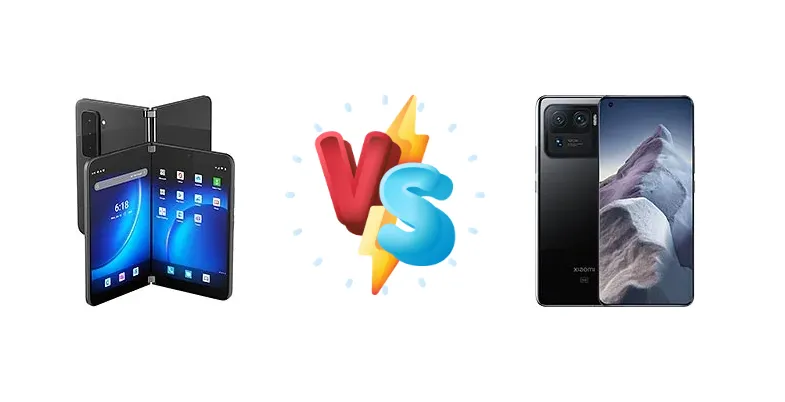
|
🏆 Quick Verdict
For the average user prioritizing camera capabilities and rapid charging, the Xiaomi Mi 11 Ultra emerges as the stronger choice. Its 95-hour endurance rating and 67W wired/wireless charging significantly outperform the Surface Duo 2. However, the Duo 2’s unique dual-screen experience is unmatched for multitasking and productivity.
| PHONES | ||
|---|---|---|
| Phone Names | Microsoft Surface Duo 2 | Xiaomi Mi 11 Ultra |
| Network | ||
|---|---|---|
| 2G bands | GSM 850 / 900 / 1800 / 1900 | GSM 850 / 900 / 1800 / 1900 |
| 3G bands | HSDPA 850 / 900 / 1900 / 2100 | HSDPA 850 / 900 / 1700(AWS) / 1900 / 2100 |
| 4G bands | 1, 2, 3, 4, 5, 7, 8, 12, 13, 14, 19, 20, 25, 26, 28, 29, 30, 38, 39, 40, 41, 42, 46, 48, 66, 71 | 1, 2, 3, 4, 5, 7, 8, 12, 17, 20, 28, 32, 38, 40, 41, 42, 66 - International |
| 5G bands | 1, 2, 3, 5, 7, 20, 25, 28, 38, 41, 66, 71, 77, 78, 79 SA/NSA/Sub6 - International | 1, 3, 5, 7, 8, 20, 28, 38, 40, 41, 77, 78, 79 SA/NSA - International |
| Speed | HSPA 42.2/5.76 Mbps, LTE (5CA) Cat20 2000/150 Mbps, 5G 6 Gbps DL | HSPA, LTE, 5G |
| Technology | GSM / HSPA / LTE / 5G | GSM / CDMA / HSPA / EVDO / LTE / 5G |
| 1, 2, 3, 5, 7, 20, 25, 28, 38, 41, 66, 71, 77, 78, 79, 257, 260, 261 SA/NSA/Sub6/mmWave - USA | 1, 3, 28, 41, 77, 78, 79 SA/NSA - China | |
| Launch | ||
|---|---|---|
| Announced | 2021, September 22. Released 2021, October 21 | 2021, March 29 |
| Status | Discontinued | Available. Released 2021, April 02 |
| Body | ||
|---|---|---|
| Build | Glass front (Gorilla Glass Victus), glass back (Gorilla Glass) | Glass front (Gorilla Glass Victus), ceramic back, aluminum frame |
| Dimensions | Unfolded: 184.5 x 145.2 x 5.5 mm Folded: 145.2 x 92.1 x 11 mm | 164.3 x 74.6 x 8.4 mm (6.47 x 2.94 x 0.33 in) |
| SIM | Nano-SIM + eSIM | Nano-SIM + Nano-SIM |
| Weight | 284 g (10.02 oz) | 234 g (8.25 oz) |
| Stylus support | IP68 dust/water resistant (up to 1.5m for 30 min) | |
| Display | ||
|---|---|---|
| Protection | Corning Gorilla Glass Victus | Corning Gorilla Glass Victus |
| Resolution | 1892 x 2688 pixels (~401 ppi density) | 1440 x 3200 pixels, 20:9 ratio (~515 ppi density) |
| Size | 8.3 inches, 204.0 cm2 (~152.6% screen-to-body ratio) | 6.81 inches, 112.0 cm2 (~91.4% screen-to-body ratio) |
| Type | AMOLED, 90Hz, HDR, 800 nits (peak) | AMOLED, 1B colors, 120Hz, HDR10+, Dolby Vision, 900 nits (HBM), 1700 nits (peak) |
| Folded position display: 5.8 inches, AMOLED, 1344 x 1892 pixels (4:3) | - | |
| Platform | ||
|---|---|---|
| CPU | Octa-core (1x2.84 GHz Cortex-X1 & 3x2.42 GHz Cortex-A78 & 4x1.80 GHz Cortex-A55) | Octa-core (1x2.84 GHz Cortex-X1 & 3x2.42 GHz Cortex-A78 & 4x1.80 GHz Cortex-A55) |
| Chipset | Qualcomm SM8350 Snapdragon 888 5G (5 nm) | Qualcomm SM8350 Snapdragon 888 5G (5 nm) |
| GPU | Adreno 660 | Adreno 660 |
| OS | Android 11 | Android 11, upgradable to Android 13, MIUI 14 |
| Memory | ||
|---|---|---|
| Card slot | No | No |
| Internal | 128GB 8GB RAM, 256GB 8GB RAM, 512GB 8GB RAM | 256GB 8GB RAM, 256GB 12GB RAM, 512GB 12GB RAM |
| UFS | UFS 3.1 | |
| Main Camera | ||
|---|---|---|
| Features | Dual-LED dual-tone flash, HDR, panorama | Laser AF, color spectrum sensor, Dual-LED flash, HDR, panorama, 1.1” AMOLED selfie display |
| Single | 12 MP, f/2.0, 24mm (wide), 1.0µm | 20 MP, f/2.2, 27mm (wide), 1/3.4", 0.8µm |
| Triple | 12 MP, f/1.7, 27mm (wide), 1.4µm, dual pixel PDAF, OIS 12 MP, f/2.4, 51mm (telephoto), 1.0µm, PDAF, OIS, 2x optical zoom 16 MP, f/2.2, 13mm (ultrawide), 1.0µm TOF 3D, (depth) | 50 MP, f/2.0, 24mm (wide), 1/1.12", 1.4µm, dual pixel PDAF, OIS 48 MP, f/4.1, 120mm (periscope telephoto), 1/2.0", 0.8µm, PDAF, OIS, 5x optical zoom 48 MP, f/2.2, 12mm, 128˚ (ultrawide), 1/2.0", 0.8µm, PDAF |
| Video | 4K@30/60fps, 1080p@30/60/120/240fps, gyro-EIS, HDR | 8K@24fps, 4K@30/60fps, 1080p@30/60/120/240/960/1920fps, gyro-EIS, HDR10+ rec. |
| Selfie camera | ||
|---|---|---|
| Features | - | HDR, panorama |
| Single | 12 MP, f/2.0, 24mm (wide), 1.0µm | 20 MP, f/2.2, 27mm (wide), 1/3.4", 0.8µm |
| Video | 1080p@30fps | 1080p@30/60fps, 720p@120fps, gyro-EIS |
| Sound | ||
|---|---|---|
| 3.5mm jack | No | No |
| 35mm jack | No | No |
| Loudspeaker | Yes, with stereo speakers | Yes, with stereo speakers |
| - | 24-bit/192kHz audio Tuned by Harman Kardon | |
| Comms | ||
|---|---|---|
| Bluetooth | 5.1, A2DP, LE, aptX Adaptive | 5.2, A2DP, LE, aptX HD, aptX Adaptive |
| Infrared port | - | Yes |
| NFC | Yes | Yes |
| Positioning | GPS, GLONASS, GALILEO, QZSS, BDS | GPS (L1+L5), GLONASS (L1), BDS (B1I+B1c+B2a), GALILEO (E1+E5a), QZSS (L1+L5), NavIC (L5) |
| Radio | No | No |
| USB | USB Type-C 3.2, DisplayPort | USB Type-C 2.0, OTG |
| WLAN | Wi-Fi 802.11 a/b/g/n/ac/6, dual-band, Wi-Fi Direct | Wi-Fi 802.11 a/b/g/n/ac/6e, dual-band, Wi-Fi Direct, DLNA |
| Features | ||
|---|---|---|
| Sensors | Fingerprint (side-mounted), dual accelerometer, dual gyro, dual proximity, dual compass | Fingerprint (under display, optical), accelerometer, gyro, compass |
| - | Virtual proximity sensing | |
| Battery | ||
|---|---|---|
| Charging | 23W wired | 67W wired, PD3.0, QC4, 100% in 36 min 67W wireless, 100% in 39 min 10W reverse wireless |
| Type | Li-Po 4449 mAh | Li-Po 5000 mAh |
| Misc | ||
|---|---|---|
| Colors | Glacier, Obsidian | Ceramic White (Cosmic White), Ceramic Black (Cosmic Black) |
| Models | - | M2102K1G, M2102K1C |
| Price | About 1480 EUR | About 1500 EUR |
| SAR | - | 1.08 W/kg (head) 0.81 W/kg (body) |
| SAR EU | - | 0.55 W/kg (head) 0.99 W/kg (body) |
| Tests | ||
|---|---|---|
| Battery life | - | Endurance rating 95h |
| Camera | - | Photo / Video |
| Display | - | Contrast ratio: Infinite (nominal) |
| Loudspeaker | - | -24.3 LUFS (Very good) |
| Performance | - | AnTuTu: 688720 (v8) GeekBench: 3191 (v5.1) GFXBench: 33fps (ES 3.1 onscreen) |
Microsoft Surface Duo 2
- Unique dual-screen multitasking experience
- Highly portable and foldable design
- Premium build quality
- Slower charging speed (23W)
- Potentially limited battery life (data unavailable)
- Camera system not a primary strength
Xiaomi Mi 11 Ultra
- Exceptional camera performance
- Long battery life (95h endurance)
- Ultra-fast 67W wired and wireless charging
- Larger and heavier form factor
- More conventional smartphone design
- May lack the unique productivity features of the Duo 2
Display Comparison
Both devices utilize the Qualcomm Snapdragon 888 5G chipset, but their display philosophies diverge significantly. The Mi 11 Ultra boasts a measured peak brightness of 943 nits, ensuring excellent visibility outdoors. While the Surface Duo 2’s display specs aren’t provided, its dual-screen design inherently offers more screen real estate for multitasking. The Mi 11 Ultra’s ‘Infinite’ contrast ratio suggests a high-quality AMOLED panel, but the Duo 2’s flexible displays present unique challenges in terms of durability and crease visibility. The Duo 2’s screen is optimized for productivity, while the Mi 11 Ultra’s is geared towards immersive media consumption.
Camera Comparison
The Xiaomi Mi 11 Ultra is unequivocally the camera champion here. While both are listed as having 'Photo / Video' capabilities, the Mi 11 Ultra’s reputation centers around its exceptional imaging system. Details on sensor sizes and apertures are absent, but the Mi 11 Ultra is known for its large main sensor and advanced image processing. The Surface Duo 2’s camera system, while competent, is not positioned as a primary selling point. The Duo 2’s dual-screen form factor *can* be leveraged for unique camera experiences (using one screen as a viewfinder and the other for controls), but it doesn’t compensate for the Mi 11 Ultra’s hardware advantage.
Performance
Both the Surface Duo 2 and the Xiaomi Mi 11 Ultra are powered by the Qualcomm SM8350 Snapdragon 888 5G (5 nm) chipset, featuring an Octa-core CPU configuration (1x2.84 GHz Cortex-X1, 3x2.42 GHz Cortex-A78, 4x1.80 GHz Cortex-A55). This means raw processing power is largely equivalent. However, the Mi 11 Ultra’s superior thermal management, implied by its larger chassis and advanced cooling solutions (not specified in the data but typical for Xiaomi flagships), likely allows it to sustain peak performance for longer periods during demanding tasks. The Duo 2’s thinner profile may lead to more aggressive throttling under sustained load. RAM specifications are missing for both, but both would likely utilize LPDDR5 for fast memory access.
Battery Life
The Xiaomi Mi 11 Ultra’s 95-hour endurance rating is a significant advantage over the Surface Duo 2, which lacks battery life data. This endurance is further bolstered by its incredibly fast charging capabilities: 67W wired (100% in 36 minutes), 67W wireless (100% in 39 minutes), and 10W reverse wireless charging. The Surface Duo 2’s 23W wired charging is comparatively slow. The Mi 11 Ultra’s charging speed is a game-changer for users who frequently need to top up their battery, while the Duo 2 requires more planning around charging cycles.
Buying Guide
Buy the Microsoft Surface Duo 2 if you need a truly portable workstation, value multitasking above all else, and are willing to compromise on camera performance and battery life. Buy the Xiaomi Mi 11 Ultra if you prioritize exceptional camera quality, long battery life, incredibly fast charging, and a more conventional smartphone experience.