
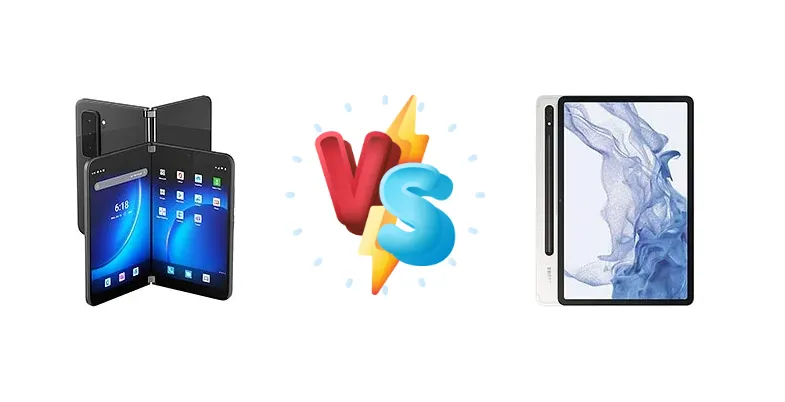
Microsoft Surface Duo 2 vs Samsung Galaxy Tab S8: The Ultimate Showdown
| Phones Images | |||||
|---|---|---|---|---|---|
|
🏆 Quick Verdict
The Samsung Galaxy Tab S8 offers superior performance, a better display, and faster charging. However, the Surface Duo 2's unique dual-screen design and focus on productivity make it a compelling choice for those seeking a truly innovative experience. The Tab S8 is the overall winner for most users.
| PHONES | ||
|---|---|---|
| Phone Names | Microsoft Surface Duo 2 | Samsung Galaxy Tab S8 |
| Network | ||
|---|---|---|
| 2G bands | GSM 850 / 900 / 1800 / 1900 | GSM 850 / 900 / 1800 / 1900 |
| 3G bands | HSDPA 850 / 900 / 1900 / 2100 | HSDPA 850 / 900 / 1700(AWS) / 1900 / 2100 |
| 4G bands | 1, 2, 3, 4, 5, 7, 8, 12, 13, 14, 19, 20, 25, 26, 28, 29, 30, 38, 39, 40, 41, 42, 46, 48, 66, 71 | LTE |
| 5G bands | 1, 2, 3, 5, 7, 20, 25, 28, 38, 41, 66, 71, 77, 78, 79 SA/NSA/Sub6 - International | SA/NSA |
| Speed | HSPA 42.2/5.76 Mbps, LTE (5CA) Cat20 2000/150 Mbps, 5G 6 Gbps DL | HSPA, LTE, 5G - cellular model only |
| Technology | GSM / HSPA / LTE / 5G | GSM / HSPA / LTE / 5G |
| 1, 2, 3, 5, 7, 20, 25, 28, 38, 41, 66, 71, 77, 78, 79, 257, 260, 261 SA/NSA/Sub6/mmWave - USA | - | |
| Launch | ||
|---|---|---|
| Announced | 2021, September 22. Released 2021, October 21 | 2022, February 09 |
| Status | Discontinued | Available. Released 2022, March 22 |
| Body | ||
|---|---|---|
| Build | Glass front (Gorilla Glass Victus), glass back (Gorilla Glass) | - |
| Dimensions | Unfolded: 184.5 x 145.2 x 5.5 mm Folded: 145.2 x 92.1 x 11 mm | 253.8 x 165.3 x 6.3 mm (9.99 x 6.51 x 0.25 in) |
| SIM | Nano-SIM + eSIM | Nano-SIM (cellular model only) |
| Weight | 284 g (10.02 oz) | 503 g (Wi-Fi), 507 g (5G) (1.11 lb) |
| Stylus support | Stylus, 6.2ms latency (Bluetooth integration, accelerometer, gyro) | |
| Display | ||
|---|---|---|
| Protection | Corning Gorilla Glass Victus | Corning Gorilla Glass 5 |
| Resolution | 1892 x 2688 pixels (~401 ppi density) | 1600 x 2560 pixels, 16:10 ratio (~274 ppi density) |
| Size | 8.3 inches, 204.0 cm2 (~152.6% screen-to-body ratio) | 11.0 inches, 350.9 cm2 (~83.6% screen-to-body ratio) |
| Type | AMOLED, 90Hz, HDR, 800 nits (peak) | TFT LCD, 120Hz |
| Folded position display: 5.8 inches, AMOLED, 1344 x 1892 pixels (4:3) | - | |
| Platform | ||
|---|---|---|
| CPU | Octa-core (1x2.84 GHz Cortex-X1 & 3x2.42 GHz Cortex-A78 & 4x1.80 GHz Cortex-A55) | Octa-core (1x3.00 GHz Cortex-X2 & 3x2.50 GHz Cortex-A710 & 4x1.80 GHz Cortex-A510) |
| Chipset | Qualcomm SM8350 Snapdragon 888 5G (5 nm) | Qualcomm SM8450 Snapdragon 8 Gen 1 (4 nm) |
| GPU | Adreno 660 | Adreno 730 |
| OS | Android 11 | Android 12, up to 4 major Android upgrades, One UI 6.1.1 |
| Memory | ||
|---|---|---|
| Card slot | No | microSDXC (dedicated slot) |
| Internal | 128GB 8GB RAM, 256GB 8GB RAM, 512GB 8GB RAM | 128GB 8GB RAM, 256GB 8GB RAM, 256GB 12GB RAM |
| UFS | UFS | |
| Main Camera | ||
|---|---|---|
| Dual | - | 13 MP, f/2.0, 26mm (wide), 1/3.4", 1.0µm, AF 6 MP, f/2.2, (ultrawide) |
| Features | Dual-LED dual-tone flash, HDR, panorama | LED flash, HDR, panorama |
| Single | 12 MP, f/2.0, 24mm (wide), 1.0µm | - |
| Triple | 12 MP, f/1.7, 27mm (wide), 1.4µm, dual pixel PDAF, OIS 12 MP, f/2.4, 51mm (telephoto), 1.0µm, PDAF, OIS, 2x optical zoom 16 MP, f/2.2, 13mm (ultrawide), 1.0µm TOF 3D, (depth) | - |
| Video | 4K@30/60fps, 1080p@30/60/120/240fps, gyro-EIS, HDR | 4K@30/60fps, 1080p@30fps |
| Selfie camera | ||
|---|---|---|
| Dual | - | 12 MP, f/2.4, 120˚ (ultrawide) |
| Features | - | HDR |
| Single | 12 MP, f/2.0, 24mm (wide), 1.0µm | - |
| Video | 1080p@30fps | 4K@30/60fps, 1080p@30fps |
| Sound | ||
|---|---|---|
| 3.5mm jack | No | No |
| 35mm jack | No | No |
| Loudspeaker | Yes, with stereo speakers | Yes, with stereo speakers (4 speakers) |
| - | Tuned by AKG | |
| Comms | ||
|---|---|---|
| Bluetooth | 5.1, A2DP, LE, aptX Adaptive | 5.2, A2DP, LE |
| NFC | Yes | No |
| Positioning | GPS, GLONASS, GALILEO, QZSS, BDS | GPS, GLONASS, BDS, GALILEO - cellular model only |
| Radio | No | No |
| USB | USB Type-C 3.2, DisplayPort | USB Type-C 3.2, magnetic connector |
| WLAN | Wi-Fi 802.11 a/b/g/n/ac/6, dual-band, Wi-Fi Direct | Wi-Fi 802.11 a/b/g/n/ac/6e, dual-band, Wi-Fi Direct |
| Features | ||
|---|---|---|
| Sensors | Fingerprint (side-mounted), dual accelerometer, dual gyro, dual proximity, dual compass | Fingerprint (side-mounted), accelerometer, gyro, proximity, compass |
| - | Wireless Samsung DeX | |
| Battery | ||
|---|---|---|
| Charging | 23W wired | 45W wired, 100% in 80 min |
| Type | Li-Po 4449 mAh | Li-Po 8000 mAh |
| Misc | ||
|---|---|---|
| Colors | Glacier, Obsidian | Graphite, Silver, Pink Gold |
| Models | - | SM-X700, SM-X706, SM-X706B, SM-X706U, SM-X706N |
| Price | About 1480 EUR | About 350 EUR |
| SAR EU | - | 0.87 W/kg (body) |
Microsoft Surface Duo 2
- Unique dual-screen design
- Excellent for multitasking
- Seamless Microsoft ecosystem integration
- Compact and pocketable when folded
- Lower performance than Tab S8
- Basic camera system
- Slower charging
- Higher price point
Samsung Galaxy Tab S8
- Powerful Snapdragon 8 Gen 1 processor
- Stunning 120Hz display
- Versatile camera system
- Fast charging
- Excellent battery life
- Less innovative design
- Larger and heavier than Duo 2
- Pricey
Display Comparison
The Galaxy Tab S8 boasts an 11-inch LCD display with a 120Hz refresh rate, delivering vibrant colors and smooth visuals. The Surface Duo 2 features two 5.8-inch OLED displays, offering a unique foldable form factor. While the Duo 2's OLEDs are excellent, the Tab S8's larger size and higher refresh rate provide a more immersive and fluid experience for media consumption and gaming.
Camera Comparison
The Galaxy Tab S8 features a versatile triple-camera system, including a wide, ultrawide, and telephoto lens, providing excellent photo and video capabilities. The Surface Duo 2's camera setup is more basic, prioritizing convenience over image quality. The Tab S8 is the clear winner for photography enthusiasts.
Performance
The Galaxy Tab S8's Snapdragon 8 Gen 1 offers a noticeable performance edge over the Duo 2's Snapdragon 888. Apps launch faster, multitasking is smoother, and demanding games run with ease. The Duo 2 is still capable, but the Tab S8's raw power is undeniable.
Battery Life
The Galaxy Tab S8's larger battery and faster charging (45W) provide significantly better battery life and quicker top-ups compared to the Surface Duo 2 (23W). The Duo 2's battery life is adequate for moderate use, but the Tab S8 offers more peace of mind.
Buying Guide
Who should buy the Microsoft Surface Duo 2? Users prioritizing a unique dual-screen experience for multitasking and productivity, especially those deeply integrated into the Microsoft ecosystem. Who should buy the Samsung Galaxy Tab S8? Users seeking a powerful, versatile Android tablet with a stunning display, excellent performance, and a more traditional tablet experience.