
Microsoft Surface Duo 2 vs. Surface Duo: A Detailed Comparison
| Phones Images | |||||
|---|---|---|---|---|---|
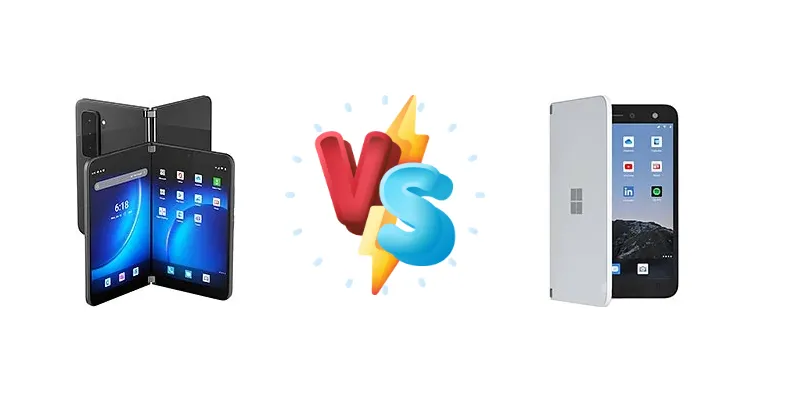
|
🏆 Quick Verdict
The Surface Duo 2 is the clear winner, boasting a significantly faster Snapdragon 888 processor, improved cameras, and faster charging. While the original Duo offered a novel form factor, the Duo 2's performance and refinements make it the superior choice for most users.
| PHONES | ||
|---|---|---|
| Phone Names | Microsoft Surface Duo 2 | Microsoft Surface Duo |
| Network | ||
|---|---|---|
| 2G bands | GSM 850 / 900 / 1800 / 1900 | GSM 850 / 900 / 1800 / 1900 |
| 3G bands | HSDPA 850 / 900 / 1900 / 2100 | HSDPA 850 / 900 / 1900 / 2100 |
| 4G bands | 1, 2, 3, 4, 5, 7, 8, 12, 13, 14, 19, 20, 25, 26, 28, 29, 30, 38, 39, 40, 41, 42, 46, 48, 66, 71 | 1, 2, 3, 4, 5, 7, 8, 12, 13, 14, 19 20, 25, 26, 28, 29, 30, 38, 39, 40, 41, 46, 66 |
| 5G bands | 1, 2, 3, 5, 7, 20, 25, 28, 38, 41, 66, 71, 77, 78, 79 SA/NSA/Sub6 - International | - |
| Speed | HSPA 42.2/5.76 Mbps, LTE (5CA) Cat20 2000/150 Mbps, 5G 6 Gbps DL | HSPA 42.2/5.76 Mbps, LTE Cat18 1200/150 Mbps |
| Technology | GSM / HSPA / LTE / 5G | GSM / HSPA / LTE |
| 1, 2, 3, 5, 7, 20, 25, 28, 38, 41, 66, 71, 77, 78, 79, 257, 260, 261 SA/NSA/Sub6/mmWave - USA | - | |
| Launch | ||
|---|---|---|
| Announced | 2021, September 22. Released 2021, October 21 | 2020, August 12. Released 2020, September 10 |
| Status | Discontinued | Discontinued |
| Body | ||
|---|---|---|
| Build | Glass front (Gorilla Glass Victus), glass back (Gorilla Glass) | Glass front (Gorilla Glass 5), glass back (Gorilla Glass 5) |
| Dimensions | Unfolded: 184.5 x 145.2 x 5.5 mm Folded: 145.2 x 92.1 x 11 mm | Unfolded: 186.9 x 145.2 x 4.8 mm Folded: 145.2 x 93.3 x 9.9 mm |
| SIM | Nano-SIM + eSIM | Nano-SIM + eSIM |
| Weight | 284 g (10.02 oz) | 250 g (8.82 oz) |
| Stylus support | Stylus support | |
| Display | ||
|---|---|---|
| Protection | Corning Gorilla Glass Victus | Corning Gorilla Glass 5 |
| Resolution | 1892 x 2688 pixels (~401 ppi density) | 1800 x 2700 pixels, 3:2 ratio (~401 ppi density) |
| Size | 8.3 inches, 204.0 cm2 (~152.6% screen-to-body ratio) | 8.1 inches, 195.4 cm2 (~144.2% screen-to-body ratio) |
| Type | AMOLED, 90Hz, HDR, 800 nits (peak) | AMOLED |
| Folded position display: 5.8 inches, AMOLED, 1344 x 1892 pixels (4:3) | Folded position display: 5.6 inches, AMOLED, 1350 x 1800 pixels (4:3) | |
| Platform | ||
|---|---|---|
| CPU | Octa-core (1x2.84 GHz Cortex-X1 & 3x2.42 GHz Cortex-A78 & 4x1.80 GHz Cortex-A55) | Octa-core (1x2.84 GHz Kryo 485 & 3x2.42 GHz Kryo 485 & 4x1.78 GHz Kryo 485) |
| Chipset | Qualcomm SM8350 Snapdragon 888 5G (5 nm) | Qualcomm SM8150 Snapdragon 855 (7 nm) |
| GPU | Adreno 660 | Adreno 640 |
| OS | Android 11 | Android 10, upgradable to Android 12 |
| Memory | ||
|---|---|---|
| Card slot | No | No |
| Internal | 128GB 8GB RAM, 256GB 8GB RAM, 512GB 8GB RAM | 128GB 6GB RAM, 256GB 6GB RAM |
| UFS | UFS 3.0 | |
| Main Camera | ||
|---|---|---|
| Features | Dual-LED dual-tone flash, HDR, panorama | HDR, panorama |
| Single | 12 MP, f/2.0, 24mm (wide), 1.0µm | 11 MP, f/2.0, 23mm (wide), 1.0µm, PDAF |
| Triple | 12 MP, f/1.7, 27mm (wide), 1.4µm, dual pixel PDAF, OIS 12 MP, f/2.4, 51mm (telephoto), 1.0µm, PDAF, OIS, 2x optical zoom 16 MP, f/2.2, 13mm (ultrawide), 1.0µm TOF 3D, (depth) | - |
| Video | 4K@30/60fps, 1080p@30/60/120/240fps, gyro-EIS, HDR | 4K@30/60fps, 1080p@30/60/120/240fps, gyro-EIS, HDR |
| Selfie camera | ||
|---|---|---|
| Features | - | HDR, panorama |
| Single | 12 MP, f/2.0, 24mm (wide), 1.0µm | Uses main camera |
| Video | 1080p@30fps | 4K@30/60fps, 1080p@30/60fps, gyro-EIS, HDR |
| Sound | ||
|---|---|---|
| 3.5mm jack | No | No |
| 35mm jack | No | No |
| Loudspeaker | Yes, with stereo speakers | Yes |
| Comms | ||
|---|---|---|
| Bluetooth | 5.1, A2DP, LE, aptX Adaptive | 5.0, A2DP, LE, aptX Adaptive |
| NFC | Yes | No |
| Positioning | GPS, GLONASS, GALILEO, QZSS, BDS | GPS |
| Radio | No | No |
| USB | USB Type-C 3.2, DisplayPort | USB Type-C 3.1 |
| WLAN | Wi-Fi 802.11 a/b/g/n/ac/6, dual-band, Wi-Fi Direct | Wi-Fi 802.11 a/b/g/n/ac, dual-band, Wi-Fi Direct |
| Features | ||
|---|---|---|
| Sensors | Fingerprint (side-mounted), dual accelerometer, dual gyro, dual proximity, dual compass | Fingerprint (side-mounted), dual accelerometer, dual gyro, proximity, dual compass |
| Battery | ||
|---|---|---|
| Charging | 23W wired | 18W wired |
| Type | Li-Po 4449 mAh | Li-Po 3577 mAh |
| Misc | ||
|---|---|---|
| Colors | Glacier, Obsidian | White |
| Price | About 1480 EUR | About 650 EUR |
Microsoft Surface Duo 2
- Significantly faster processor (Snapdragon 888)
- Improved camera system
- Faster charging (23W)
- Refined hinge mechanism
- Brighter and more vibrant display
- Higher price point
- Software still evolving for dual-screen usage
Microsoft Surface Duo
- Lower price point
- Unique dual-screen design
- Compact and pocketable
- Slower processor (Snapdragon 855)
- Subpar camera performance
- Slower charging (18W)
- Less vibrant display
Display Comparison
The Surface Duo 2 features a brighter and more vibrant display with improved color accuracy compared to the original Duo. Both devices utilize 5.8-inch PixelSense screens, but the Duo 2's panel offers a noticeable upgrade in viewing experience. The hinge mechanism on the Duo 2 also feels more refined and durable.
Camera Comparison
The Surface Duo 2 features an upgraded camera system with improved image quality, particularly in low-light conditions. While both devices share a similar camera setup (three 12MP lenses), the Duo 2's image processing algorithms are noticeably better. The original Duo's camera was a known weakness.
Performance
The Snapdragon 888 in the Surface Duo 2 provides a substantial performance boost over the Snapdragon 855 in the original Duo. Expect smoother multitasking, faster app loading times, and improved gaming performance on the Duo 2. The 5nm process of the 888 also contributes to better power efficiency.
Battery Life
While both devices offer all-day battery life for moderate usage, the Surface Duo 2's more efficient Snapdragon 888 chip contributes to slightly better battery performance. The faster 23W wired charging on the Duo 2 also reduces charging times.
Buying Guide
Who should buy the Microsoft Surface Duo 2? Productivity-focused users who value performance, multitasking, and a refined folding experience. Who should buy the Microsoft Surface Duo? Budget-conscious buyers who appreciate the unique dual-screen design and don't require top-tier performance, or those seeking a more affordable entry point into the folding phone world.