
Surface Duo 2 vs. Asus ROG Phone 5s: A Clash of Concepts
| Phones Images | |||||
|---|---|---|---|---|---|
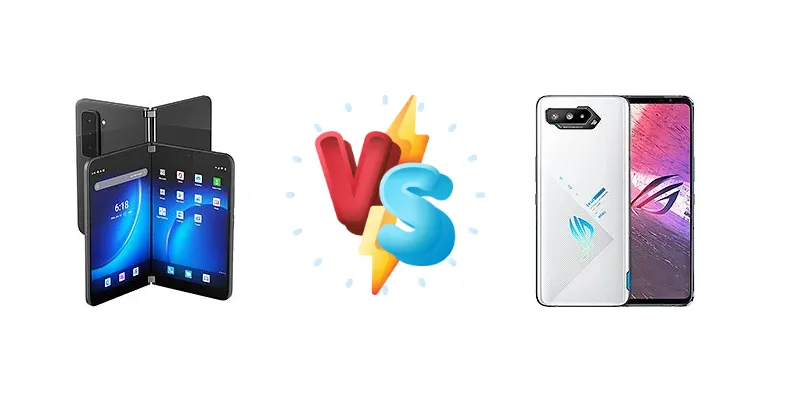
|
🏆 Quick Verdict
For the average user, the Asus ROG Phone 5s emerges as the stronger choice. Its Snapdragon 888+ chipset, coupled with 65W fast charging, delivers superior performance and convenience. However, the Surface Duo 2 remains a compelling option for those specifically seeking a unique dual-screen multitasking experience.
| PHONES | ||
|---|---|---|
| Phone Names | Microsoft Surface Duo 2 | Asus ROG Phone 5s |
| Network | ||
|---|---|---|
| 2G bands | GSM 850 / 900 / 1800 / 1900 | GSM 850 / 900 / 1800 / 1900 |
| 3G bands | HSDPA 850 / 900 / 1900 / 2100 | HSDPA 800 / 850 / 900 / 1700(AWS) / 1800 / 1900 / 2100 - Version 1 |
| 4G bands | 1, 2, 3, 4, 5, 7, 8, 12, 13, 14, 19, 20, 25, 26, 28, 29, 30, 38, 39, 40, 41, 42, 46, 48, 66, 71 | 1, 2, 3, 4, 5, 7, 8, 12, 13, 17, 18, 19, 20, 25, 26, 28, 29, 30, 32, 34, 38, 39, 40, 41, 42, 48, 66, 71 - Version 1 |
| 5G bands | 1, 2, 3, 5, 7, 20, 25, 28, 38, 41, 66, 71, 77, 78, 79 SA/NSA/Sub6 - International | 1, 2, 3, 5, 7, 8, 12, 20, 25, 28, 38, 40, 41, 66, 71, 77, 78, 79 SA/NSA - Version 1 |
| Speed | HSPA 42.2/5.76 Mbps, LTE (5CA) Cat20 2000/150 Mbps, 5G 6 Gbps DL | HSPA 42.2/5.76 Mbps, LTE (7CA) Cat20 1400/150 Mbps, 5G 4 Gbps DL |
| Technology | GSM / HSPA / LTE / 5G | GSM / HSPA / LTE / 5G |
| 1, 2, 3, 5, 7, 20, 25, 28, 38, 41, 66, 71, 77, 78, 79, 257, 260, 261 SA/NSA/Sub6/mmWave - USA | 2, 3, 5, 7, 12, 20, 25, 28, 38, 40, 66, 71, 77, 78, 79 SA/NSA - Version 4 | |
| Launch | ||
|---|---|---|
| Announced | 2021, September 22. Released 2021, October 21 | 2021, August 16 |
| Status | Discontinued | Available. Released 2021, August 26 |
| Body | ||
|---|---|---|
| Build | Glass front (Gorilla Glass Victus), glass back (Gorilla Glass) | Glass front (Gorilla Glass Victus), glass back (Gorilla Glass 3), aluminum frame |
| Dimensions | Unfolded: 184.5 x 145.2 x 5.5 mm Folded: 145.2 x 92.1 x 11 mm | 172.8 x 77.3 x 9.9 mm (6.80 x 3.04 x 0.39 in) |
| SIM | Nano-SIM + eSIM | Nano-SIM + Nano-SIM |
| Weight | 284 g (10.02 oz) | 238 g (8.40 oz) |
| Stylus support | RGB light panel (on the back) Pressure sensitive zones (Gaming triggers) | |
| Display | ||
|---|---|---|
| Protection | Corning Gorilla Glass Victus | Corning Gorilla Glass Victus |
| Resolution | 1892 x 2688 pixels (~401 ppi density) | 1080 x 2448 pixels (~395 ppi density) |
| Size | 8.3 inches, 204.0 cm2 (~152.6% screen-to-body ratio) | 6.78 inches, 109.5 cm2 (~82.0% screen-to-body ratio) |
| Type | AMOLED, 90Hz, HDR, 800 nits (peak) | AMOLED, 1B colors, 144Hz, HDR10+, 800 nits (typ), 1200 nits (peak) |
| Folded position display: 5.8 inches, AMOLED, 1344 x 1892 pixels (4:3) | - | |
| Platform | ||
|---|---|---|
| CPU | Octa-core (1x2.84 GHz Cortex-X1 & 3x2.42 GHz Cortex-A78 & 4x1.80 GHz Cortex-A55) | Octa-core (1x2.99 GHz Cortex-X1 & 3x2.42 GHz Cortex-A78 & 4x1.80 GHz Cortex-A55) |
| Chipset | Qualcomm SM8350 Snapdragon 888 5G (5 nm) | Qualcomm SM8350 Snapdragon 888+ 5G (5 nm) |
| GPU | Adreno 660 | Adreno 660 |
| OS | Android 11 | Android 11, upgradable to Android 13, ROG UI |
| Memory | ||
|---|---|---|
| Card slot | No | No |
| Internal | 128GB 8GB RAM, 256GB 8GB RAM, 512GB 8GB RAM | 128GB 8GB RAM, 128GB 12GB RAM, 256GB 12GB RAM, 256GB 16GB RAM, 512GB 16GB RAM, 512GB 18GB RAM |
| UFS | UFS 3.1 | |
| Main Camera | ||
|---|---|---|
| Features | Dual-LED dual-tone flash, HDR, panorama | LED flash, HDR, panorama |
| Single | 12 MP, f/2.0, 24mm (wide), 1.0µm | - |
| Triple | 12 MP, f/1.7, 27mm (wide), 1.4µm, dual pixel PDAF, OIS 12 MP, f/2.4, 51mm (telephoto), 1.0µm, PDAF, OIS, 2x optical zoom 16 MP, f/2.2, 13mm (ultrawide), 1.0µm TOF 3D, (depth) | 64 MP, f/1.8, 26mm (wide), 1/1.73", 0.8µm, PDAF 13 MP, f/2.4, 11mm, 125˚ (ultrawide) 5 MP (macro) |
| Video | 4K@30/60fps, 1080p@30/60/120/240fps, gyro-EIS, HDR | 8K@30fps, 4K@30/60/120fps, 1080p@30/60/120/240fps, 720p@480fps; gyro-EIS |
| Selfie camera | ||
|---|---|---|
| Features | - | Panorama, HDR |
| Single | 12 MP, f/2.0, 24mm (wide), 1.0µm | 24 MP, f/2.5, 27mm (wide), 0.9µm |
| Video | 1080p@30fps | 1080p@30fps |
| Sound | ||
|---|---|---|
| 3.5mm jack | No | Yes |
| 35mm jack | No | Yes |
| Loudspeaker | Yes, with stereo speakers | Yes, with stereo speakers (2 amplifiers) |
| - | 24-bit/192kHz audio | |
| Comms | ||
|---|---|---|
| Bluetooth | 5.1, A2DP, LE, aptX Adaptive | 5.2, A2DP, LE, aptX HD, aptX Adaptive |
| NFC | Yes | Yes |
| Positioning | GPS, GLONASS, GALILEO, QZSS, BDS | GPS (L1+L5), GLONASS (L1), BDS (B1I+B1c+B2a), GALILEO (E1+E5a), QZSS (L1+L5), NavIC (L5) |
| Radio | No | No |
| USB | USB Type-C 3.2, DisplayPort | USB Type-C 3.1 (side), USB Type-C 2.0 (bottom), OTG, accessory connector |
| WLAN | Wi-Fi 802.11 a/b/g/n/ac/6, dual-band, Wi-Fi Direct | Wi-Fi 802.11 a/b/g/n/ac/6e, dual-band, Wi-Fi Direct |
| Features | ||
|---|---|---|
| Sensors | Fingerprint (side-mounted), dual accelerometer, dual gyro, dual proximity, dual compass | Fingerprint (under display, optical), accelerometer, gyro, proximity, compass |
| Battery | ||
|---|---|---|
| Charging | 23W wired | 65W wired, PD3.0, QC5, 70% in 30 min, 100% in 52 min 10W reverse wired |
| Type | Li-Po 4449 mAh | Li-Po 6000 mAh |
| Misc | ||
|---|---|---|
| Colors | Glacier, Obsidian | Phantom Black, Storm White |
| Models | - | ZS676KS |
| Price | About 1480 EUR | About 1030 EUR |
Microsoft Surface Duo 2
- Unique dual-screen multitasking experience
- Highly portable and foldable design
- Excellent for productivity and note-taking
- Slower processor compared to the ROG Phone 5s
- Significantly slower charging speed
- Compromised camera system
Asus ROG Phone 5s
- Faster Snapdragon 888+ processor
- 65W fast charging for quick power-ups
- High refresh rate display for smooth gaming
- Conventional single-screen design
- Larger and heavier form factor
- Gaming-focused aesthetics may not appeal to everyone
Display Comparison
The Surface Duo 2’s defining feature is its two 5.8-inch AMOLED displays, offering a unique canvas for multitasking. While the individual panel specs aren’t groundbreaking, the combined screen real estate is. The ROG Phone 5s, conversely, features a single, larger 6.78-inch AMOLED display with a 144Hz refresh rate, optimized for smooth gaming visuals. The ROG Phone’s higher refresh rate provides a more fluid experience for fast-paced games, while the Duo 2’s dual-screen setup allows for running two apps side-by-side without resizing windows. The Duo 2’s hinge design, while innovative, introduces a noticeable crease where the screens meet, a factor absent on the ROG Phone 5s.
Camera Comparison
The camera systems represent a significant divergence in priorities. While detailed specs are limited, the ROG Phone 5s is expected to have a more robust camera setup geared towards general photography, likely featuring a larger main sensor and more advanced image processing. The Surface Duo 2’s camera system, while capable, appears to be a secondary consideration, focusing on functionality for video conferencing and basic photography. The ROG Phone 5s’ emphasis on gaming suggests a more refined image signal processor (ISP) optimized for capturing fast-moving subjects, a benefit for both gaming streams and action photography.
Performance
Both devices utilize the Qualcomm Snapdragon 888 series, but with key differences. The Asus ROG Phone 5s boasts the Snapdragon 888+ 5G, a slightly overclocked version of the 888 found in the Surface Duo 2. The ROG Phone 5s’ CPU clocks in at 2.99 GHz versus the Duo 2’s 2.84 GHz, resulting in a measurable performance advantage in CPU-intensive tasks. While both phones feature an octa-core configuration with the same Cortex-X1, A78, and A55 cores, the ROG Phone 5s’ thermal design, including its GameCool system, allows it to sustain peak performance for longer periods. The ROG Phone 5s also benefits from potentially faster LPDDR5 RAM, contributing to quicker app loading and smoother multitasking.
Battery Life
The Asus ROG Phone 5s significantly outpaces the Surface Duo 2 in charging speed. With 65W wired charging, the ROG Phone 5s can reach 70% charge in just 30 minutes and 100% in 52 minutes, a crucial advantage for gamers who need to quickly top up their battery. The Surface Duo 2’s 23W wired charging is comparatively slow, requiring considerably more time to reach a full charge. While the Surface Duo 2’s battery capacity is not specified, the ROG Phone 5s’ larger battery, combined with its efficient charging, provides a more convenient and reliable power experience.
Buying Guide
Buy the Microsoft Surface Duo 2 if you need a truly portable workstation with exceptional multitasking capabilities and are willing to accept compromises in raw processing power and camera quality. Buy the Asus ROG Phone 5s if you prioritize gaming performance, fast charging, and a more conventional smartphone experience with a focus on responsiveness and sustained high frame rates.