
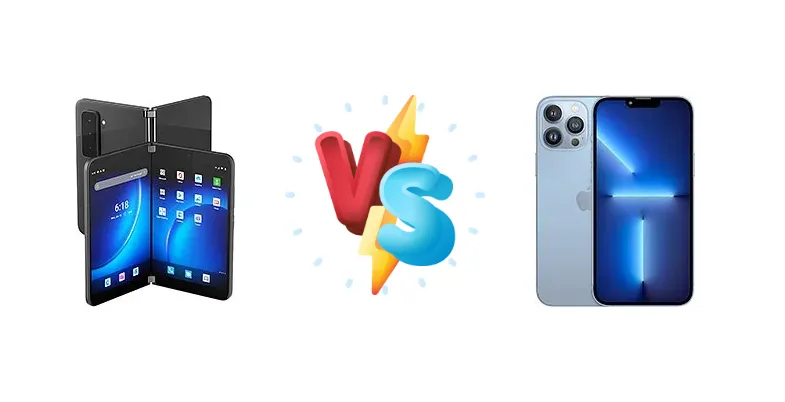
Surface Duo 2 vs iPhone 13 Pro Max: A Clash of Titans
| Phones Images | |||||
|---|---|---|---|---|---|
|
🏆 Quick Verdict
The iPhone 13 Pro Max wins on overall performance, camera quality, and battery life. However, the Surface Duo 2's innovative dual-screen design offers a unique productivity experience. If you prioritize raw power and a polished ecosystem, the iPhone is the clear choice; if you crave a novel form factor, the Duo 2 is worth considering.
| PHONES | ||
|---|---|---|
| Phone Names | Microsoft Surface Duo 2 | Apple iPhone 13 Pro Max |
| Network | ||
|---|---|---|
| 2G bands | GSM 850 / 900 / 1800 / 1900 | GSM 850 / 900 / 1800 / 1900 |
| 3G bands | HSDPA 850 / 900 / 1900 / 2100 | HSDPA 850 / 900 / 1700(AWS) / 1900 / 2100 |
| 4G bands | 1, 2, 3, 4, 5, 7, 8, 12, 13, 14, 19, 20, 25, 26, 28, 29, 30, 38, 39, 40, 41, 42, 46, 48, 66, 71 | 1, 2, 3, 4, 5, 7, 8, 12, 13, 17, 18, 19, 20, 25, 26, 28, 30, 32, 34, 38, 39, 40, 41, 42, 46, 48, 66 - A2643, A2644, A2645 |
| 5G bands | 1, 2, 3, 5, 7, 20, 25, 28, 38, 41, 66, 71, 77, 78, 79 SA/NSA/Sub6 - International | 1, 2, 3, 5, 7, 8, 12, 20, 25, 28, 30, 38, 40, 41, 48, 66, 77, 78, 79 SA/NSA/Sub6 - A2643, A2644 |
| Speed | HSPA 42.2/5.76 Mbps, LTE (5CA) Cat20 2000/150 Mbps, 5G 6 Gbps DL | HSPA, LTE, 5G, EV-DO Rev.A 3.1 Mbps |
| Technology | GSM / HSPA / LTE / 5G | GSM / CDMA / HSPA / EVDO / LTE / 5G |
| 1, 2, 3, 5, 7, 20, 25, 28, 38, 41, 66, 71, 77, 78, 79, 257, 260, 261 SA/NSA/Sub6/mmWave - USA | 1, 2, 3, 5, 7, 8, 12, 20, 25, 28, 29, 30, 38, 40, 41, 48, 66, 71, 77, 78, 79 SA/NSA/Sub6 - A2641 | |
| Launch | ||
|---|---|---|
| Announced | 2021, September 22. Released 2021, October 21 | 2021, September 14 |
| Status | Discontinued | Available. Released 2021, September 24 |
| Body | ||
|---|---|---|
| Build | Glass front (Gorilla Glass Victus), glass back (Gorilla Glass) | Glass front, glass back, stainless steel frame |
| Dimensions | Unfolded: 184.5 x 145.2 x 5.5 mm Folded: 145.2 x 92.1 x 11 mm | 160.8 x 78.1 x 7.7 mm (6.33 x 3.07 x 0.30 in) |
| SIM | Nano-SIM + eSIM | · Nano-SIM + eSIM· Nano-SIM + Nano-SIM |
| Weight | 284 g (10.02 oz) | 240 g (8.47 oz) |
| Stylus support | IP68 dust/water resistant (up to 6m for 30 min) Apple Pay (Visa, MasterCard, AMEX certified) | |
| Display | ||
|---|---|---|
| Protection | Corning Gorilla Glass Victus | Ceramic Shield glass |
| Resolution | 1892 x 2688 pixels (~401 ppi density) | 1284 x 2778 pixels, 19.5:9 ratio (~458 ppi density) |
| Size | 8.3 inches, 204.0 cm2 (~152.6% screen-to-body ratio) | 6.7 inches, 109.8 cm2 (~87.4% screen-to-body ratio) |
| Type | AMOLED, 90Hz, HDR, 800 nits (peak) | Super Retina XDR OLED, 120Hz, HDR10, Dolby Vision, 1000 nits (HBM), 1200 nits (peak) |
| Folded position display: 5.8 inches, AMOLED, 1344 x 1892 pixels (4:3) | - | |
| Platform | ||
|---|---|---|
| CPU | Octa-core (1x2.84 GHz Cortex-X1 & 3x2.42 GHz Cortex-A78 & 4x1.80 GHz Cortex-A55) | Hexa-core (2x3.23 GHz Avalanche + 4x1.82 GHz Blizzard) |
| Chipset | Qualcomm SM8350 Snapdragon 888 5G (5 nm) | Apple A15 Bionic (5 nm) |
| GPU | Adreno 660 | Apple GPU (5-core graphics) |
| OS | Android 11 | iOS 15, upgradable to iOS 26.1 |
| Memory | ||
|---|---|---|
| Card slot | No | No |
| Internal | 128GB 8GB RAM, 256GB 8GB RAM, 512GB 8GB RAM | 128GB 6GB RAM, 256GB 6GB RAM, 512GB 6GB RAM, 1TB 6GB RAM |
| UFS | NVMe | |
| Main Camera | ||
|---|---|---|
| Features | Dual-LED dual-tone flash, HDR, panorama | Dual-LED dual-tone flash, HDR (photo/panorama) |
| Single | 12 MP, f/2.0, 24mm (wide), 1.0µm | 12 MP, f/2.2, 23mm (wide), 1/3.6" SL 3D, (depth/biometrics sensor) |
| Triple | 12 MP, f/1.7, 27mm (wide), 1.4µm, dual pixel PDAF, OIS 12 MP, f/2.4, 51mm (telephoto), 1.0µm, PDAF, OIS, 2x optical zoom 16 MP, f/2.2, 13mm (ultrawide), 1.0µm TOF 3D, (depth) | 12 MP, f/1.5, 26mm (wide), 1/1.7", 1.9µm, dual pixel PDAF, sensor-shift OIS 12 MP, f/2.8, 77mm (telephoto), PDAF, 1/3.4", 1.0µm, OIS, 3x optical zoom 12 MP, f/1.8, 13mm, 120˚ (ultrawide), 1/3.4", 1.0µm, PDAF TOF 3D LiDAR scanner (depth) |
| Video | 4K@30/60fps, 1080p@30/60/120/240fps, gyro-EIS, HDR | 4K@24/25/30/60fps, 1080p@25/30/60/120/240fps, 10-bit HDR, Dolby Vision HDR (up to 60fps), ProRes, stereo sound rec. |
| Selfie camera | ||
|---|---|---|
| Features | - | HDR |
| Single | 12 MP, f/2.0, 24mm (wide), 1.0µm | 12 MP, f/2.2, 23mm (wide), 1/3.6", 1.0µm SL 3D, (depth/biometrics sensor) |
| Video | 1080p@30fps | 4K@24/25/30/60fps, 1080p@25/30/60/120fps, gyro-EIS |
| Sound | ||
|---|---|---|
| 3.5mm jack | No | No |
| 35mm jack | No | No |
| Loudspeaker | Yes, with stereo speakers | Yes, with stereo speakers |
| Comms | ||
|---|---|---|
| Bluetooth | 5.1, A2DP, LE, aptX Adaptive | 5.0, A2DP, LE |
| NFC | Yes | Yes |
| Positioning | GPS, GLONASS, GALILEO, QZSS, BDS | GPS, GLONASS, GALILEO, BDS, QZSS |
| Radio | No | No |
| USB | USB Type-C 3.2, DisplayPort | Lightning, USB 2.0 |
| WLAN | Wi-Fi 802.11 a/b/g/n/ac/6, dual-band, Wi-Fi Direct | Wi-Fi 802.11 a/b/g/n/ac/6, dual-band, hotspot |
| Features | ||
|---|---|---|
| Sensors | Fingerprint (side-mounted), dual accelerometer, dual gyro, dual proximity, dual compass | Face ID, accelerometer, gyro, proximity, compass, barometer |
| - | Ultra Wideband (UWB) support | |
| Battery | ||
|---|---|---|
| Charging | 23W wired | Wired, PD2.0, 50% in 30 min 15W wireless (MagSafe) 15W wireless (Qi2) - requires iOS 17.2 update |
| Type | Li-Po 4449 mAh | Li-Ion 4352 mAh (16.75 Wh) |
| Misc | ||
|---|---|---|
| Colors | Glacier, Obsidian | Graphite, Gold, Silver, Sierra Blue, Alpine Green |
| Models | - | A2643, A2484, A2641, A2644, A2645, iphone14,3 |
| Price | About 1480 EUR | € 423.38 / $ 394.86 / £ 355.00 |
| SAR | - | 1.18 W/kg (head) 1.20 W/kg (body) |
| SAR EU | - | 0.99 W/kg (head) 0.98 W/kg (body) |
| Tests | ||
|---|---|---|
| Battery life | - | Endurance rating 121h |
| Camera | - | Photo / Video |
| Display | - | Contrast ratio: Infinite (nominal) |
| Loudspeaker | - | -24.0 LUFS (Very good) |
| Performance | - | AnTuTu: 801691 (v9) GeekBench: 4706 (v5.1) GFXBench: 60fps (ES 3.1 onscreen) |
Microsoft Surface Duo 2
- Unique dual-screen design
- Excellent for multitasking
- Compact and pocketable
- Runs Android
- Shorter battery life
- Less powerful processor
- Camera quality lags behind
- Pricey
Apple iPhone 13 Pro Max
- Exceptional performance
- Outstanding camera system
- Long battery life
- Premium build quality
- Seamless iOS ecosystem
- Less innovative design
- Limited customization options
- Can be expensive
- Lightning port (older standard)
Display Comparison
The iPhone 13 Pro Max boasts a stunning Super Retina XDR display with ProMotion (adaptive refresh rate up to 120Hz) and incredible brightness (1050 nits). Its contrast ratio is effectively infinite. The Surface Duo 2 features two 5.8-inch OLED displays, offering a wider canvas for multitasking but with a lower peak brightness and no adaptive refresh rate. While the Duo 2's dual-screen setup is innovative, the iPhone's display is objectively superior in terms of visual quality and smoothness.
Camera Comparison
The iPhone 13 Pro Max's camera system is renowned for its exceptional image and video quality. Its computational photography capabilities are industry-leading. The Surface Duo 2's camera is adequate but lacks the sophistication and overall quality of the iPhone's. Low-light performance and video recording are significant areas where the iPhone excels.
Performance
The iPhone 13 Pro Max's A15 Bionic chip is a performance powerhouse, consistently outperforming the Snapdragon 888 in the Surface Duo 2. While the Duo 2 is capable for everyday tasks, the iPhone handles demanding games and applications with ease. The A15's efficiency also contributes to better battery life. iOS optimization further enhances the iPhone's responsiveness.
Battery Life
The iPhone 13 Pro Max offers exceptional battery life, consistently achieving impressive endurance ratings (121h). The Surface Duo 2's battery life is noticeably shorter, struggling to last a full day with heavy usage. The iPhone's power efficiency and larger battery capacity contribute to its superior longevity.
Buying Guide
Who should buy the Microsoft Surface Duo 2? Productivity-focused users who value multitasking and a unique form factor. Those seeking a tablet-like experience in a pocketable device. Who should buy the Apple iPhone 13 Pro Max? Users deeply invested in the Apple ecosystem, photographers and videographers, and anyone prioritizing top-tier performance and battery life.