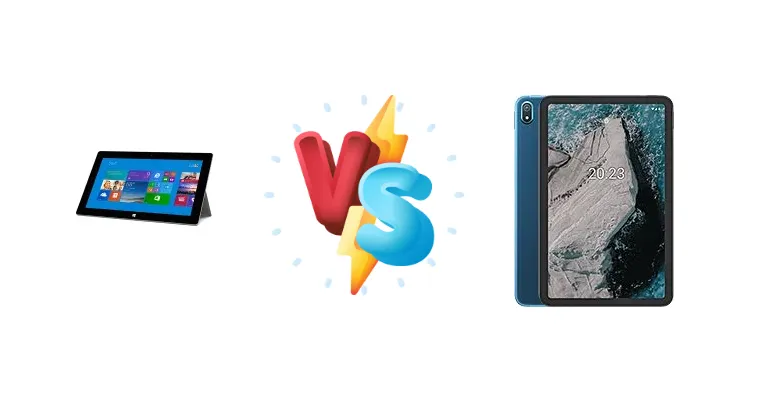
The Microsoft Surface 2, released in 2013, represents a pivotal moment in Microsoft’s hardware ambitions, powered by the Nvidia Tegra 4. The Nokia T20, a more recent entrant from HMD Global, aims to deliver an affordable Android tablet experience with a Unisoc T610 chipset. This comparison dissects these two tablets, examining how their differing architectures and target markets translate into real-world usability.
🏆 Quick Verdict
For users prioritizing a more responsive experience, even with the age of its hardware, the Microsoft Surface 2 edges out the Nokia T20. The Tegra 4’s Cortex-A15 cores, while older, offer a performance advantage over the Unisoc T610’s Cortex-A75/A55 mix. However, the Nokia T20’s superior display and modern Android support make it a compelling choice for media consumption and basic productivity.
| Network |
|---|
| 2G bands | N/A | GSM 850 / 900 / 1800 / 1900 |
| 3G bands | - | HSDPA 850 / 900 / 1700(AWS) / 1900 / 2100 - US, LATAM |
| 4G bands | - | 1, 2, 3, 4, 5, 7, 8, 12, 13, 17, 20, 28, 40, 66 - US, LATAM |
| EDGE | No | - |
| GPRS | No | - |
| Speed | - | HSPA, LTE Cat4 150/50 Mbps - cellular model only |
| Technology | No cellular connectivity | GSM / HSPA / LTE |
| | - | 1, 3, 5, 7, 8, 20, 28, 38, 40, 41 - International |
| Launch |
|---|
| Announced | 2013, September. Released 2013, October | 2021, October 06 |
| Status | Discontinued | Available. Released 2021, November 02 |
| Body |
|---|
| Build | - | Glass front, aluminum back |
| Dimensions | 274.6 x 172.5 x 8.9 mm (10.81 x 6.79 x 0.35 in) | 247.6 x 157.5 x 7.8 mm (9.75 x 6.20 x 0.31 in) |
| SIM | No | Nano-SIM (cellular model only) |
| Weight | 675.9 g (1.49 lb) | 465 g (Wi-Fi), 470 g (LTE) (1.03 lb) |
| | Built-in 2-stage kickstand | Splash resistant |
| Display |
|---|
| Protection | - | Scratch-resistant glass |
| Resolution | 1920 x 1080 pixels, 16:9 ratio (~208 ppi density) | 1200 x 2000 pixels, 5:3 ratio (~224 ppi density) |
| Size | 10.6 inches, 309.8 cm2 (~65.4% screen-to-body ratio) | 10.4 inches, 307.9 cm2 (~78.9% screen-to-body ratio) |
| Type | TFT | IPS LCD, 400 nits (typ) |
| | ClearType technology | - |
| Platform |
|---|
| CPU | Quad-core 1.7 GHz Cortex-A15 | Octa-core (2x1.8 GHz Cortex-A75 & 6x1.8 GHz Cortex-A55) |
| Chipset | Nvidia Tegra 4 T40 | Unisoc T610 (12 nm) |
| GPU | ULP GeForce (72 cores) | Mali-G52 MP2 |
| OS | Microsoft Windows RT | Android 11, upgradable to Android 13 |
| Memory |
|---|
| Card slot | microSDXC (dedicated slot) | microSDXC (dedicated slot) |
| Internal | 32GB 2GB RAM, 64GB 2GB RAM | 32GB 3GB RAM, 64GB 4GB RAM |
| | - | eMMC 5.1 |
| Main Camera |
|---|
| Features | LED flash | LED flash |
| Single | 5 MP, AF | 8 MP, AF |
| Video | 1080p@30fps | 1080p@30fps |
| Selfie camera |
|---|
| Single | 3.5 MP | 5 MP |
| Video | 1080p@30fps | Yes |
| Sound |
|---|
| 3.5mm jack | Yes | Yes |
| 35mm jack | Yes | Yes |
| Loudspeaker | Yes, with stereo speakers | Yes, with stereo speakers |
| Comms |
|---|
| Bluetooth | 4.0, A2DP | 5.0, A2DP, LE |
| NFC | No | No |
| Positioning | No | GPS - cellular model only |
| Radio | No | FM radio |
| USB | USB 3.0, OTG | USB Type-C 2.0 |
| WLAN | Wi-Fi 802.11 a/b/g/n, dual-band, Wi-Fi Direct | Wi-Fi 802.11 a/b/g/n/ac, dual-band |
| Features |
|---|
| Sensors | Accelerometer, gyro, compass | Accelerometer |
| | TV-out via HDMI port
MP4/DivX/XviD/WMV/H.264 player
MP3/WAV/eAAC+/FLAC player
Photo viewer/editor
Microsoft Office 2013 RT
SkyDrive (200 GB cloud storage)
Skype free international calls and Wi-Fi for 1 year | - |
| Battery |
|---|
| Charging | - | 15W wired |
| Type | Li-Ion, non-removable | Li-Po 8200 mAh |
| Misc |
|---|
| Colors | Dark Titanium | Deep Ocean |
| Models | - | TA-1397, TA-1394, TA-1392 |
| Price | About 330 EUR | About 200 EUR |
| SAR | - | 1.34 W/kg (body) |
| SAR EU | - | 1.35 W/kg (body) |
Microsoft Surface 2
- More powerful processor for its time (Tegra 4)
- Premium build quality (typical of Surface devices)
- Unique Windows RT experience
- Outdated software (Windows RT)
- Limited app compatibility
- Potentially shorter battery life
Nokia T20
- Modern Android operating system
- Brighter and higher contrast display
- Longer battery life and faster charging
- Less powerful processor than the Surface 2 (in its prime)
- Budget-oriented build quality
- Unisoc chipset may have limited software optimization
Display Comparison
The Nokia T20 boasts a significantly more modern display, achieving a measured peak brightness of 422 nits and a 1786:1 contrast ratio. This contrasts sharply with the Surface 2, where display specifications are less readily available, but generally fall behind modern standards. The Nokia T20’s higher brightness improves outdoor visibility, while the superior contrast ratio delivers richer, more vibrant colors. While the Surface 2’s display was considered good for its time, the Nokia T20 offers a demonstrably better viewing experience, particularly for video playback and image viewing.
Camera Comparison
Camera performance is difficult to directly compare due to limited information on the Surface 2’s camera capabilities. However, given its age, it’s reasonable to assume the Nokia T20 offers a superior camera experience. While the T20 doesn’t boast flagship-level camera specs, it provides adequate image quality for casual photography and video calls. The Surface 2’s camera, likely a lower-resolution sensor, would struggle in comparison, particularly in low-light conditions. The focus here isn't on photographic prowess, but the Nokia T20 is the clear winner.
Performance
The core architectural difference lies in the CPUs. The Surface 2 utilizes a quad-core 1.7 GHz Cortex-A15 processor within the Nvidia Tegra 4. While the A15 was a high-performance core in 2013, it’s now surpassed by the Nokia T20’s octa-core Unisoc T610, featuring two 1.8 GHz Cortex-A75 cores and six 1.8 GHz Cortex-A55 cores. The T610’s combination of performance and efficiency cores allows for better multitasking and sustained performance under load. The Tegra 4’s integrated Nvidia GPU was a strength, but the Unisoc T610’s GPU, while not as powerful, is sufficient for everyday tasks and light gaming. The 12nm process node of the Unisoc T610 also contributes to better power efficiency compared to the Tegra 4’s older manufacturing process.
Battery Life
The Nokia T20’s 15W wired charging is a significant advantage over the Surface 2, which likely utilized a slower charging standard. While the Surface 2’s battery capacity is unknown, the Nokia T20’s 8200mAh battery provides ample power for all-day use. The Unisoc T610’s power efficiency further contributes to longer battery life. The Nokia T20’s ability to quickly top up its battery is a practical benefit for users on the go, while the Surface 2 may require longer charging times.
Buying Guide
Buy the Microsoft Surface 2 if you need a tablet with a more powerful processor for its time, and are comfortable with older software and potentially limited app compatibility. It’s ideal for users who appreciate a more premium build quality and are willing to explore the Windows RT ecosystem. Buy the Nokia T20 if you prefer a modern Android experience, a brighter and higher contrast display for media consumption, and a longer software support lifecycle, all at a more accessible price point.
Frequently Asked Questions
❓ Is the Nvidia Tegra 4 still capable of running modern Android apps through emulation?
While technically possible through emulation, the Surface 2’s Windows RT operating system and the Tegra 4’s architecture present significant hurdles. Performance would likely be sluggish and compatibility limited, making it impractical for most users. The Nokia T20’s native Android support provides a far smoother experience.
❓ How does the Unisoc T610 handle multitasking compared to the Surface 2’s Tegra 4?
The Unisoc T610’s octa-core configuration, with its mix of performance and efficiency cores, is better suited for multitasking than the Surface 2’s quad-core Tegra 4. The T610 can efficiently handle background tasks without significantly impacting foreground app performance, offering a more responsive user experience.
❓ What is the long-term software support situation for the Nokia T20?
HMD Global typically provides at least two major Android updates and three years of security patches for its tablets, including the Nokia T20. This is a significant advantage over the Surface 2, which is no longer receiving updates from Microsoft.
❓ Is the Nokia T20 a good choice for gaming?
The Nokia T20 can handle casual gaming adequately, but it’s not designed for demanding titles. The Unisoc T610’s GPU is sufficient for less graphically intensive games, but may struggle with high settings or frame rates in more demanding games. The Surface 2’s Tegra 4 GPU was stronger in its day, but the age of the hardware and software limitations may hinder its gaming performance.