
Surface 2 vs. Surface Duo 2: A Generational Leap in Mobile Computing
| Phones Images | |||||
|---|---|---|---|---|---|
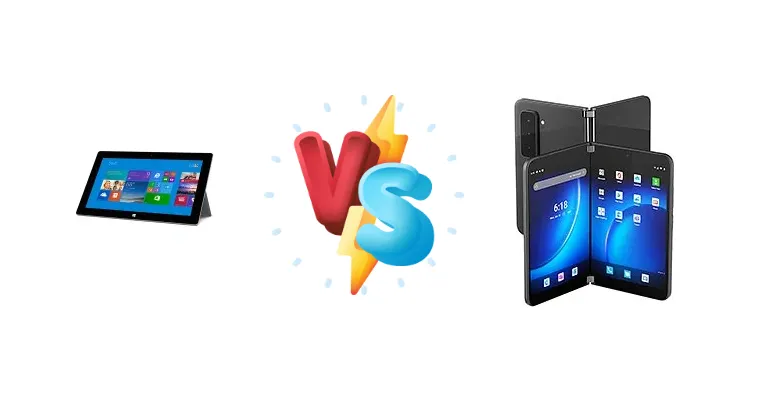
|
🏆 Quick Verdict
For the average user in 2024, the Surface Duo 2 is the clear winner. The Snapdragon 888 5G chipset delivers significantly superior performance and 5G connectivity, while 23W charging addresses a key pain point of earlier Surface devices. However, the Surface 2 remains a viable option for basic tasks and retro enthusiasts.
| PHONES | ||
|---|---|---|
| Phone Names | Microsoft Surface 2 | Microsoft Surface Duo 2 |
| Network | ||
|---|---|---|
| 2G bands | N/A | GSM 850 / 900 / 1800 / 1900 |
| 3G bands | - | HSDPA 850 / 900 / 1900 / 2100 |
| 4G bands | - | 1, 2, 3, 4, 5, 7, 8, 12, 13, 14, 19, 20, 25, 26, 28, 29, 30, 38, 39, 40, 41, 42, 46, 48, 66, 71 |
| 5G bands | - | 1, 2, 3, 5, 7, 20, 25, 28, 38, 41, 66, 71, 77, 78, 79 SA/NSA/Sub6 - International |
| EDGE | No | - |
| GPRS | No | - |
| Speed | - | HSPA 42.2/5.76 Mbps, LTE (5CA) Cat20 2000/150 Mbps, 5G 6 Gbps DL |
| Technology | No cellular connectivity | GSM / HSPA / LTE / 5G |
| - | 1, 2, 3, 5, 7, 20, 25, 28, 38, 41, 66, 71, 77, 78, 79, 257, 260, 261 SA/NSA/Sub6/mmWave - USA | |
| Launch | ||
|---|---|---|
| Announced | 2013, September. Released 2013, October | 2021, September 22. Released 2021, October 21 |
| Status | Discontinued | Discontinued |
| Body | ||
|---|---|---|
| Build | - | Glass front (Gorilla Glass Victus), glass back (Gorilla Glass) |
| Dimensions | 274.6 x 172.5 x 8.9 mm (10.81 x 6.79 x 0.35 in) | Unfolded: 184.5 x 145.2 x 5.5 mm Folded: 145.2 x 92.1 x 11 mm |
| SIM | No | Nano-SIM + eSIM |
| Weight | 675.9 g (1.49 lb) | 284 g (10.02 oz) |
| Built-in 2-stage kickstand | Stylus support | |
| Display | ||
|---|---|---|
| Protection | - | Corning Gorilla Glass Victus |
| Resolution | 1920 x 1080 pixels, 16:9 ratio (~208 ppi density) | 1892 x 2688 pixels (~401 ppi density) |
| Size | 10.6 inches, 309.8 cm2 (~65.4% screen-to-body ratio) | 8.3 inches, 204.0 cm2 (~152.6% screen-to-body ratio) |
| Type | TFT | AMOLED, 90Hz, HDR, 800 nits (peak) |
| ClearType technology | Folded position display: 5.8 inches, AMOLED, 1344 x 1892 pixels (4:3) | |
| Platform | ||
|---|---|---|
| CPU | Quad-core 1.7 GHz Cortex-A15 | Octa-core (1x2.84 GHz Cortex-X1 & 3x2.42 GHz Cortex-A78 & 4x1.80 GHz Cortex-A55) |
| Chipset | Nvidia Tegra 4 T40 | Qualcomm SM8350 Snapdragon 888 5G (5 nm) |
| GPU | ULP GeForce (72 cores) | Adreno 660 |
| OS | Microsoft Windows RT | Android 11 |
| Memory | ||
|---|---|---|
| Card slot | microSDXC (dedicated slot) | No |
| Internal | 32GB 2GB RAM, 64GB 2GB RAM | 128GB 8GB RAM, 256GB 8GB RAM, 512GB 8GB RAM |
| - | UFS | |
| Main Camera | ||
|---|---|---|
| Features | LED flash | Dual-LED dual-tone flash, HDR, panorama |
| Single | 5 MP, AF | 12 MP, f/2.0, 24mm (wide), 1.0µm |
| Triple | - | 12 MP, f/1.7, 27mm (wide), 1.4µm, dual pixel PDAF, OIS 12 MP, f/2.4, 51mm (telephoto), 1.0µm, PDAF, OIS, 2x optical zoom 16 MP, f/2.2, 13mm (ultrawide), 1.0µm TOF 3D, (depth) |
| Video | 1080p@30fps | 4K@30/60fps, 1080p@30/60/120/240fps, gyro-EIS, HDR |
| Selfie camera | ||
|---|---|---|
| Single | 3.5 MP | 12 MP, f/2.0, 24mm (wide), 1.0µm |
| Video | 1080p@30fps | 1080p@30fps |
| Sound | ||
|---|---|---|
| 3.5mm jack | Yes | No |
| 35mm jack | Yes | No |
| Loudspeaker | Yes, with stereo speakers | Yes, with stereo speakers |
| Comms | ||
|---|---|---|
| Bluetooth | 4.0, A2DP | 5.1, A2DP, LE, aptX Adaptive |
| NFC | No | Yes |
| Positioning | No | GPS, GLONASS, GALILEO, QZSS, BDS |
| Radio | No | No |
| USB | USB 3.0, OTG | USB Type-C 3.2, DisplayPort |
| WLAN | Wi-Fi 802.11 a/b/g/n, dual-band, Wi-Fi Direct | Wi-Fi 802.11 a/b/g/n/ac/6, dual-band, Wi-Fi Direct |
| Features | ||
|---|---|---|
| Sensors | Accelerometer, gyro, compass | Fingerprint (side-mounted), dual accelerometer, dual gyro, dual proximity, dual compass |
| TV-out via HDMI port MP4/DivX/XviD/WMV/H.264 player MP3/WAV/eAAC+/FLAC player Photo viewer/editor Microsoft Office 2013 RT SkyDrive (200 GB cloud storage) Skype free international calls and Wi-Fi for 1 year | - | |
| Battery | ||
|---|---|---|
| Charging | - | 23W wired |
| Type | Li-Ion, non-removable | Li-Po 4449 mAh |
| Misc | ||
|---|---|---|
| Colors | Dark Titanium | Glacier, Obsidian |
| Price | About 330 EUR | About 1480 EUR |
Microsoft Surface 2
- Extremely affordable price point (in the used market)
- Lightweight and portable design
- Functional as a basic tablet
- Outdated processor and limited performance
- Poor battery life compared to modern devices
- Lack of modern features like 5G connectivity
Microsoft Surface Duo 2
- Powerful Snapdragon 888 5G processor
- Unique dual-screen multitasking experience
- Fast 23W wired charging
- Higher price point
- Potentially shorter battery life due to power-hungry processor
- Bulky form factor compared to traditional smartphones
Display Comparison
The Surface 2 features a single 10.6-inch display, while the Surface Duo 2 boasts two 5.8-inch displays. While the Surface 2’s display resolution isn’t specified, the Duo 2’s displays offer a combined larger viewing area. Crucially, the Duo 2 benefits from advancements in display technology not available in 2013. The Duo 2’s panel likely features a higher refresh rate and improved color accuracy, though specific nit brightness figures are unavailable for either device. The Duo 2’s dual-screen design fundamentally alters the user experience, enabling unique multitasking workflows.
Camera Comparison
Detailed camera specifications for the Surface 2 are scarce. The Surface Duo 2, while not a camera-focused device, features a more modern camera system. Without specific sensor details for the Surface 2, it’s safe to assume the Duo 2’s camera offers superior image quality, particularly in low-light conditions. The Snapdragon 888’s image signal processor (ISP) also contributes to improved image processing capabilities, including better dynamic range and noise reduction.
Performance
The performance gap between the Surface 2’s Nvidia Tegra 4 T40 and the Surface Duo 2’s Qualcomm Snapdragon 888 5G is immense. The Tegra 4, with its quad-core 1.7 GHz Cortex-A15 CPU, was competitive in its time, but pales in comparison to the Snapdragon 888’s octa-core configuration (1x2.84 GHz Cortex-X1, 3x2.42 GHz Cortex-A78, 4x1.80 GHz Cortex-A55). The Snapdragon 888, built on a 5nm process, offers significantly improved CPU and GPU performance, alongside enhanced power efficiency. This translates to faster app loading times, smoother multitasking, and the ability to run demanding games on the Duo 2. The Duo 2’s architecture also benefits from advancements in RAM technology, likely utilizing LPDDR5x for faster data transfer speeds.
Battery Life
Battery capacity for both devices is not specified in the provided data. However, the Surface Duo 2’s 23W wired charging capability represents a significant advantage over the Surface 2, which likely relied on slower charging standards. While the Duo 2’s more powerful processor consumes more energy, the faster charging speed mitigates this concern, allowing for quicker top-ups. The efficiency gains from the 5nm Snapdragon 888 also contribute to potentially comparable real-world battery life, despite the performance difference.
Buying Guide
Buy the Microsoft Surface 2 if you need a very affordable, basic tablet for light web browsing, media consumption, and simple productivity tasks, and are comfortable with its dated hardware. Buy the Microsoft Surface Duo 2 if you prioritize multitasking, demanding applications, 5G connectivity, and a premium dual-screen experience, and are willing to pay a premium for these features.