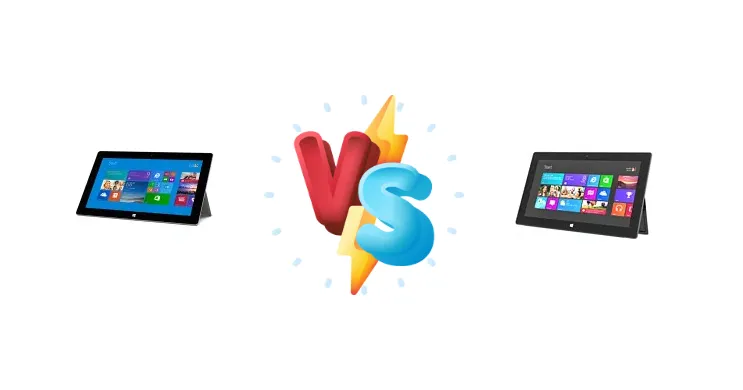
The original Microsoft Surface launched a new era of Windows tablets, but its successor, the Surface 2, arrived with significant internal changes. Both devices aimed to bridge the gap between tablet portability and desktop productivity, but the shift from the Nvidia Tegra 3 T30 to the Tegra 4 T40 represents a crucial architectural leap. This comparison dissects the differences, focusing on performance, efficiency, and the user experience each offers.
🏆 Quick Verdict
For most users, the Surface 2 is the superior choice. The Tegra 4’s Cortex-A15 architecture delivers a noticeable performance boost over the Tegra 3’s Cortex-A9, improving responsiveness and application loading times. While both share the same excellent 1324:1 contrast ratio display, the Surface 2’s improved processing power justifies the upgrade.
| Network |
|---|
| 2G bands | N/A | N/A |
| EDGE | No | No |
| GPRS | No | No |
| Technology | No cellular connectivity | No cellular connectivity |
| Launch |
|---|
| Announced | 2013, September. Released 2013, October | 2012, October. Released 2012, November |
| Status | Discontinued | Discontinued |
| Body |
|---|
| Dimensions | 274.6 x 172.5 x 8.9 mm (10.81 x 6.79 x 0.35 in) | 274.6 x 172 x 9.4 mm (10.81 x 6.77 x 0.37 in) |
| SIM | No | No |
| Weight | 675.9 g (1.49 lb) | 680.4 g (1.50 lb) |
| | Built-in 2-stage kickstand | Built-in kickstand |
| Display |
|---|
| Resolution | 1920 x 1080 pixels, 16:9 ratio (~208 ppi density) | 1366 x 768 pixels, 16:9 ratio (~148 ppi density) |
| Size | 10.6 inches, 309.8 cm2 (~65.4% screen-to-body ratio) | 10.6 inches, 309.7 cm2 (~65.6% screen-to-body ratio) |
| Type | TFT | TFT |
| | ClearType technology | ClearType technology |
| Platform |
|---|
| CPU | Quad-core 1.7 GHz Cortex-A15 | Quad-core 1.3 GHz Cortex-A9 |
| Chipset | Nvidia Tegra 4 T40 | Nvidia Tegra 3 T30 |
| GPU | ULP GeForce (72 cores) | ULP GeForce |
| OS | Microsoft Windows RT | Microsoft Windows RT |
| Memory |
|---|
| Card slot | microSDXC (dedicated slot) | microSDXC (dedicated slot) |
| Internal | 32GB 2GB RAM, 64GB 2GB RAM | 32GB 2GB RAM, 64GB 2GB RAM |
| Main Camera |
|---|
| Features | LED flash | - |
| Single | 5 MP, AF | 1.2 MP |
| Video | 1080p@30fps | 720p |
| Selfie camera |
|---|
| Single | 3.5 MP | 1.2 MP |
| Video | 1080p@30fps | 720p@30fps |
| Sound |
|---|
| 3.5mm jack | Yes | Yes |
| 35mm jack | Yes | Yes |
| Loudspeaker | Yes, with stereo speakers | Yes, with stereo speakers |
| Comms |
|---|
| Bluetooth | 4.0, A2DP | 4.0, A2DP |
| NFC | No | No |
| Positioning | No | No |
| Radio | No | No |
| USB | USB 3.0, OTG | USB 2.0, OTG |
| WLAN | Wi-Fi 802.11 a/b/g/n, dual-band, Wi-Fi Direct | Wi-Fi 802.11 a/b/g/n, dual-band, Wi-Fi Direct |
| Features |
|---|
| Sensors | Accelerometer, gyro, compass | Accelerometer, gyro, compass |
| | TV-out via HDMI port
MP4/DivX/XviD/WMV/H.264 player
MP3/WAV/eAAC+/FLAC player
Photo viewer/editor
Microsoft Office 2013 RT
SkyDrive (200 GB cloud storage)
Skype free international calls and Wi-Fi for 1 year | TV-out
MP4/DivX/XviD/WMV/H.264 player
MP3/WAV/eAAC+/FLAC player
Photo viewer/editor
Microsoft Office 2013 RT |
| Battery |
|---|
| Stand-by | - | Up to 360 h |
| Talk time | - | Up to 8 h |
| Type | Li-Ion, non-removable | Li-Ion battery, non-removable (31.5 Wh) |
| Misc |
|---|
| Colors | Dark Titanium | Dark Titanium |
| Price | About 330 EUR | About 260 EUR |
| Tests |
|---|
| Audio quality | - |
Noise -82.6dB / Crosstalk -81.7dB |
| Display | - |
Contrast ratio: 1324:1 (nominal) |
Microsoft Surface 2
- Faster CPU performance due to Cortex-A15 architecture
- Improved graphics capabilities with Tegra 4 GPU
- Potentially smoother multitasking experience
- May not offer significantly improved battery life due to higher clock speed
- Still limited by Windows RT operating system
Microsoft Surface
- Lower price point (likely, given its age)
- Capable of handling basic tasks effectively
- Excellent display contrast ratio (1324:1)
- Slower CPU performance with Cortex-A9 architecture
- Less responsive user experience
- Older chipset may struggle with modern applications
Display Comparison
Both the Surface 2 and the original Surface boast a 1324:1 nominal contrast ratio, indicating excellent black levels and vibrant colors. However, the context data lacks specifics on panel technology (IPS, TFT) or resolution. Given the launch timeframe, both likely utilize IPS panels for wide viewing angles. The absence of information regarding brightness nits makes a direct comparison impossible, but the display quality was a strong point for both devices in contemporary reviews. Bezels were relatively substantial for both models, reflecting design trends of the time.
Camera Comparison
The provided context data does not include camera specifications. Based on the market segment and launch period, both devices likely featured modest cameras suitable for video conferencing and casual snapshots. It’s reasonable to assume the Surface 2 may have received minor camera improvements, but these were not a primary selling point for either device. Without specific details on sensor size, aperture, or image processing, a meaningful comparison is impossible.
Performance
The core difference lies in the chipset. The Surface 2’s Nvidia Tegra 4 T40, featuring a quad-core 1.7 GHz Cortex-A15 CPU, represents a significant architectural upgrade over the original Surface’s Tegra 3 T30 with its 1.3 GHz quad-core Cortex-A9 CPU. The Cortex-A15 offers improved instructions per clock (IPC) and a more efficient architecture, translating to faster processing speeds and better multi-tasking capabilities. While both are ARM-based, the A15’s architecture is demonstrably more capable. The Surface 2’s GPU also benefits from the Tegra 4, offering improved graphics performance, though both are limited by the Windows RT operating system.
Battery Life
Battery life is difficult to assess without detailed testing data. The Tegra 4, despite its performance gains, is built on a 28nm process, similar to the Tegra 3. While the Cortex-A15 is more efficient per clock cycle, the higher clock speed of the Surface 2’s CPU could offset some of those gains. Real-world battery life would depend heavily on usage patterns and screen brightness. The absence of mAh ratings prevents a direct comparison, but the Surface 2’s improved efficiency *could* translate to slightly longer runtimes under similar workloads.
Buying Guide
Buy the Microsoft Surface 2 if you prioritize responsiveness and a smoother user experience, especially when multitasking or running demanding applications. Its more modern CPU architecture provides a tangible benefit for productivity tasks. Buy the original Microsoft Surface if you can find it at a significantly lower price and your needs are limited to basic web browsing, media consumption, and light office work. The original Surface remains a capable device for simple tasks, but it will show its age more quickly.
Frequently Asked Questions
❓ Does the Tegra 4 in the Surface 2 offer a noticeable performance improvement over the Tegra 3 in the original Surface for everyday tasks like web browsing and email?
Yes, the Tegra 4’s Cortex-A15 CPU provides a tangible performance boost. While both devices can handle basic tasks, the Surface 2 will feel more responsive and snappier when switching between applications or loading complex web pages. The architectural improvements in the A15 core translate to a smoother overall experience.
❓ Is the Windows RT operating system on both devices a significant limitation, and does it affect the types of applications I can run?
Yes, Windows RT is a major limitation. It only runs applications from the Windows Store, meaning you cannot install traditional desktop Windows applications. This significantly restricts the software ecosystem compared to full Windows 8 or 10. While the Surface 2 received some updates, the core limitation of app compatibility remains.
❓ Given the age of both devices, should I be concerned about software updates or long-term support?
Yes, both devices are no longer officially supported by Microsoft with feature updates. Security updates may have ceased as well. This poses a security risk and limits access to new features. Consider this a significant drawback before purchasing either device.