
Google Pixel Fold vs. Microsoft Surface 2: A Generational Leap in Mobile Computing
| Phones Images | |||||
|---|---|---|---|---|---|
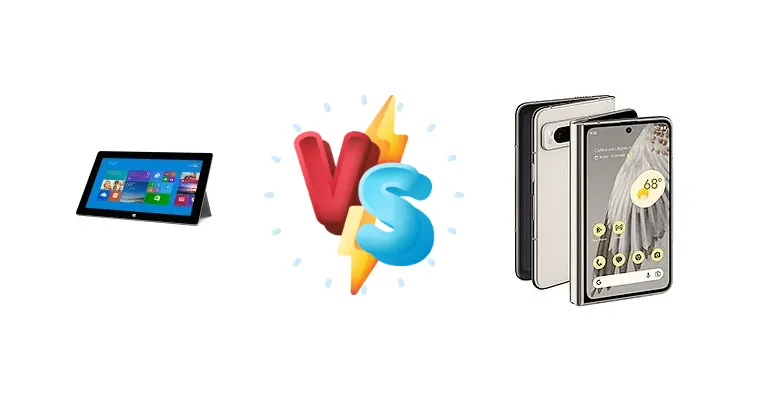
|
🏆 Quick Verdict
For the vast majority of users, the Google Pixel Fold is the superior device. The Tensor G2 chipset delivers significantly faster performance, a more modern software experience, and the convenience of a smartphone form factor. However, the Surface 2 remains a viable option for those seeking a basic, affordable tablet for light tasks.
| PHONES | ||
|---|---|---|
| Phone Names | Microsoft Surface 2 | Google Pixel Fold |
| Network | ||
|---|---|---|
| 2G bands | N/A | GSM 850 / 900 / 1800 / 1900 |
| 3G bands | - | HSDPA 800 / 850 / 900 / 1700(AWS) / 1900 / 2100 |
| 4G bands | - | 1, 2, 3, 4, 5, 7, 8, 12, 13, 14, 17, 18, 19, 20, 21, 25, 26, 28, 29, 30, 32, 38, 39, 40, 41, 42, 46, 48, 66, 71 |
| 5G bands | - | 1, 2, 3, 5, 7, 8, 12, 14, 20, 25, 28, 30, 38, 40, 41, 48, 66, 71, 75, 76, 77, 78, 79, 257, 258, 260, 261 SA/NSA/Sub6/mmWave |
| EDGE | No | - |
| GPRS | No | - |
| Speed | - | HSPA, LTE, 5G |
| Technology | No cellular connectivity | GSM / CDMA / HSPA / EVDO / LTE / 5G |
| - | CDMA2000 1xEV-DO | |
| Launch | ||
|---|---|---|
| Announced | 2013, September. Released 2013, October | 2023, May 10 |
| Status | Discontinued | Available. Released 2023, June 27 |
| Body | ||
|---|---|---|
| Build | - | Glass front (Gorilla Glass Victus) (folded), plastic front (unfolded), glass back (Gorilla Glass Victus), aluminum frame |
| Dimensions | 274.6 x 172.5 x 8.9 mm (10.81 x 6.79 x 0.35 in) | Unfolded: 139.7 x 158.7 x 5.8 mmFolded: 139.7 x 79.5 x 12.1 mm |
| SIM | No | Nano-SIM + eSIM |
| Weight | 675.9 g (1.49 lb) | 283 g (9.98 oz) |
| Built-in 2-stage kickstand | IPX8 water resistant | |
| Display | ||
|---|---|---|
| Resolution | 1920 x 1080 pixels, 16:9 ratio (~208 ppi density) | 1840 x 2208 pixels (~378 ppi density) |
| Size | 10.6 inches, 309.8 cm2 (~65.4% screen-to-body ratio) | 7.6 inches, 183.3 cm2 (~82.7% screen-to-body ratio) |
| Type | TFT | Foldable OLED, 120Hz, HDR10+, 1000 nits (HBM), 1450 nits (peak) |
| ClearType technology | Cover display: OLED, 120Hz, HDR, Corning Gorilla Glass Victus 5.8 inches, 1080 x 2092 pixels, 17.4:9 ratio, 408 ppi 1200 nits (HBM), 1550 nits (peak) | |
| Platform | ||
|---|---|---|
| CPU | Quad-core 1.7 GHz Cortex-A15 | Octa-core (2x2.85 GHz Cortex-X1 & 2x2.35 GHz Cortex-A78 & 4x1.80 GHz Cortex-A55) |
| Chipset | Nvidia Tegra 4 T40 | Google Tensor G2 (5 nm) |
| GPU | ULP GeForce (72 cores) | Mali-G710 MP7 |
| OS | Microsoft Windows RT | Android 13, upgradable to Android 15, up to 5 major Android upgrades |
| Memory | ||
|---|---|---|
| Card slot | microSDXC (dedicated slot) | No |
| Internal | 32GB 2GB RAM, 64GB 2GB RAM | 256GB 12GB RAM, 512GB 12GB RAM |
| - | UFS 3.1 | |
| Main Camera | ||
|---|---|---|
| Features | LED flash | Laser AF, Dual-LED flash, HDR, panorama |
| Single | 5 MP, AF | - |
| Triple | - | 48 MP, f/1.7, 25mm (wide), 1/2.0", 0.8µm, dual pixel PDAF, OIS 10.8 MP, f/3.1, 112mm (telephoto), 1/3.1", 1.22µm, dual pixel PDAF, OIS, 5x optical zoom 10.8 MP, f/2.2, 121˚, (ultrawide), 1/3.0", 1.25µm |
| Video | 1080p@30fps | 4K@30/60fps, 1080p@30/60/120/240fps, 10-bit HDR |
| Selfie camera | ||
|---|---|---|
| Features | - | HDR, panorama |
| Single | 3.5 MP | 8 MP, f/2.0, 24mm (wide), 1/4.0", 1.12µm Cover camera: 9.5 MP, f/2.2, 24mm (wide), 1.22µm, dual pixel PDAF |
| Video | 1080p@30fps | 4K@30/60fps, 1080p@30/60fps |
| Sound | ||
|---|---|---|
| 3.5mm jack | Yes | No |
| 35mm jack | Yes | No |
| Loudspeaker | Yes, with stereo speakers | Yes, with stereo speakers |
| Comms | ||
|---|---|---|
| Bluetooth | 4.0, A2DP | 5.2, A2DP, LE, aptX HD |
| NFC | No | Yes |
| Positioning | No | GPS, GLONASS, GALILEO, BDS |
| Radio | No | No |
| USB | USB 3.0, OTG | USB Type-C 3.2, OTG |
| WLAN | Wi-Fi 802.11 a/b/g/n, dual-band, Wi-Fi Direct | Wi-Fi 802.11 a/b/g/n/ac/6e, tri-band, Wi-Fi Direct |
| Features | ||
|---|---|---|
| Sensors | Accelerometer, gyro, compass | Fingerprint (side-mounted), accelerometer, gyro, proximity, compass, barometer |
| TV-out via HDMI port MP4/DivX/XviD/WMV/H.264 player MP3/WAV/eAAC+/FLAC player Photo viewer/editor Microsoft Office 2013 RT SkyDrive (200 GB cloud storage) Skype free international calls and Wi-Fi for 1 year | Ultra Wideband (UWB) support | |
| Battery | ||
|---|---|---|
| Charging | - | Wired, PD3.0 Wireless |
| Type | Li-Ion, non-removable | Li-Po 4821 mAh |
| Misc | ||
|---|---|---|
| Colors | Dark Titanium | Porcelain, Obsidian |
| Models | - | G9FPL |
| Price | About 330 EUR | € 670.87 / $ 389.26 / £ 899.99 |
Microsoft Surface 2
- Extremely affordable price point
- Lightweight and portable for a 10-inch tablet
- Familiar Windows operating system
- Outdated Tegra 4 processor
- Limited app ecosystem compared to Android
- Poor performance with modern applications
Google Pixel Fold
- Powerful Google Tensor G2 processor
- Versatile foldable display
- Advanced camera system with Google's image processing
- High price tag
- Foldable display durability concerns
- Larger and heavier than traditional smartphones
Display Comparison
The Surface 2 features a 10.6-inch ClearType Full HD display, while the Pixel Fold boasts a 7.6-inch foldable OLED display and a 5.8-inch cover display. The Pixel Fold’s OLED technology offers superior contrast and color accuracy compared to the Surface 2’s LCD. While the Surface 2’s resolution is adequate, the Pixel Fold’s foldable design and higher pixel density provide a more immersive viewing experience. The Pixel Fold likely incorporates LTPO technology for variable refresh rates, improving battery efficiency, a feature absent in the Surface 2. Bezels are significantly slimmer on the Pixel Fold, maximizing screen real estate.
Camera Comparison
The Surface 2’s camera specifications are not readily available in the provided context, but based on its release year, it likely features a basic camera system suitable for casual snapshots. The Pixel Fold, however, is equipped with a more sophisticated camera system, leveraging Google’s computational photography expertise. While specific sensor sizes and apertures aren’t provided, the Pixel Fold’s image processing capabilities, powered by the Tensor G2’s dedicated image signal processor (ISP), will deliver superior image quality, especially in low-light conditions. The Pixel Fold’s camera system is designed for versatility, offering features like advanced zoom capabilities and cinematic video recording, features absent in the Surface 2.
Performance
The core difference lies in the chipsets. The Surface 2’s Nvidia Tegra 4 T40, with its quad-core 1.7 GHz Cortex-A15 CPU, is dwarfed by the Google Pixel Fold’s Google Tensor G2 (5 nm) with its octa-core configuration (2x2.85 GHz Cortex-X1 & 2x2.35 GHz Cortex-A78 & 4x1.80 GHz Cortex-A55). The Tensor G2’s 5nm fabrication process offers vastly improved power efficiency and transistor density, resulting in significantly higher performance and reduced thermal throttling. The Cortex-X1 cores in the Tensor G2 provide a substantial boost in single-core performance, crucial for responsive app launches and smooth multitasking. The Surface 2 will struggle with modern demanding applications, while the Pixel Fold handles them with ease. The Pixel Fold also benefits from faster LPDDR5x RAM, further enhancing performance.
Battery Life
The Surface 2’s battery capacity is not specified, but tablets of that era typically featured batteries in the 40-50Wh range. The Pixel Fold’s battery capacity is also not provided, but foldable phones generally prioritize battery life given their larger displays. The Pixel Fold supports both wired (PD3.0) and wireless charging, offering greater convenience. While the Surface 2 likely supports wired charging, it lacks wireless charging capabilities. The Tensor G2’s power efficiency, combined with potential software optimizations, likely allows the Pixel Fold to achieve comparable or better battery life despite its more demanding display and processor.
Buying Guide
Buy the Microsoft Surface 2 if you need a very affordable, basic tablet for media consumption and light productivity tasks, and are comfortable with the limitations of its older hardware and software. Buy the Google Pixel Fold if you prioritize performance, a premium foldable display, a versatile camera system, and the latest Android features, and are willing to pay a premium price.