
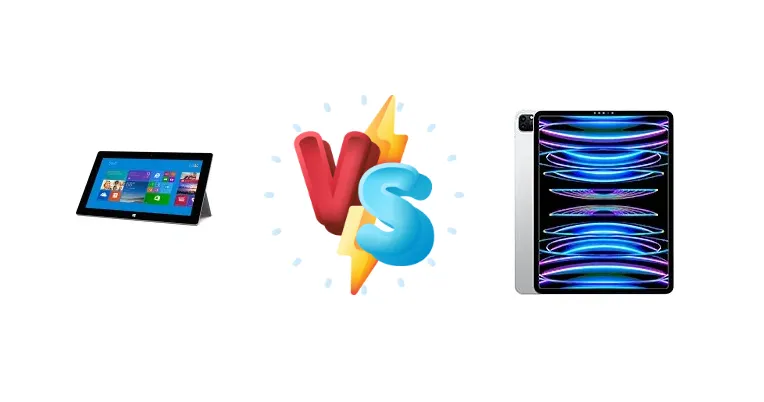
Surface 2 vs. iPad Pro 12.9 (2022): A Tale of Two Tablet Generations
| Phones Images | |||||
|---|---|---|---|---|---|
|
🏆 Quick Verdict
For the vast majority of users, the Apple iPad Pro 12.9 (2022) is the clear winner. Its Apple M2 chip delivers a performance leap over the Surface 2’s Nvidia Tegra 4, making it significantly faster for demanding tasks. However, the Surface 2 might appeal to users on a very tight budget or those deeply invested in the Windows ecosystem.
| PHONES | ||
|---|---|---|
| Phone Names | Microsoft Surface 2 | Apple iPad Pro 12.9 (2022) |
| Network | ||
|---|---|---|
| 2G bands | N/A | GSM 850 / 900 / 1800 / 1900 |
| 3G bands | - | HSDPA 850 / 900 / 1700(AWS) / 1900 / 2100 |
| 4G bands | - | 1, 2, 3, 4, 5, 7, 8, 11, 12, 13, 14, 17, 18, 19, 20, 21, 25, 26, 28, 29, 30, 32, 34, 38, 39, 40, 41, 42, 46, 48, 66, 71 - A2764, A2437 |
| 5G bands | - | 1, 2, 3, 5, 7, 8, 12, 14, 20, 25, 26, 28, 29, 30, 38, 40, 41, 48, 66, 70, 71, 77, 78, 79, 258, 260, 261 SA/NSA/Sub6/mmWave - A2764 |
| EDGE | No | - |
| GPRS | No | - |
| Speed | - | HSPA, LTE, 5G |
| Technology | No cellular connectivity | GSM / HSPA / LTE / 5G |
| - | 1, 2, 3, 5, 7, 8, 12, 14, 20, 25, 26, 28, 29, 30, 38, 40, 41, 48, 66, 70, 71, 77, 78, 79 SA/NSA/Sub6 - A2437, A2766 | |
| Launch | ||
|---|---|---|
| Announced | 2013, September. Released 2013, October | 2022, October 18 |
| Status | Discontinued | Available. Released 2022, October 26 |
| Body | ||
|---|---|---|
| Build | - | Glass front, aluminum back, aluminum frame |
| Dimensions | 274.6 x 172.5 x 8.9 mm (10.81 x 6.79 x 0.35 in) | 280.6 x 214.9 x 6.4 mm (11.05 x 8.46 x 0.25 in) |
| SIM | No | Nano-SIM + eSIM |
| Weight | 675.9 g (1.49 lb) | 682 g (Wi-Fi), 685 g (5G) (1.50 lb) |
| Built-in 2-stage kickstand | Stylus support (Bluetooth integration; magnetic) | |
| Display | ||
|---|---|---|
| Protection | - | Scratch-resistant glass, oleophobic coating |
| Resolution | 1920 x 1080 pixels, 16:9 ratio (~208 ppi density) | 2048 x 2732 pixels, 4:3 ratio (~265 ppi density) |
| Size | 10.6 inches, 309.8 cm2 (~65.4% screen-to-body ratio) | 12.9 inches, 515.3 cm2 (~85.4% screen-to-body ratio) |
| Type | TFT | Liquid Retina XDR mini-LED LCD, 120Hz, HDR10, Dolby Vision, 1000 nits (typ), 1600 nits (peak) |
| ClearType technology | - | |
| Platform | ||
|---|---|---|
| CPU | Quad-core 1.7 GHz Cortex-A15 | Octa-core (4x3.49 GHz performance cores, 4 efficiency cores) |
| Chipset | Nvidia Tegra 4 T40 | Apple M2 |
| GPU | ULP GeForce (72 cores) | Apple GPU (10-core graphics) |
| OS | Microsoft Windows RT | iPadOS 16.1, upgradable to iPadOS 26.1 |
| Memory | ||
|---|---|---|
| Card slot | microSDXC (dedicated slot) | No |
| Internal | 32GB 2GB RAM, 64GB 2GB RAM | 128GB 8GB RAM, 256GB 8GB RAM, 512GB 8GB RAM, 1TB 16GB RAM, 2TB 16GB RAM |
| Main Camera | ||
|---|---|---|
| Dual | - | 12 MP, f/1.8, (wide), 1/3.0", 1.22µm, dual pixel PDAF 10 MP, f/2.4, 125˚ (ultrawide) TOF 3D LiDAR scanner (depth) |
| Features | LED flash | Quad-LED dual-tone flash, HDR |
| Single | 5 MP, AF | 12 MP, f/2.4, 122˚ (ultrawide) |
| Video | 1080p@30fps | 4K@24/25/30/60fps, 1080p@25/30/60/120/240fps; gyro-EIS, ProRes |
| Selfie camera | ||
|---|---|---|
| Features | - | Face detection, HDR, panorama |
| Single | 3.5 MP | 12 MP, f/2.4, 122˚ (ultrawide) |
| Video | 1080p@30fps | 1080p@25/30/60fps, gyro-EIS, HDR |
| Sound | ||
|---|---|---|
| 3.5mm jack | Yes | No |
| 35mm jack | Yes | No |
| Loudspeaker | Yes, with stereo speakers | Yes, with stereo speakers (4 speakers) |
| Comms | ||
|---|---|---|
| Bluetooth | 4.0, A2DP | 5.3, A2DP, LE, EDR |
| NFC | No | No |
| Positioning | No | GPS, GLONASS, GALILEO, QZSS (Wi‑Fi + Cellular model only) |
| Radio | No | No |
| USB | USB 3.0, OTG | USB Type-C 4 (Thunderbolt 3), DisplayPort, magnetic connector |
| WLAN | Wi-Fi 802.11 a/b/g/n, dual-band, Wi-Fi Direct | Wi-Fi 802.11 a/b/g/n/ac/6e, dual-band, hotspot |
| Features | ||
|---|---|---|
| Sensors | Accelerometer, gyro, compass | Face ID, accelerometer, gyro, compass, barometer |
| TV-out via HDMI port MP4/DivX/XviD/WMV/H.264 player MP3/WAV/eAAC+/FLAC player Photo viewer/editor Microsoft Office 2013 RT SkyDrive (200 GB cloud storage) Skype free international calls and Wi-Fi for 1 year | - | |
| Battery | ||
|---|---|---|
| Type | Li-Ion, non-removable | Li-Po 10758 mAh (40.88 Wh) |
| Misc | ||
|---|---|---|
| Colors | Dark Titanium | Silver, Space Gray |
| Models | - | A2764, A2437, A2766, A2436, iPad14,5, iPad14,6 |
| Price | About 330 EUR | About 1450 EUR |
Microsoft Surface 2
- Extremely affordable (due to age)
- Runs full Windows 8.1
- Compact and relatively lightweight
- Outdated processor and limited performance
- Poor app ecosystem compared to iPadOS
- Limited software support
Apple iPad Pro 12.9 (2022)
- Exceptional performance with the Apple M2 chip
- Stunning Liquid Retina XDR display with ProMotion
- Robust app ecosystem and long-term software support
- High price point
- iPadOS limitations compared to full desktop OS
- Accessories (Apple Pencil, Magic Keyboard) are expensive
Display Comparison
The Surface 2 featured a 10.6-inch display, while the iPad Pro 12.9 (2022) boasts a significantly larger 12.9-inch Liquid Retina XDR display. While the Surface 2’s resolution was adequate for its time, the iPad Pro’s higher pixel density and mini-LED backlighting provide superior clarity and contrast. The iPad Pro also benefits from ProMotion technology (adaptive refresh rates up to 120Hz), resulting in smoother scrolling and animations, a feature absent on the Surface 2. The iPad Pro’s display is also brighter, offering better outdoor visibility.
Camera Comparison
The Surface 2’s camera capabilities were basic for its time, and details are scarce. The iPad Pro 12.9 (2022), however, features a more sophisticated camera system. While not its primary focus, the iPad Pro’s 12MP Wide camera with a larger sensor and improved image processing delivers significantly better image quality, particularly in low light. The inclusion of features like Smart HDR 4 and ProRes video recording further elevates its capabilities. The Surface 2’s camera is unlikely to compete in any meaningful way.
Performance
The performance gap between these devices is immense. The Surface 2’s Nvidia Tegra 4 T40, with its quad-core 1.7 GHz Cortex-A15 CPU, is dwarfed by the Apple M2. The M2’s octa-core configuration (4 performance cores at 3.49 GHz and 4 efficiency cores) and advanced architecture deliver multiple times the processing power. The M2’s unified memory architecture and significantly faster LPDDR5X RAM further enhance performance, especially in graphics-intensive tasks. The Surface 2 would struggle with modern mobile games and demanding applications, while the iPad Pro 12.9 (2022) handles them with ease. The M2’s efficiency also translates to better battery life under load.
Battery Life
The Surface 2’s battery life was reasonable for its era, but the iPad Pro 12.9 (2022) offers a more substantial battery capacity and, crucially, a far more efficient processor. While the Surface 2’s Tegra 4 consumed a significant amount of power, the M2’s efficiency allows the iPad Pro to deliver all-day battery life even with demanding workloads. The iPad Pro also supports faster charging, reducing downtime. While specific 0-100% times for the Surface 2 are difficult to ascertain, the iPad Pro can charge significantly faster with a compatible power adapter.
Buying Guide
Buy the Microsoft Surface 2 if you need a very affordable tablet for basic tasks like web browsing and light document editing, and you are already heavily invested in the Windows ecosystem. Buy the Apple iPad Pro 12.9 (2022) if you prioritize performance, a vibrant display, a robust app ecosystem, and are willing to pay a premium for a best-in-class tablet experience, particularly for creative work or demanding mobile gaming.