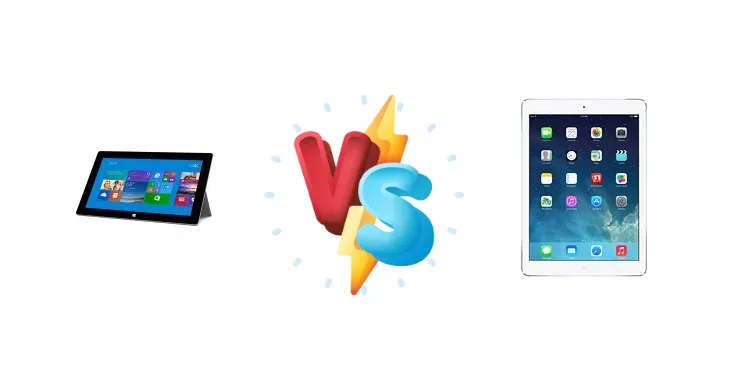
In 2013, the tablet landscape was rapidly evolving. Microsoft’s Surface 2, running Windows RT and powered by an Nvidia Tegra 4, aimed to challenge Apple’s iPad Air, a dominant force with its custom Apple A7 chip. This comparison dissects the core differences between these two tablets, focusing on performance, display, and the implications of their respective operating systems.
🏆 Quick Verdict
For the average user prioritizing app ecosystem and sustained performance, the iPad Air emerges as the superior choice. While the Surface 2 offered a familiar Windows-like interface, the A7’s architecture and optimization provided a smoother, more responsive experience, especially in demanding tasks.
| Network |
|---|
| 2G bands | N/A | GSM 850 / 900 / 1800 / 1900 |
| 3G bands | - | HSDPA 850 / 900 / 1700(AWS) / 1900 / 2100 |
| 4G bands | - | 1, 2, 3, 4, 5, 7, 8, 13, 17, 18, 19, 20, 25, 26 |
| EDGE | No | - |
| GPRS | No | - |
| Speed | - | HSPA 42.2/5.76 Mbps, LTE Cat3 100/50 Mbps, EV-DO Rev.A 3.1 Mbps - cellular model only |
| Technology | No cellular connectivity | GSM / CDMA / HSPA / EVDO / LTE |
| | - | CDMA2000 1xEV-DO |
| Launch |
|---|
| Announced | 2013, September. Released 2013, October | 2013, October 22. Released 2013, November 01 |
| Status | Discontinued | Discontinued |
| Body |
|---|
| Build | - | Glass front, aluminum back, aluminum frame |
| Dimensions | 274.6 x 172.5 x 8.9 mm (10.81 x 6.79 x 0.35 in) | 240 x 169.5 x 7.5 mm (9.45 x 6.67 x 0.30 in) |
| SIM | No | Nano-SIM (cellular model only) |
| Weight | 675.9 g (1.49 lb) | 469 g (Wi-Fi) / 478 g (3G/LTE) (1.03 lb) |
| | Built-in 2-stage kickstand | - |
| Display |
|---|
| Protection | - | Scratch-resistant glass, oleophobic coating |
| Resolution | 1920 x 1080 pixels, 16:9 ratio (~208 ppi density) | 1536 x 2048 pixels, 4:3 ratio (~264 ppi density) |
| Size | 10.6 inches, 309.8 cm2 (~65.4% screen-to-body ratio) | 9.7 inches, 291.4 cm2 (~71.6% screen-to-body ratio) |
| Type | TFT | IPS LCD |
| | ClearType technology | - |
| Platform |
|---|
| CPU | Quad-core 1.7 GHz Cortex-A15 | Dual-core 1.3 GHz Cyclone (ARM v8-based) |
| Chipset | Nvidia Tegra 4 T40 | Apple A7 (28 nm) |
| GPU | ULP GeForce (72 cores) | PowerVR G6430 (quad-core graphics) |
| OS | Microsoft Windows RT | iOS 7, upgradable to iPadOS 12.5.7 |
| Memory |
|---|
| Card slot | microSDXC (dedicated slot) | No |
| Internal | 32GB 2GB RAM, 64GB 2GB RAM | 16GB 1GB RAM, 32GB 1GB RAM, 64GB 1GB RAM, 128GB 1GB RAM |
| Main Camera |
|---|
| Features | LED flash | HDR |
| Single | 5 MP, AF | 5 MP, f/2.4, 33mm (standard), AF |
| Video | 1080p@30fps | 1080p@30fps |
| Selfie camera |
|---|
| Features | - | face detection, FaceTime over Wi-Fi or Cellular |
| Single | 3.5 MP | 1.2 MP |
| Video | 1080p@30fps | 720p@30fps |
| Sound |
|---|
| 3.5mm jack | Yes | Yes |
| 35mm jack | Yes | Yes |
| Loudspeaker | Yes, with stereo speakers | Yes, with stereo speakers |
| Comms |
|---|
| Bluetooth | 4.0, A2DP | 4.0, A2DP, EDR |
| NFC | No | No |
| Positioning | No | GPS, GLONASS - cellular model only |
| Radio | No | No |
| USB | USB 3.0, OTG | Lightning, USB 2.0 |
| WLAN | Wi-Fi 802.11 a/b/g/n, dual-band, Wi-Fi Direct | Wi-Fi 802.11 a/b/g/n, dual-band, hotspot |
| Features |
|---|
| Sensors | Accelerometer, gyro, compass | Accelerometer, gyro, compass |
| | TV-out via HDMI port
MP4/DivX/XviD/WMV/H.264 player
MP3/WAV/eAAC+/FLAC player
Photo viewer/editor
Microsoft Office 2013 RT
SkyDrive (200 GB cloud storage)
Skype free international calls and Wi-Fi for 1 year | - |
| Battery |
|---|
| Talk time | - | Up to 10 h (multimedia) |
| Type | Li-Ion, non-removable | Li-Po 8600 mAh, non-removable (32.4 Wh) |
| Misc |
|---|
| Colors | Dark Titanium | Space Gray, Silver |
| Models | - | A1474, A1475, A1476, iPad4,1, iPad4,2, iPad4,3 |
| Price | About 330 EUR | About 350 EUR |
| SAR | - | 1.18 W/kg (body) |
| SAR EU | - | 0.99 W/kg (body) |
| Tests |
|---|
| Audio quality | - |
Noise -93.9dB / Crosstalk -89.9dB |
| Camera | - |
Photo / Video |
| Display | - |
Contrast ratio: 968:1 (nominal) / 2.504:1 (sunlight) |
| Loudspeaker | - |
Voice 67dB / Noise 65dB / Ring 76dB
|
| Performance | - |
Basemark X: 13597 |
Microsoft Surface 2
- Familiar Windows-like interface (Windows RT)
- Integrated kickstand for versatile viewing angles
- Full-size USB port for easy peripheral connectivity
- Limited app ecosystem compared to iOS
- Windows RT’s performance limitations
- Tegra 4’s lower power efficiency
Apple iPad Air
- Superior performance with the Apple A7 chip
- Vibrant display with excellent contrast ratios
- Extensive app ecosystem and software support
- Less flexible operating system compared to Windows
- Proprietary Lightning connector
- No integrated kickstand
Display Comparison
The iPad Air boasts a contrast ratio of 968:1 (nominal) and 2.504:1 in sunlight, indicating excellent visibility even in bright conditions. While the Surface 2’s display specifications are not provided, Apple’s contrast ratios suggest a superior viewing experience, particularly outdoors. The iPad Air’s display technology, though not specified beyond the contrast ratio, likely benefits from Apple’s color calibration and panel quality control, resulting in more accurate and vibrant colors. The lack of detailed display specs for the Surface 2 makes a direct comparison difficult, but the iPad Air’s numbers suggest a clear advantage.
Camera Comparison
Both devices feature photo and video capabilities, but detailed camera specifications are absent. Given Apple’s historical focus on camera quality, the iPad Air likely possesses superior image processing and potentially a better sensor. The Surface 2’s camera, while functional, was likely positioned as a secondary feature, prioritizing other aspects of the tablet experience. Without specific details like sensor size or aperture, it’s difficult to make a definitive judgment, but Apple’s brand reputation suggests an advantage in image quality.
Performance
The core difference lies in the chipsets. The iPad Air’s Apple A7, a 28nm dual-core Cyclone processor based on the ARM v8 architecture, represents a significant leap forward in efficiency and performance compared to the Surface 2’s Nvidia Tegra 4 T40. While the Tegra 4 features a quad-core 1.7 GHz Cortex-A15 CPU, the A7’s ARM v8 architecture delivers improved instructions per clock (IPC) and a 64-bit instruction set, enabling it to handle more complex tasks with greater speed. The A7’s integrated GPU also likely outperforms the Tegra 4’s, providing a smoother experience in graphics-intensive applications and games. The Surface 2’s reliance on Windows RT further hampered performance, as it wasn’t fully optimized for the Tegra 4’s architecture.
Battery Life
Battery life is difficult to assess without independent testing data. The Surface 2’s Tegra 4, while powerful, is known to be less power-efficient than Apple’s A-series chips. The A7’s ARM v8 architecture and Apple’s software optimization likely contribute to longer battery life on the iPad Air, despite potentially having a similar capacity battery. The iPad Air’s power management is generally considered best-in-class, allowing it to extract maximum usage from its battery.
Buying Guide
Buy the Microsoft Surface 2 if you absolutely require a Windows environment and are comfortable with the limitations of Windows RT, and need the flexibility of a full desktop-like interface for specific software. Buy the Apple iPad Air if you prioritize a polished user experience, a vast app library, and consistently strong performance across a wide range of tasks, and value a streamlined, intuitive operating system.
Frequently Asked Questions
❓ Does the Nvidia Tegra 4 in the Surface 2 struggle with demanding applications like video editing?
Yes, the Tegra 4, coupled with the limitations of Windows RT, often exhibited performance bottlenecks in demanding applications. While capable of basic tasks, video editing and other resource-intensive workflows were noticeably slower and less responsive compared to the iPad Air’s A7 chip.
❓ How does the ARM v8 architecture of the A7 chip benefit the iPad Air’s performance?
The ARM v8 architecture introduced a 64-bit instruction set and improved IPC (instructions per clock). This allowed the A7 to process more data per cycle, resulting in faster application loading times, smoother multitasking, and improved performance in 64-bit optimized apps.
❓ Is Windows RT on the Surface 2 a significant limitation compared to full Windows?
Absolutely. Windows RT was a stripped-down version of Windows 8 designed for ARM processors. It lacked compatibility with many traditional Windows applications and relied on the Windows Store for software, which had a significantly smaller selection than the iPad’s App Store.