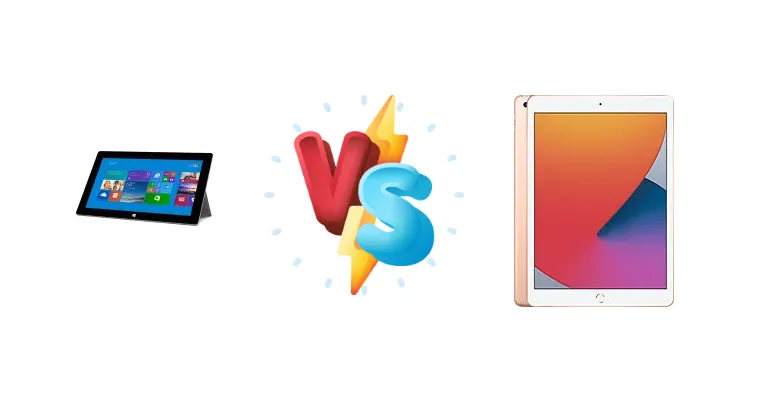
The Microsoft Surface 2 and the Apple iPad 10.2 (2020) represent distinct approaches to the tablet market. The Surface 2, powered by Nvidia's Tegra 4, aimed for a more PC-like experience, while the iPad 10.2 leveraged Apple’s A12 Bionic to deliver a streamlined, app-focused experience. This comparison dissects their core differences, focusing on performance, efficiency, and suitability for various user needs.
🏆 Quick Verdict
For the average user, the Apple iPad 10.2 (2020) is the superior choice. The A12 Bionic’s architectural advantages and optimized software ecosystem deliver significantly better performance and efficiency than the aging Nvidia Tegra 4 in the Surface 2, despite the Surface 2's attempt at a more desktop-like OS.
| Network |
|---|
| 2G bands | N/A | GSM 850 / 900 / 1800 / 1900 |
| 3G bands | - | HSDPA 800 / 850 / 900 / 1700(AWS) / 1900 / 2100 |
| 4G bands | - | 1, 2, 3, 4, 5, 7, 8, 11, 12, 13, 14, 17, 18, 19, 20, 21, 25, 26, 29, 30, 34, 38, 39, 40, 41, 66, 71 - A2428 |
| EDGE | No | - |
| GPRS | No | - |
| Speed | - | HSPA, LTE |
| Technology | No cellular connectivity | GSM / HSPA / LTE |
| | - | 1, 2, 3, 4, 5, 7, 8, 11, 12, 13, 14, 17, 18, 19, 20, 21, 25, 26, 28, 29, 30, 32, 34, 38, 39, 40, 41, 66 - A2429 |
| Launch |
|---|
| Announced | 2013, September. Released 2013, October | 2020, September 15 |
| Status | Discontinued | Available. Released 2020, September 18 |
| Body |
|---|
| Build | - | Glass front, aluminum back, aluminum frame |
| Dimensions | 274.6 x 172.5 x 8.9 mm (10.81 x 6.79 x 0.35 in) | 250.6 x 174.1 x 7.5 mm (9.87 x 6.85 x 0.30 in) |
| SIM | No | Nano-SIM + eSIM |
| Weight | 675.9 g (1.49 lb) | 490 g (Wi-Fi) / 495 g (LTE) (1.08 lb) |
| | Built-in 2-stage kickstand | Stylus support (1st gen only) |
| Display |
|---|
| Protection | - | Scratch-resistant glass, oleophobic coating |
| Resolution | 1920 x 1080 pixels, 16:9 ratio (~208 ppi density) | 1620 x 2160 pixels, 4:3 ratio (~264 ppi density) |
| Size | 10.6 inches, 309.8 cm2 (~65.4% screen-to-body ratio) | 10.2 inches, 324.6 cm2 (~74.4% screen-to-body ratio) |
| Type | TFT | Retina IPS LCD, 500 nits (typ) |
| | ClearType technology | - |
| Platform |
|---|
| CPU | Quad-core 1.7 GHz Cortex-A15 | Hexa-core (2x2.5 GHz Vortex + 4x1.6 GHz Tempest) |
| Chipset | Nvidia Tegra 4 T40 | Apple A12 Bionic (7 nm) |
| GPU | ULP GeForce (72 cores) | Apple GPU (4-core graphics) |
| OS | Microsoft Windows RT | iPadOS 14, upgradable to iPadOS 26.1 |
| Memory |
|---|
| Card slot | microSDXC (dedicated slot) | No |
| Internal | 32GB 2GB RAM, 64GB 2GB RAM | 32GB 3GB RAM, 128GB 3GB RAM |
| Main Camera |
|---|
| Features | LED flash | HDR, panorama |
| Single | 5 MP, AF | 8 MP, f/2.4, 31mm (standard), 1.12µm, AF |
| Video | 1080p@30fps | 1080p@30fps, 720p@120fps, HDR |
| Selfie camera |
|---|
| Features | - | HDR |
| Single | 3.5 MP | 1.2 MP, f/2.2, 31mm (standard) |
| Video | 1080p@30fps | 720p@30fps |
| Sound |
|---|
| 3.5mm jack | Yes | Yes |
| 35mm jack | Yes | Yes |
| Loudspeaker | Yes, with stereo speakers | Yes, with stereo speakers |
| Comms |
|---|
| Bluetooth | 4.0, A2DP | 4.2, A2DP, EDR, LE |
| NFC | No | No |
| Positioning | No | GPS, GLONASS (Wi‑Fi + Cellular model only) |
| Radio | No | No |
| USB | USB 3.0, OTG | Lightning, USB 2.0; magnetic connector |
| WLAN | Wi-Fi 802.11 a/b/g/n, dual-band, Wi-Fi Direct | Wi-Fi 802.11 a/b/g/n/ac, dual-band, hotspot |
| Features |
|---|
| Sensors | Accelerometer, gyro, compass | Fingerprint (front-mounted), accelerometer, gyro, compass, barometer |
| | TV-out via HDMI port
MP4/DivX/XviD/WMV/H.264 player
MP3/WAV/eAAC+/FLAC player
Photo viewer/editor
Microsoft Office 2013 RT
SkyDrive (200 GB cloud storage)
Skype free international calls and Wi-Fi for 1 year | - |
| Battery |
|---|
| Type | Li-Ion, non-removable | Li-Ion 8827 mAh (32.4 Wh) |
| Misc |
|---|
| Colors | Dark Titanium | Silver, Gold, Space Gray |
| Models | - | A2428, A2429, A2270, A2430, iPad11,6, iPad11,7 |
| Price | About 330 EUR | About 370 EUR |
Microsoft Surface 2
- Full Windows OS for software compatibility
- More traditional PC-like experience
- Potential for keyboard and mouse support
- Outdated Nvidia Tegra 4 processor
- Lower performance and efficiency
- Likely shorter battery life
Apple iPad 10.2 (2020)
- Powerful Apple A12 Bionic chip
- Excellent performance and efficiency
- Long battery life
- Access to a vast app ecosystem
- iPadOS limitations compared to Windows
- Less flexible file management
- Accessories often sold separately
Display Comparison
While specific display specs for the Surface 2 are not provided, it's reasonable to assume a resolution around 1080p given its market positioning. The iPad 10.2 (2020) features a 10.2-inch Retina display. The A12 Bionic’s image signal processor likely contributes to more accurate color reproduction on the iPad. The Tegra 4’s graphics capabilities, while decent for its time, would struggle to drive a high-refresh-rate display, a feature absent on both devices. The iPad’s display benefits from Apple’s color management, offering a more consistent viewing experience.
Camera Comparison
Neither device is known for its camera prowess. However, the iPad 10.2 (2020) likely benefits from Apple’s superior image processing algorithms, even with a relatively modest sensor. The Surface 2’s camera performance is likely to be more basic, relying heavily on hardware limitations. Without specific sensor details for the Surface 2, it’s difficult to make a precise comparison, but the A12 Bionic’s ISP provides a clear advantage in image quality and video recording.
Performance
The core difference lies in the chipsets. The Apple A12 Bionic, built on a 7nm process, boasts a hexa-core CPU (2x2.5 GHz Vortex + 4x1.6 GHz Tempest) and a custom GPU. This architecture is significantly more advanced than the Nvidia Tegra 4 T40’s quad-core 1.7 GHz Cortex-A15 CPU. The A12 Bionic’s performance per watt is substantially higher, meaning it delivers more processing power with less energy consumption. The Tegra 4, while capable, suffers from its older architecture and larger manufacturing process, leading to lower efficiency and potential thermal throttling under sustained load. This translates to smoother multitasking, faster app loading times, and better gaming performance on the iPad 10.2.
Battery Life
The A12 Bionic’s efficiency is a major advantage in battery life. While the iPad 10.2’s battery capacity isn’t dramatically larger than what the Surface 2 likely offered, the A12’s lower power consumption translates to significantly longer usage times. The Tegra 4, being an older and less efficient chip, will drain the battery faster, especially during demanding tasks. The iPad 10.2 supports standard charging speeds for its time, while the Surface 2’s charging speed is likely slower due to its older technology.
Buying Guide
Buy the Microsoft Surface 2 if you specifically require a full Windows operating system for legacy software compatibility or specialized applications. Its form factor, while dated, offers a more traditional computing experience. Buy the Apple iPad 10.2 (2020) if you prioritize app availability, smooth performance, long battery life, and a user-friendly interface. It’s ideal for media consumption, casual gaming, and productivity tasks within the Apple ecosystem.
Frequently Asked Questions
❓ Will the Surface 2 struggle with modern web browsing and multitasking?
Yes, the Nvidia Tegra 4 is significantly outdated. Modern websites with complex scripts and multiple browser tabs will likely cause noticeable slowdowns and lag on the Surface 2. Multitasking between several apps will also be less fluid compared to the iPad 10.2.
❓ Can the iPad 10.2 (2020) handle demanding games like PUBG Mobile or Call of Duty Mobile?
The A12 Bionic is capable of running these games at medium to high settings with playable frame rates. While it won’t match the performance of newer iPads, it provides a solid gaming experience. The Surface 2’s Tegra 4 would likely struggle with these titles, requiring significantly reduced graphics settings and potentially experiencing frame rate drops.
❓ Is the Surface 2 a viable option for running Windows-specific software?
This is the Surface 2’s primary strength. If you absolutely need to run legacy Windows applications or software that isn’t available on iPadOS, the Surface 2 is a viable, albeit compromised, option. However, be prepared for slower performance compared to running the same software on a more modern Windows machine.