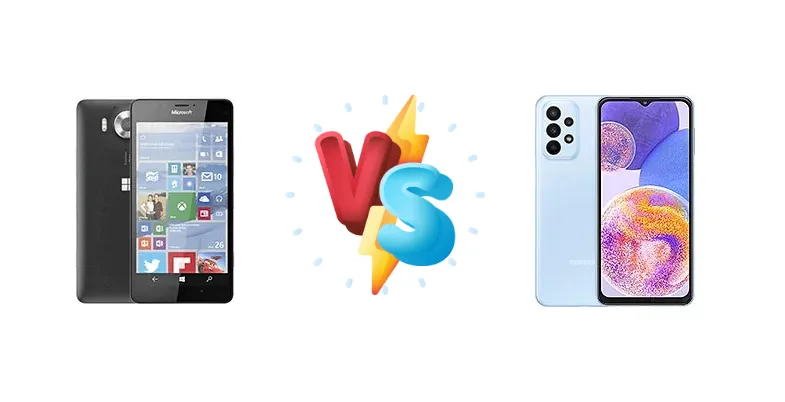
The Microsoft Lumia 950, a 2015 flagship, represents a bygone era of Windows Phone ambition. We're pitting it against the Samsung Galaxy A23, a modern budget device, to see if premium hardware age can overcome sheer endurance and current-generation efficiency. This isn't about raw power; it's about usability in 2024.
🏆 Quick Verdict
For the average user in 2024, the Samsung Galaxy A23 is the clear winner. Its significantly superior battery life (130h vs 48h) and continued software support outweigh the Lumia 950’s higher display contrast. The A23 offers a practical, reliable experience, while the Lumia 950 is hampered by its age and platform limitations.
| Network |
|---|
| 2G bands | GSM 850 / 900 / 1800 / 1900 | GSM 850 / 900 / 1800 / 1900 |
| 3G bands | HSDPA 850 / 900 / 1700(AWS) / 1900 / 2100 | HSDPA 850 / 900 / 2100 |
| 4G bands | 1, 2, 3, 4, 5, 7, 8, 12, 17, 20, 28, 38, 40 - EMEA | 1, 3, 5, 7, 8, 20, 28, 38, 40, 41 |
| Speed | HSPA 42.2/5.76 Mbps, LTE Cat6 300/50 Mbps | HSPA, LTE |
| Technology | GSM / HSPA / LTE | GSM / HSPA / LTE |
| | 1, 2, 3, 4, 5, 7, 8, 12, 17, 20, 28, 38, 40, 41 - USA | - |
| Launch |
|---|
| Announced | 2015, October. Released 2015, November | 2022, March 04 |
| Status | Discontinued | Available. Released 2022, March 25 |
| Body |
|---|
| Build | - | Glass front (Gorilla Glass 5), plastic frame, plastic back |
| Dimensions | 145 x 73.2 x 8.2 mm (5.71 x 2.88 x 0.32 in) | 165.4 x 76.9 x 8.4 mm (6.51 x 3.03 x 0.33 in) |
| SIM | Nano-SIM | · Nano-SIM· Nano-SIM + Nano-SIM |
| Weight | 150 g (5.29 oz) | 195 g (6.88 oz) |
| Display |
|---|
| Protection | Corning Gorilla Glass 3 | Corning Gorilla Glass 5 |
| Resolution | 1440 x 2560 pixels, 16:9 ratio (~564 ppi density) | 1080 x 2408 pixels, 20:9 ratio (~400 ppi density) |
| Size | 5.2 inches, 74.8 cm2 (~70.5% screen-to-body ratio) | 6.6 inches, 104.9 cm2 (~82.5% screen-to-body ratio) |
| Type | AMOLED | PLS LCD, 90Hz |
| | ClearBlack display | - |
| Platform |
|---|
| CPU | Hexa-core (4x1.4 GHz Cortex-A53 & 2x1.8 GHz Cortex-A57) | Octa-core (4x2.4 GHz Kryo 265 Gold & 4x1.9 GHz Kryo 265 Silver) |
| Chipset | Qualcomm MSM8992 Snapdragon 808 (20 nm) | Qualcomm SM6225 Snapdragon 680 4G (6 nm) |
| GPU | Adreno 418 | Adreno 610 |
| OS | Microsoft Windows 10 | Android 12, upgradable to Android 14, One UI 6.1 |
| Memory |
|---|
| Card slot | microSDXC (dedicated slot) | microSDXC (dedicated slot) |
| Internal | 32GB 3GB RAM | 64GB 4GB RAM, 64GB 6GB RAM, 128GB 4GB RAM, 128GB 6GB RAM, 128GB 8GB RAM |
| | eMMC 5.0 | eMMC 5.1 |
| Main Camera |
|---|
| Features | Zeiss optics, triple-LED RGB flash, panorama, HDR | LED flash, panorama, HDR |
| Quad | - | 50 MP, f/1.8, (wide), PDAF, OIS
5 MP, f/2.2, 123˚ (ultrawide), 1/5.0", 1.12µm
2 MP (macro)
Auxiliary lens |
| Single | 20 MP, f/1.9, 26mm (wide), 1/2.4", 1.12µm, AF, OIS | 8 MP, f/2.2, (wide) |
| Video | 4K@30fps, stereo sound rec., 1080p@30/60fps (after SW update) | 1080p@30fps |
| Selfie camera |
|---|
| Single | 5 MP, f/2.4 | 8 MP, f/2.2, (wide) |
| Video | 1080p@30fps | 1080p@30fps |
| Sound |
|---|
| 3.5mm jack | Yes | Yes |
| 35mm jack | Yes | Yes |
| Loudspeaker | Yes | Yes |
| Comms |
|---|
| Bluetooth | 4.1, A2DP | 5.0, A2DP, LE |
| NFC | Yes | Yes (market/region dependent) |
| Positioning | GPS, GLONASS, BDS | GPS, GLONASS, GALILEO, BDS |
| Radio | FM radio | FM radio |
| USB | USB Type-C 3.1 | USB Type-C 2.0 |
| WLAN | Wi-Fi 802.11 a/b/g/n/ac, dual-band, hotspot | Wi-Fi 802.11 a/b/g/n/ac, dual-band, Wi-Fi Direct |
| Features |
|---|
| Sensors | Iris scanner, accelerometer, gyro, proximity, compass, barometer, sensor core | Fingerprint (side-mounted), accelerometer, gyro, compass |
| | Microsoft Continuum support | Virtual proximity sensing |
| Battery |
|---|
| Charging | 18W wired
Wireless (Qi) (market dependent) | 25W wired |
| Music play | Up to 67 h | - |
| Stand-by | Up to 288 h (2G) / Up to 288 h (3G) | - |
| Talk time | Up to 23 h (2G) / Up to 18 h (3G) | - |
| Type | Li-Ion 3000 mAh, removable | Li-Po 5000 mAh |
| Misc |
|---|
| Colors | Black, White | Black, White, Peach, Blue |
| Models | - | SM-A235F, SM-A235F/DS, SM-A235F/DSN, SM-A235M, SM-A235M/DS, SM-A235N |
| Price | About 280 EUR | £ 99.00 / ₹ 14,999 |
| SAR | - | 0.48 W/kg (head) |
| SAR EU | - | 0.36 W/kg (head) 0.96 W/kg (body) |
| Tests |
|---|
| Audio quality |
Noise -91.3dB / Crosstalk -91.6dB | - |
| Battery life |
Endurance rating 48h
|
Endurance rating 130h
|
| Camera |
Photo / Video |
Photo / Video |
| Display |
Contrast ratio: Infinite (nominal), 3512 (sunlight) |
Contrast ratio: 1241:1 |
| Loudspeaker |
Voice 71dB / Noise 73dB / Ring 77dB
|
-27.6 LUFS (Good)
|
| Performance |
Basemark OS II 2.0: 1281Basemark X: 26330 |
AnTuTu: 273554 (v9)
GeekBench: 1632 (v5.1)
GFXBench: 6.7fps (ES 3.1 onscreen) |
Microsoft Lumia 950
- Potentially superior display contrast ratio
- Qi wireless charging support (market dependent)
- Premium build quality for its time
- Outdated operating system (Windows Phone)
- Poor battery life compared to modern standards
- Limited app availability
- Older chipset with potential throttling issues
Samsung Galaxy A23
- Exceptional battery life
- Modern Android operating system with app support
- Efficient Snapdragon 680 chipset
- Faster 25W charging
- Lower display contrast ratio
- Budget-oriented build quality
- Less impressive camera system compared to flagship contemporaries
Display Comparison
The Lumia 950 boasts an 'infinite' (nominal) contrast ratio and a remarkable 3512:1 sunlight contrast, suggesting excellent visibility outdoors. However, this is a specification from 2015. The Galaxy A23’s 1241:1 contrast ratio and 464 nits peak brightness are considerably lower on paper, but represent a more realistic experience for modern viewing habits. The Lumia’s contrast advantage is likely noticeable, but the A23’s brightness is sufficient for most users. The A23’s panel technology is likely TFT LCD, while the Lumia 950 used OLED, further emphasizing the contrast difference, but also potential burn-in risks on the older device.
Camera Comparison
Both devices offer photo and video capabilities, but detailed sensor information is lacking. The Lumia 950 was known for its excellent image processing and Carl Zeiss optics, potentially offering superior image quality in ideal conditions. However, the Galaxy A23 benefits from modern image processing algorithms and likely a larger main sensor (though specifics are unavailable). The A23’s camera system is likely more versatile in varying lighting conditions, and benefits from ongoing software improvements. We can assume the A23 has a more robust and actively developed camera software stack.
Performance
The Qualcomm MSM8992 Snapdragon 808 in the Lumia 950 was a high-end chip in 2015, featuring a hexa-core CPU. However, the Samsung Galaxy A23’s Snapdragon 680, built on a more efficient 6nm process, offers a more balanced experience. While the 808’s Cortex-A57 cores provide burst performance, the A23’s octa-core CPU (4x2.4 GHz Kryo 265 Gold & 4x1.9 GHz Kryo 265 Silver) delivers consistent performance for everyday tasks. The 6nm node of the Snapdragon 680 also translates to better thermal management, preventing throttling during sustained use, a potential issue for the older 20nm Snapdragon 808.
Battery Life
The Galaxy A23 dominates in battery life with an endurance rating of 130 hours, compared to the Lumia 950’s 48 hours. This is a massive difference, translating to multi-day usage for the A23 versus a single day for the Lumia. The A23 also supports 25W wired charging, significantly faster than the Lumia 950’s 18W charging. While the Lumia 950 offered Qi wireless charging (market dependent), the A23’s superior battery capacity and faster charging make it the more practical choice for users who prioritize longevity.
Buying Guide
Buy the Microsoft Lumia 950 if you're a collector of mobile technology, specifically interested in the Windows Phone ecosystem, and prioritize a potentially superior display contrast ratio. Buy the Samsung Galaxy A23 if you need a dependable, long-lasting smartphone with a modern operating system, readily available apps, and a focus on battery endurance for everyday use.
Frequently Asked Questions
❓ Is the Lumia 950 still secure to use with its outdated Windows Phone OS?
No. Microsoft ended support for Windows Phone in 2019. Using a Lumia 950 in 2024 poses significant security risks due to the lack of security updates. It's highly discouraged for any tasks involving personal data.
❓ Can I still find apps for the Lumia 950?
App availability for Windows Phone is extremely limited. While some legacy apps may still function, the vast majority of modern applications are not compatible. The Galaxy A23, running Android, has access to millions of apps through the Google Play Store.
❓ Does the Snapdragon 680 in the Galaxy A23 struggle with demanding games?
The Snapdragon 680 is a budget-focused chipset. While it can handle many popular games, you may need to lower graphics settings for smoother performance in more demanding titles. It's not a gaming powerhouse, but it's sufficient for casual gaming.
❓ How does the Lumia 950's camera compare to modern smartphone cameras?
While the Lumia 950's camera was excellent for its time, modern smartphone cameras have made significant advancements in sensor technology, image processing, and low-light performance. The Galaxy A23 likely offers a more versatile and consistently reliable camera experience.