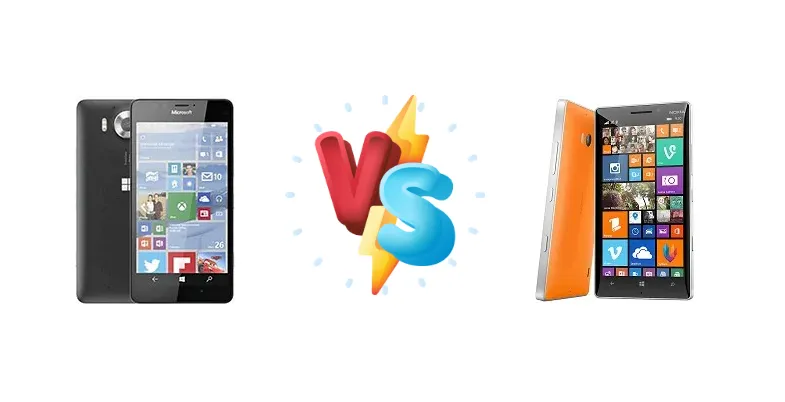
The Microsoft Lumia 950 and Nokia Lumia 930 represent pivotal moments in Microsoft’s attempt to conquer the smartphone market with Windows Phone. Released roughly a year apart, both devices aimed for the flagship space, but employed different approaches to achieve it. This comparison dissects their key specifications to determine which device delivers the best experience, particularly considering the advancements in processing power and display technology between their release dates.
🏆 Quick Verdict
For the average user seeking the best overall experience, the Microsoft Lumia 950 emerges as the superior choice. Its Snapdragon 808 chipset, while not a generational leap, offers a performance edge over the 930’s Snapdragon 800, and its slightly improved battery endurance, coupled with faster wired charging, makes it more practical for daily use.
| Network |
|---|
| 2G bands | GSM 850 / 900 / 1800 / 1900 | GSM 850 / 900 / 1800 / 1900 |
| 3G bands | HSDPA 850 / 900 / 1700(AWS) / 1900 / 2100 | HSDPA 850 / 900 / 1900 / 2100 |
| 4G bands | 1, 2, 3, 4, 5, 7, 8, 12, 17, 20, 28, 38, 40 - EMEA | 1, 3, 7, 8, 20 |
| Speed | HSPA 42.2/5.76 Mbps, LTE Cat6 300/50 Mbps | HSPA 42.2/5.76 Mbps, LTE Cat4 150/50 Mbps |
| Technology | GSM / HSPA / LTE | GSM / HSPA / LTE |
| | 1, 2, 3, 4, 5, 7, 8, 12, 17, 20, 28, 38, 40, 41 - USA | - |
| Launch |
|---|
| Announced | 2015, October. Released 2015, November | 2014, April. Released 2014, July |
| Status | Discontinued | Discontinued |
| Body |
|---|
| Dimensions | 145 x 73.2 x 8.2 mm (5.71 x 2.88 x 0.32 in) | 137 x 71 x 9.8 mm, 94.7 cc (5.39 x 2.80 x 0.39 in) |
| SIM | Nano-SIM | Nano-SIM |
| Weight | 150 g (5.29 oz) | 167 g (5.89 oz) |
| Display |
|---|
| Protection | Corning Gorilla Glass 3 | Corning Gorilla Glass 3 |
| Resolution | 1440 x 2560 pixels, 16:9 ratio (~564 ppi density) | 1080 x 1920 pixels, 16:9 ratio (~441 ppi density) |
| Size | 5.2 inches, 74.8 cm2 (~70.5% screen-to-body ratio) | 5.0 inches, 68.9 cm2 (~70.9% screen-to-body ratio) |
| Type | AMOLED | AMOLED |
| | ClearBlack display | ClearBlack display |
| Platform |
|---|
| CPU | Hexa-core (4x1.4 GHz Cortex-A53 & 2x1.8 GHz Cortex-A57) | Quad-core 2.2 GHz Krait 400 |
| Chipset | Qualcomm MSM8992 Snapdragon 808 (20 nm) | Qualcomm MSM8974 Snapdragon 800 (28 nm) |
| GPU | Adreno 418 | Adreno 330 |
| OS | Microsoft Windows 10 | Microsoft Windows Phone 8.1, upgradable to Windows 10 |
| Memory |
|---|
| Card slot | microSDXC (dedicated slot) | No |
| Internal | 32GB 3GB RAM | 32GB 2GB RAM |
| | eMMC 5.0 | eMMC 4.5 |
| Main Camera |
|---|
| Features | Zeiss optics, triple-LED RGB flash, panorama, HDR | Zeiss optics, dual-LED flash, panorama, HDR |
| Single | 20 MP, f/1.9, 26mm (wide), 1/2.4", 1.12µm, AF, OIS | 20 MP, f/2.4, 26mm (wide), 1/2.5", AF, OIS |
| Video | 4K@30fps, stereo sound rec., 1080p@30/60fps (after SW update) | 4K@30fps (after WP8 Denim update), 1080p@30fps, stereo sound rec. |
| Selfie camera |
|---|
| Single | 5 MP, f/2.4 | 1.2 MP |
| Video | 1080p@30fps | 720p@30fps |
| Sound |
|---|
| 3.5mm jack | Yes | Yes |
| 35mm jack | Yes | Yes |
| Loudspeaker | Yes | Yes |
| Comms |
|---|
| Bluetooth | 4.1, A2DP | 4.0, A2DP, EDR, LE/ aptX after WP8 Denim update |
| NFC | Yes | Yes |
| Positioning | GPS, GLONASS, BDS | GPS, GLONASS |
| Radio | FM radio | FM radio |
| USB | USB Type-C 3.1 | microUSB 2.0 |
| WLAN | Wi-Fi 802.11 a/b/g/n/ac, dual-band, hotspot | Wi-Fi 802.11 a/b/g/n/ac, dual-band, DLNA, hotspot |
| Features |
|---|
| Sensors | Iris scanner, accelerometer, gyro, proximity, compass, barometer, sensor core | Accelerometer, gyro, proximity, compass, sensor core |
| | Microsoft Continuum support | - |
| Battery |
|---|
| Charging | 18W wired
Wireless (Qi) (market dependent) | Wireless (Qi) (market dependent) |
| Music play | Up to 67 h | Up to 75 h |
| Stand-by | Up to 288 h (2G) / Up to 288 h (3G) | Up to 432 h |
| Talk time | Up to 23 h (2G) / Up to 18 h (3G) | Up to 11 h 30 min (2G) / Up to 15 h 30 min (3G) |
| Type | Li-Ion 3000 mAh, removable | Li-Ion 2420 mAh, non-removable (BV-5QW) |
| Misc |
|---|
| Colors | Black, White | Bright orange, bright green, white, black, gold |
| Price | About 280 EUR | About 370 EUR |
| SAR | - | 0.90 W/kg (head) 0.56 W/kg (body) |
| SAR EU | - | 0.60 W/kg (head) 0.73 W/kg (body) |
| Tests |
|---|
| Audio quality |
Noise -91.3dB / Crosstalk -91.6dB |
Noise -91.4dB / Crosstalk -90.3dB |
| Battery life |
Endurance rating 48h
| Endurance rating 46h |
| Camera |
Photo / Video |
Photo / Video |
| Display |
Contrast ratio: Infinite (nominal), 3512 (sunlight) |
Contrast ratio: Infinite (nominal), 3.567 (sunlight) |
| Loudspeaker |
Voice 71dB / Noise 73dB / Ring 77dB
|
Voice 76dB / Noise 69dB / Ring 77dB |
| Performance |
Basemark OS II 2.0: 1281Basemark X: 26330 | - |
Microsoft Lumia 950
- Faster charging (18W wired)
- More efficient Snapdragon 808 chipset
- Improved sunlight readability
- Likely better image processing
- Potentially larger physical size
- Windows 10 Mobile software (potential for bugs)
Nokia Lumia 930
- Excellent build quality
- Proven reliability
- Compact form factor
- Qi wireless charging
- Older Snapdragon 800 chipset
- Slower charging (wireless only)
- Lower sunlight readability
Display Comparison
Both the Lumia 950 and 930 boast displays with an 'Infinite' nominal contrast ratio, a marketing term common at the time. However, the Lumia 950 significantly outperforms the 930 in sunlight readability, achieving a contrast ratio of 3512 compared to the 930’s 3.567. This suggests superior outdoor visibility for the 950. While both likely utilize AMOLED technology (implied by the contrast ratios), the 950’s higher sunlight contrast indicates improved panel calibration or potentially a brighter panel, benefiting users frequently exposed to direct sunlight.
Camera Comparison
Both devices are listed as having 'Photo / Video' capabilities, lacking specific details. However, given the Lumia line’s reputation, both likely feature capable cameras. The 950, being the newer device, likely benefits from improved image processing algorithms within Windows 10 Mobile. Without sensor size or aperture information, a definitive camera comparison is impossible, but the 950’s later release date suggests potential enhancements in low-light performance and video stabilization. The absence of detail highlights a common issue with marketing materials – focusing on features rather than quantifiable improvements.
Performance
The core difference lies in the chipsets. The Lumia 950’s Qualcomm MSM8992 Snapdragon 808, built on a 20nm process, represents an architectural improvement over the Lumia 930’s MSM8974 Snapdragon 800 (28nm). The 808’s hexa-core CPU (4x1.4 GHz Cortex-A53 & 2x1.8 GHz Cortex-A57) offers a more balanced approach to performance and efficiency compared to the 930’s quad-core 2.2 GHz Krait 400. The smaller 20nm node of the 808 translates to better thermal efficiency, potentially reducing throttling during sustained workloads. While the 930’s higher clock speed might offer a slight advantage in single-core tasks, the 950’s architecture and efficiency provide a more consistent experience overall.
Battery Life
Both phones achieve an endurance rating of approximately 46-48 hours, indicating similar real-world battery performance. However, the Lumia 950 gains an advantage with its 18W wired charging capability, significantly faster than the 930’s reliance solely on Qi wireless charging. This faster charging reduces downtime and makes the 950 more convenient for users who frequently need to top up their battery. While both support Qi wireless charging (market dependent), the 950’s wired charging speed provides a crucial advantage.
Buying Guide
Buy the Microsoft Lumia 950 if you prioritize future-proofing with a more modern chipset, faster charging speeds, and a slightly longer battery life. It’s the better option for users who demand a smoother experience with Windows 10 Mobile. Buy the Nokia Lumia 930 if you value a proven, reliable device with excellent build quality and are less concerned with having the absolute latest processing power. It remains a compelling option for those still invested in the Windows Phone ecosystem and prefer a slightly more compact form factor.
Frequently Asked Questions
❓ Does the Snapdragon 808 in the Lumia 950 suffer from the same overheating issues as the Snapdragon 810?
The Snapdragon 808 is a different architecture than the problematic 810. While it can still generate heat under sustained load, it's significantly less prone to overheating and throttling compared to its successor. The 20nm process contributes to better thermal management.
❓ Is the Lumia 950's camera significantly better than the Lumia 930's in low-light conditions?
While specific camera specs are lacking, the Lumia 950 likely benefits from improved image processing algorithms and potentially a more advanced sensor. This would translate to better low-light performance, reducing noise and improving detail in challenging lighting scenarios.
❓ Can either the Lumia 950 or 930 be upgraded to Windows 11?
Unfortunately, neither the Lumia 950 nor the Lumia 930 are officially supported for Windows 11. Microsoft has ended support for Windows 10 Mobile, meaning there will be no further operating system updates for these devices.