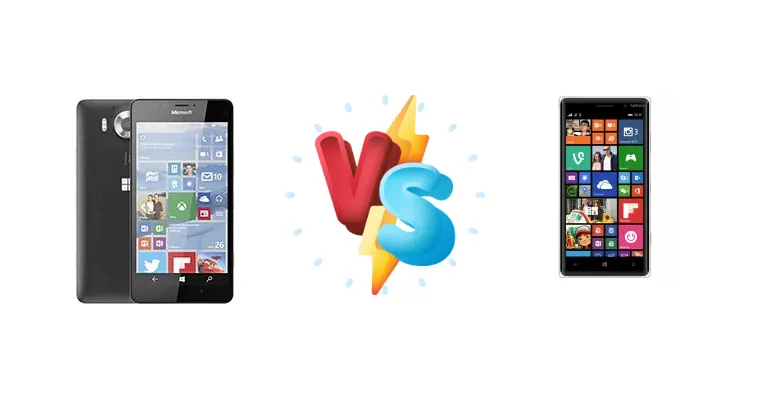
Released within a similar timeframe as Microsoft transitioned the Lumia brand, the 950 and 830 represent diverging strategies. The 950 aimed for a flagship experience with a powerful processor, while the 830 prioritized battery life and affordability. This comparison dissects their key differences to help understand which device better suits your needs, even years after their release.
🏆 Quick Verdict
For users prioritizing performance and display quality, the Microsoft Lumia 950 is the clear winner. Its Snapdragon 808 chipset delivers a significantly faster experience. However, the Nokia Lumia 830 excels in battery endurance, offering 68 hours of use, making it ideal for those needing extended uptime.
| Network |
|---|
| 2G bands | GSM 850 / 900 / 1800 / 1900 | GSM 850 / 900 / 1800 / 1900 |
| 3G bands | HSDPA 850 / 900 / 1700(AWS) / 1900 / 2100 | HSDPA 850 / 900 / 1900 / 2100 |
| 4G bands | 1, 2, 3, 4, 5, 7, 8, 12, 17, 20, 28, 38, 40 - EMEA | 1, 3, 7, 8, 20 |
| Speed | HSPA 42.2/5.76 Mbps, LTE Cat6 300/50 Mbps | HSPA 42.2/5.76 Mbps, LTE Cat4 150/50 Mbps |
| Technology | GSM / HSPA / LTE | GSM / HSPA / LTE |
| | 1, 2, 3, 4, 5, 7, 8, 12, 17, 20, 28, 38, 40, 41 - USA | 2, 4, 5, 17 - AT&T |
| Launch |
|---|
| Announced | 2015, October. Released 2015, November | 2014, September. Released 2014, September |
| Status | Discontinued | Discontinued |
| Body |
|---|
| Dimensions | 145 x 73.2 x 8.2 mm (5.71 x 2.88 x 0.32 in) | 139.4 x 70.7 x 8.5 mm (5.49 x 2.78 x 0.33 in) |
| SIM | Nano-SIM | Nano-SIM |
| Weight | 150 g (5.29 oz) | 150 g (5.29 oz) |
| Display |
|---|
| Protection | Corning Gorilla Glass 3 | Corning Gorilla Glass 3 |
| Resolution | 1440 x 2560 pixels, 16:9 ratio (~564 ppi density) | 720 x 1280 pixels, 16:9 ratio (~294 ppi density) |
| Size | 5.2 inches, 74.8 cm2 (~70.5% screen-to-body ratio) | 5.0 inches, 68.9 cm2 (~69.9% screen-to-body ratio) |
| Type | AMOLED | IPS LCD |
| | ClearBlack display | ClearBlack display |
| Platform |
|---|
| CPU | Hexa-core (4x1.4 GHz Cortex-A53 & 2x1.8 GHz Cortex-A57) | Quad-core 1.2 GHz Cortex-A7 |
| Chipset | Qualcomm MSM8992 Snapdragon 808 (20 nm) | Qualcomm Snapdragon 400 (28 nm) |
| GPU | Adreno 418 | Adreno 305 |
| OS | Microsoft Windows 10 | Microsoft Windows Phone 8.1, upgradable to Microsoft Windows 10 |
| Memory |
|---|
| Card slot | microSDXC (dedicated slot) | microSDXC (dedicated slot) |
| Internal | 32GB 3GB RAM | 16GB 1GB RAM |
| | eMMC 5.0 | eMMC 4.5 |
| Main Camera |
|---|
| Features | Zeiss optics, triple-LED RGB flash, panorama, HDR | Zeiss optics, LED flash, panorama |
| Single | 20 MP, f/1.9, 26mm (wide), 1/2.4", 1.12µm, AF, OIS | 10 MP, f/2.2, 26mm (wide), 1/3.4", AF, OIS |
| Video | 4K@30fps, stereo sound rec., 1080p@30/60fps (after SW update) | 1080p@30fps, stereo sound rec. |
| Selfie camera |
|---|
| Single | 5 MP, f/2.4 | 0.9 MP |
| Video | 1080p@30fps | 720p |
| Sound |
|---|
| 3.5mm jack | Yes | Yes |
| 35mm jack | Yes | Yes |
| Loudspeaker | Yes | Yes |
| Comms |
|---|
| Bluetooth | 4.1, A2DP | 4.0, A2DP, EDR, LE, aptX |
| NFC | Yes | Yes |
| Positioning | GPS, GLONASS, BDS | GPS, GLONASS, BDS |
| Radio | FM radio | FM radio |
| USB | USB Type-C 3.1 | microUSB 2.0 |
| WLAN | Wi-Fi 802.11 a/b/g/n/ac, dual-band, hotspot | Wi-Fi 802.11 a/b/g/n, dual-band, DLNA, hotspot |
| Features |
|---|
| Sensors | Iris scanner, accelerometer, gyro, proximity, compass, barometer, sensor core | Accelerometer, gyro, proximity, compass |
| | Microsoft Continuum support | - |
| Battery |
|---|
| Charging | 18W wired
Wireless (Qi) (market dependent) | Wireless (Qi) |
| Music play | Up to 67 h | Up to 78 h |
| Stand-by | Up to 288 h (2G) / Up to 288 h (3G) | Up to 528 h |
| Talk time | Up to 23 h (2G) / Up to 18 h (3G) | Up to 12 h 54 min (2G) / Up to 14 h 48 min (3G) |
| Type | Li-Ion 3000 mAh, removable | Li-Ion 2200 mAh, removable (BV-L4A) |
| Misc |
|---|
| Colors | Black, White | Orange, green, white, black, gold |
| Price | About 280 EUR | About 330 EUR |
| SAR | - | 0.87 W/kg (head) 0.83 W/kg (body) |
| SAR EU | - | 0.46 W/kg (head) 0.59 W/kg (body) |
| Tests |
|---|
| Audio quality |
Noise -91.3dB / Crosstalk -91.6dB |
Noise -89.7dB / Crosstalk -91.6dB |
| Battery life |
Endurance rating 48h
|
Endurance rating 68h
|
| Camera |
Photo / Video |
Photo / Video |
| Display |
Contrast ratio: Infinite (nominal), 3512 (sunlight) |
Contrast ratio: 1078 (nominal), 1887 (sunlight) |
| Loudspeaker |
Voice 71dB / Noise 73dB / Ring 77dB
|
Voice 65dB / Noise 66dB / Ring 78dB
|
| Performance |
Basemark OS II 2.0: 1281Basemark X: 26330 | - |
Microsoft Lumia 950
- Faster processor for smoother performance
- Superior display contrast and brightness
- Potentially better camera image processing
- Faster wired charging (18W)
- Shorter battery life (48h endurance)
- Market-dependent wireless charging
Nokia Lumia 830
- Exceptional battery life (68h endurance)
- Integrated Qi wireless charging
- More affordable price point
- Efficient Snapdragon 400 chipset
- Slower processor for demanding tasks
- Lower display contrast ratio
Display Comparison
The Lumia 950 boasts a superior display experience, evidenced by its infinite (nominal) contrast ratio compared to the 830’s 1078. While both achieve respectable sunlight readability with 3512 and 1887 nits respectively, the 950’s higher contrast translates to richer blacks and more vibrant colors. This difference is particularly noticeable when viewing HDR content, though the impact is limited by the age of the devices and the capabilities of Windows Phone’s display engine. Both displays share the same resolution, meaning pixel density isn’t a differentiating factor.
Camera Comparison
Both devices feature capable cameras, but the Lumia 950 likely holds an edge due to its more powerful image signal processor (ISP) integrated within the Snapdragon 808. While both are listed as offering 'Photo / Video' capabilities, the 950’s chipset allows for more advanced image processing, potentially resulting in better low-light performance and more detailed images. Without specific camera sensor details, it’s difficult to make a definitive judgment, but the 950’s processing power is a strong indicator of superior image quality. The 830’s camera is still competent, but will likely struggle in challenging lighting conditions compared to the 950.
Performance
The core difference lies in the chipsets. The Lumia 950’s Qualcomm MSM8992 Snapdragon 808, built on a 20nm process, features a hexa-core CPU (4x1.4 GHz Cortex-A53 & 2x1.8 GHz Cortex-A57) offering significantly more processing power than the Lumia 830’s Snapdragon 400 (28nm) with its quad-core 1.2 GHz Cortex-A7. The 808’s architecture allows for smoother multitasking and faster app loading times. The 28nm process of the Snapdragon 400 is less efficient, contributing to lower overall performance and potentially more heat generation under sustained load. This translates to a noticeably snappier user experience on the 950.
Battery Life
The Nokia Lumia 830 is the clear winner in battery endurance, achieving an impressive 68-hour rating versus the Lumia 950’s 48 hours. This is despite the 950 offering faster 18W wired charging. The Snapdragon 400’s lower power consumption, combined with a potentially larger battery capacity (not specified in the data), contributes to this significant advantage. The 830 also includes Qi wireless charging, adding convenience, while the 950’s wireless charging support was market-dependent. The 950’s faster charging can mitigate the shorter battery life to some extent, but the 830’s longevity is a major selling point.
Buying Guide
Buy the Microsoft Lumia 950 if you need a faster processor for apps and occasional gaming, and value a brighter, higher-contrast display for media consumption. Buy the Nokia Lumia 830 if you prioritize exceptional battery life, wireless charging convenience, and a more budget-friendly price point, accepting a trade-off in processing power.
Frequently Asked Questions
❓ Does the Lumia 950's Snapdragon 808 struggle with thermal throttling during extended gaming sessions?
While the Snapdragon 808 is a capable chip, its 20nm process isn't the most thermally efficient. Prolonged, graphically intensive gaming *could* lead to some throttling, reducing sustained performance. However, the Lumia 950's relatively large chassis likely provides adequate cooling to mitigate this to some extent.
❓ Is the Lumia 830's wireless charging still functional after all these years, considering battery degradation?
Wireless charging functionality is generally robust, but battery degradation over time can impact charging speeds and overall efficiency. While the 830’s wireless charging should still work, expect slower charging times and potentially reduced overall battery capacity compared to when the device was new.
❓ Given the age of both devices, are software updates still available for either the Lumia 950 or 830?
Unfortunately, official software support for both the Lumia 950 and 830 has ended. Microsoft discontinued support for Windows Phone/Windows 10 Mobile. While community-driven efforts may exist, relying on them carries inherent risks regarding security and stability.