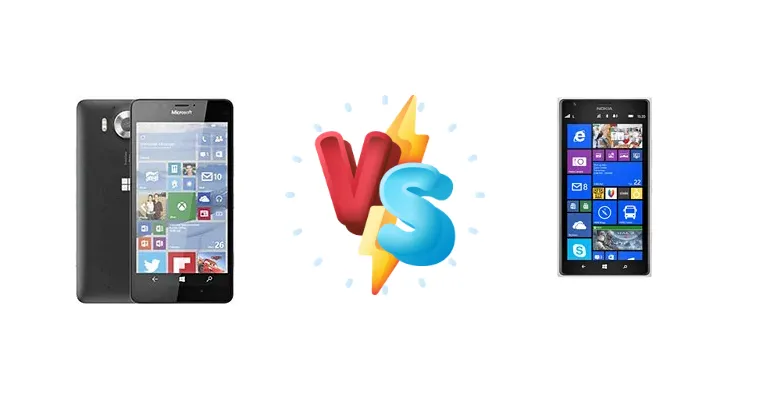
The Microsoft Lumia 950 and Nokia Lumia 1520 represent distinct eras of Windows Phone. The 1520, a phablet from Nokia’s final years, prioritized massive battery life and a large screen. The 950, released under Microsoft’s banner, aimed to modernize the experience with a newer processor and improved camera capabilities. This comparison dissects their strengths and weaknesses to help you decide which, even today, offers the better experience.
🏆 Quick Verdict
For the average user seeking a functional Windows Phone experience, the Nokia Lumia 1520 is the stronger choice. Its exceptional 107-hour endurance rating significantly outweighs the Lumia 950’s newer chipset, especially considering both devices are now aging and likely used for secondary purposes. The 950’s modern processor is less impactful given the platform’s age.
| Network |
|---|
| 2G bands | GSM 850 / 900 / 1800 / 1900 | GSM 850 / 900 / 1800 / 1900 - all versions |
| 3G bands | HSDPA 850 / 900 / 1700(AWS) / 1900 / 2100 | HSDPA 850 / 900 / 1900 / 2100 - RM-937, RM-939, RM-940 |
| 4G bands | 1, 2, 3, 4, 5, 7, 8, 12, 17, 20, 28, 38, 40 - EMEA | 1, 3, 7, 8, 20 - RM-937 |
| Speed | HSPA 42.2/5.76 Mbps, LTE Cat6 300/50 Mbps | HSPA 42.2/5.76 Mbps, LTE Cat4 150/50 Mbps |
| Technology | GSM / HSPA / LTE | GSM / HSPA / LTE |
| | 1, 2, 3, 4, 5, 7, 8, 12, 17, 20, 28, 38, 40, 41 - USA | 2, 4, 5, 7, 17 - RM-938, RM-940 |
| Launch |
|---|
| Announced | 2015, October. Released 2015, November | 2013, October. Released 2013, November |
| Status | Discontinued | Discontinued |
| Body |
|---|
| Dimensions | 145 x 73.2 x 8.2 mm (5.71 x 2.88 x 0.32 in) | 162.8 x 85.4 x 8.7 mm, 120.3 cc (6.41 x 3.36 x 0.34 in) |
| SIM | Nano-SIM | Nano-SIM |
| Weight | 150 g (5.29 oz) | 209 g (7.37 oz) |
| Display |
|---|
| Protection | Corning Gorilla Glass 3 | Corning Gorilla Glass 2 |
| Resolution | 1440 x 2560 pixels, 16:9 ratio (~564 ppi density) | 1080 x 1920 pixels, 16:9 ratio (~367 ppi density) |
| Size | 5.2 inches, 74.8 cm2 (~70.5% screen-to-body ratio) | 6.0 inches, 99.2 cm2 (~71.4% screen-to-body ratio) |
| Type | AMOLED | IPS LCD |
| | ClearBlack display | ClearBlack display |
| Platform |
|---|
| CPU | Hexa-core (4x1.4 GHz Cortex-A53 & 2x1.8 GHz Cortex-A57) | Quad-core 2.2 GHz Krait 400 |
| Chipset | Qualcomm MSM8992 Snapdragon 808 (20 nm) | Qualcomm MSM8974 Snapdragon 800 (28 nm) |
| GPU | Adreno 418 | Adreno 330 |
| OS | Microsoft Windows 10 | Microsoft Windows Phone 8, upgradable to Windows 10 |
| Memory |
|---|
| Card slot | microSDXC (dedicated slot) | microSDXC (dedicated slot) |
| Internal | 32GB 3GB RAM | 16GB 2GB RAM, 32GB 2GB RAM |
| | eMMC 5.0 | eMMC 4.5 |
| Main Camera |
|---|
| Features | Zeiss optics, triple-LED RGB flash, panorama, HDR | Zeiss optics, dual-LED flash, panorama |
| Single | 20 MP, f/1.9, 26mm (wide), 1/2.4", 1.12µm, AF, OIS | 20 MP, f/2.4, 26mm (wide), 1/2.5", 1.12µm, AF, OIS |
| Video | 4K@30fps, stereo sound rec., 1080p@30/60fps (after SW update) | 4K@30fps (after WP8 Denim update), 1080p@30fps, stereo sound rec. |
| Selfie camera |
|---|
| Single | 5 MP, f/2.4 | 1.2 MP, f/2.4 |
| Video | 1080p@30fps | 720p@30fps |
| Sound |
|---|
| 3.5mm jack | Yes | Yes |
| 35mm jack | Yes | Yes |
| Loudspeaker | Yes | Yes |
| Comms |
|---|
| Bluetooth | 4.1, A2DP | 4.0, A2DP, EDR, LE/ aptX after WP8 Denim update |
| NFC | Yes | Yes |
| Positioning | GPS, GLONASS, BDS | GPS, GLONASS |
| Radio | FM radio | FM radio |
| USB | USB Type-C 3.1 | microUSB 2.0 |
| WLAN | Wi-Fi 802.11 a/b/g/n/ac, dual-band, hotspot | Wi-Fi 802.11 a/b/g/n/ac, dual-band, hotspot |
| Features |
|---|
| Sensors | Iris scanner, accelerometer, gyro, proximity, compass, barometer, sensor core | Accelerometer, gyro, proximity, compass, sensor core |
| | Microsoft Continuum support | - |
| Battery |
|---|
| Charging | 18W wired
Wireless (Qi) (market dependent) | Wireless (Qi) |
| Music play | Up to 67 h | Up to 124 h |
| Stand-by | Up to 288 h (2G) / Up to 288 h (3G) | Up to 768 h (2G) / Up to 768 h (3G) |
| Talk time | Up to 23 h (2G) / Up to 18 h (3G) | Up to 27 h 40 min (2G) / Up to 25 h (3G) |
| Type | Li-Ion 3000 mAh, removable | Li-Ion 3400 mAh, non-removable (BV-4BW) |
| Misc |
|---|
| Colors | Black, White | Yellow, white, black, red, green (AT&T) |
| Price | About 280 EUR | About 350 EUR |
| SAR EU | - | 0.64 W/kg (head) 0.20 W/kg (body) |
| Tests |
|---|
| Audio quality |
Noise -91.3dB / Crosstalk -91.6dB |
Noise -89.3dB / Crosstalk -89.4dB |
| Battery life |
Endurance rating 48h
|
Endurance rating 107h
|
| Camera |
Photo / Video |
Photo / Video |
| Display |
Contrast ratio: Infinite (nominal), 3512 (sunlight) |
Contrast ratio: 1207:1 (nominal) / 1.813:1 (sunlight) |
| Loudspeaker |
Voice 71dB / Noise 73dB / Ring 77dB
|
Voice 73dB / Noise 66dB / Ring 74dB
|
| Performance |
Basemark OS II 2.0: 1281Basemark X: 26330 | - |
Microsoft Lumia 950
- More modern processor (Snapdragon 808)
- Superior display contrast ratio
- Faster charging (18W)
- Supports Qi wireless charging
- Significantly shorter battery life (48h endurance)
- Smaller screen size
- Potentially less robust camera performance in low light
Nokia Lumia 1520
- Exceptional battery life (107h endurance)
- Larger display for media consumption
- Supports Qi wireless charging
- Potentially better low-light camera performance (speculation)
- Older processor (Snapdragon 800)
- Lower display contrast ratio
- Slower charging speeds (not specified)
Display Comparison
The Nokia Lumia 1520’s 6-inch display boasts a contrast ratio of 1207:1 (nominal) and 1.813:1 in sunlight, offering acceptable visibility. However, the Microsoft Lumia 950’s display significantly surpasses it with an infinite (nominal) contrast ratio and a peak of 3512:1 in sunlight. This means deeper blacks and significantly improved readability outdoors. While both displays share the same resolution, the 950’s superior contrast makes it the better choice for visual clarity, particularly for photo and video viewing. The 1520's larger size is a benefit for media consumption, but the 950's contrast is a clear advantage.
Camera Comparison
Both devices feature capable cameras, but detailed specifications beyond 'Photo / Video' are lacking. The Lumia 1520’s larger physical size *suggests* a potentially larger sensor, which could translate to better low-light performance. However, the Lumia 950 benefits from Microsoft’s later software optimizations and potentially more advanced image processing algorithms. Without detailed sensor size and aperture information, it’s difficult to definitively declare a winner. The 950’s newer processor could also contribute to faster image processing speeds.
Performance
The Lumia 950’s Qualcomm MSM8992 Snapdragon 808, built on a 20nm process, represents a generational leap over the Lumia 1520’s Snapdragon 800 (28nm). The 808’s hexa-core CPU (4x1.4 GHz Cortex-A53 & 2x1.8 GHz Cortex-A57) offers a more efficient and powerful architecture compared to the 1520’s quad-core 2.2 GHz Krait 400. The smaller fabrication process of the 808 also contributes to better thermal efficiency. However, given the age of both devices and the limited demands of the Windows Phone OS, the real-world performance difference is likely minimal for everyday tasks. The 950 would show its advantage in more demanding applications, if any were available.
Battery Life
The Nokia Lumia 1520’s defining feature is its exceptional battery life, achieving an endurance rating of 107 hours. This is a massive advantage over the Lumia 950’s 48-hour rating. The 1520’s larger battery capacity, combined with the less power-hungry Snapdragon 800, allows for multi-day usage. While the 950 supports 18W wired charging and Qi wireless charging (market dependent), the 1520 compensates with sheer longevity. The 1520 also supports Qi wireless charging. The difference in endurance is so significant that it overshadows the 950’s faster charging capabilities.
Buying Guide
Buy the Microsoft Lumia 950 if you need a device with a more modern processor for potential compatibility with newer (though limited) apps or if you prioritize a slightly better display contrast ratio in direct sunlight. Buy the Nokia Lumia 1520 if you prioritize unparalleled battery life, a large screen for media consumption, and a device that can genuinely last for days on a single charge – a crucial benefit for those still committed to the Windows Phone ecosystem.
Frequently Asked Questions
❓ Is the Lumia 950’s Snapdragon 808 powerful enough to run modern apps, even if they aren't officially supported on Windows Phone?
While the Snapdragon 808 is a capable processor, the limitations lie with the Windows Phone operating system itself. Microsoft discontinued support for Windows Phone years ago, and app availability is extremely limited. Even with a more powerful processor, finding compatible apps will be a significant challenge. The 808's advantage is largely theoretical at this point.
❓ Does the Lumia 1520’s large screen impact battery life negatively, despite its high endurance rating?
Surprisingly, no. The Lumia 1520’s large 3430 mAh battery, combined with the power efficiency of the Snapdragon 800 and the optimizations within Windows Phone, allows it to achieve an exceptional 107-hour endurance rating. The larger screen is offset by the battery capacity and efficient chipset.
❓ Are there any known issues with the Lumia 950’s wireless charging functionality?
Wireless charging support on the Lumia 950 was market-dependent. Some regions did not receive the Qi wireless charging capability. Additionally, due to the age of the device, the wireless charging coil may have degraded over time, resulting in slower or unreliable charging.