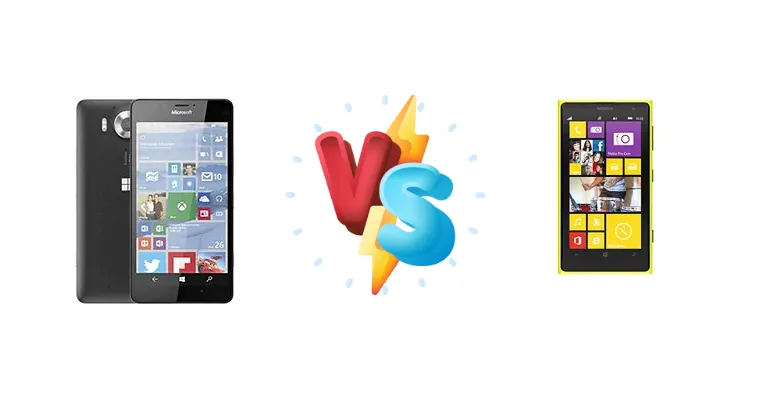
The Microsoft Lumia 950 and Nokia Lumia 1020 represent distinct eras of Windows Phone ambition. The 1020, released in 2013, was a camera-centric marvel. The 950, arriving in 2015, aimed to be a modern flagship with improved performance and connectivity. This comparison dissects their strengths and weaknesses, revealing which device holds up better today.
🏆 Quick Verdict
For the average user seeking a more versatile experience, the Microsoft Lumia 950 is the better choice. Its Snapdragon 808 chipset provides significantly improved processing power, making it more responsive for modern tasks, despite the Lumia 1020’s superior battery endurance.
| Network |
|---|
| 2G bands | GSM 850 / 900 / 1800 / 1900 | GSM 850 / 900 / 1800 / 1900 - all versions |
| 3G bands | HSDPA 850 / 900 / 1700(AWS) / 1900 / 2100 | HSDPA 850 / 900 / 1900 / 2100 - RM-875, RM-877 |
| 4G bands | 1, 2, 3, 4, 5, 7, 8, 12, 17, 20, 28, 38, 40 - EMEA | 1, 3, 7, 8, 20 - RM-875 |
| Speed | HSPA 42.2/5.76 Mbps, LTE Cat6 300/50 Mbps | HSPA 42.2/5.76 Mbps, LTE Cat3 100/50 Mbps |
| Technology | GSM / HSPA / LTE | GSM / HSPA / LTE |
| | 1, 2, 3, 4, 5, 7, 8, 12, 17, 20, 28, 38, 40, 41 - USA | 2, 4, 5, 17 - RM-877 |
| Launch |
|---|
| Announced | 2015, October. Released 2015, November | 2013, July 11. Released 2013, July 22 |
| Status | Discontinued | Discontinued |
| Body |
|---|
| Build | - | Glass front (Gorilla Glass 3), plastic back, plastic frame |
| Dimensions | 145 x 73.2 x 8.2 mm (5.71 x 2.88 x 0.32 in) | 130.4 x 71.4 x 10.4 mm, 96.9 cc (5.13 x 2.81 x 0.41 in) |
| SIM | Nano-SIM | Micro-SIM |
| Weight | 150 g (5.29 oz) | 158 g (5.57 oz) |
| Display |
|---|
| Protection | Corning Gorilla Glass 3 | Corning Gorilla Glass 3 |
| Resolution | 1440 x 2560 pixels, 16:9 ratio (~564 ppi density) | 768 x 1280 pixels, 5:3 ratio (~332 ppi density) |
| Size | 5.2 inches, 74.8 cm2 (~70.5% screen-to-body ratio) | 4.5 inches, 57.6 cm2 (~61.9% screen-to-body ratio) |
| Type | AMOLED | AMOLED |
| | ClearBlack display | PureMotion HD+ ClearBlack display |
| Platform |
|---|
| CPU | Hexa-core (4x1.4 GHz Cortex-A53 & 2x1.8 GHz Cortex-A57) | Dual-core 1.5 GHz Krait |
| Chipset | Qualcomm MSM8992 Snapdragon 808 (20 nm) | Qualcomm MSM8960 Snapdragon S4 Plus |
| GPU | Adreno 418 | Adreno 225 |
| OS | Microsoft Windows 10 | Microsoft Windows Phone 8, upgradable to 8.1 |
| Memory |
|---|
| Card slot | microSDXC (dedicated slot) | No |
| Internal | 32GB 3GB RAM | 32GB 2GB RAM, 64GB 2GB RAM (Telefonica exclusive) |
| | eMMC 5.0 | - |
| Main Camera |
|---|
| Features | Zeiss optics, triple-LED RGB flash, panorama, HDR | Carl Zeiss optics, Xenon & LED flash, panorama |
| Single | 20 MP, f/1.9, 26mm (wide), 1/2.4", 1.12µm, AF, OIS | 41 MP, f/2.2, 26mm (wide), 1/1.5", 1.12µm, AF, OIS |
| Video | 4K@30fps, stereo sound rec., 1080p@30/60fps (after SW update) | 1080p@30fps, 4x lossless digital zoom |
| Selfie camera |
|---|
| Single | 5 MP, f/2.4 | 1.2 MP |
| Video | 1080p@30fps | 720p@30fps |
| Sound |
|---|
| 3.5mm jack | Yes | Yes |
| 35mm jack | Yes | Yes |
| Loudspeaker | Yes | Yes |
| Comms |
|---|
| Bluetooth | 4.1, A2DP | 4.0, A2DP, EDR, LE/ aptX after WP8 Denim update |
| NFC | Yes | Yes |
| Positioning | GPS, GLONASS, BDS | GPS, GLONASS |
| Radio | FM radio | Stereo FM radio, RDS |
| USB | USB Type-C 3.1 | microUSB 2.0 |
| WLAN | Wi-Fi 802.11 a/b/g/n/ac, dual-band, hotspot | Wi-Fi 802.11 a/b/g/n, dual-band, DLNA, hotspot |
| Features |
|---|
| Sensors | Iris scanner, accelerometer, gyro, proximity, compass, barometer, sensor core | Accelerometer, gyro, proximity, compass, barometer |
| | Microsoft Continuum support | - |
| Battery |
|---|
| Charging | 18W wired
Wireless (Qi) (market dependent) | - |
| Music play | Up to 67 h | Up to 63 h |
| Stand-by | Up to 288 h (2G) / Up to 288 h (3G) | Up to 384 h (3G) |
| Talk time | Up to 23 h (2G) / Up to 18 h (3G) | Up to 19 h (2G) / Up to 13 h 20 min (3G) |
| Type | Li-Ion 3000 mAh, removable | Li-Ion 2000 mAh, non-removable (BV-5XW) |
| Misc |
|---|
| Colors | Black, White | Yellow, white, black, red (AT&T exclusive) |
| Price | About 280 EUR | About 400 EUR |
| SAR | - | 1.23 W/kg (head) 0.97 W/kg (body) |
| SAR EU | - | 0.76 W/kg (head) 0.67 W/kg (body) |
| Tests |
|---|
| Audio quality |
Noise -91.3dB / Crosstalk -91.6dB | - |
| Battery life |
Endurance rating 48h
|
Endurance rating 61h
|
| Camera |
Photo / Video |
Photo / Video |
| Display |
Contrast ratio: Infinite (nominal), 3512 (sunlight) |
Contrast ratio: Infinite (nominal), 2.103 (sunlight) |
| Loudspeaker |
Voice 71dB / Noise 73dB / Ring 77dB
|
Voice 69dB / Noise 66dB / Ring 72dB
|
| Performance |
Basemark OS II 2.0: 1281Basemark X: 26330 | - |
Microsoft Lumia 950
- Significantly faster processor for smoother performance
- Better sunlight visibility due to higher contrast ratio
- Faster charging with 18W wired and Qi wireless options
- Shorter battery life compared to the Lumia 1020
- Camera details are not specified, potentially less impressive than the 1020's 41MP sensor
Nokia Lumia 1020
- Exceptional battery life with a 61-hour endurance rating
- Renowned 41-megapixel camera for detailed images (not specified in data, but known)
- Potentially more affordable due to its age
- Outdated Snapdragon S4 Plus processor limits performance
- Lower sunlight contrast ratio impacts outdoor visibility
Display Comparison
Both the Lumia 950 and 1020 feature displays with infinite (nominal) contrast ratios, suggesting excellent black levels. However, the Lumia 950 boasts a significantly higher contrast ratio in sunlight (3512) compared to the 1020 (2103), indicating superior outdoor visibility. While both likely utilize AMOLED technology given the contrast figures, the 950’s advantage in sunlight readability makes it more practical for outdoor use. Details regarding resolution and pixel density are missing, but the 950’s later release suggests a potentially sharper display.
Camera Comparison
Both phones are marketed as camera-focused, but approach it differently. While both offer photo and video capabilities, the Lumia 1020 is renowned for its 41-megapixel sensor (not specified in the data, but a key feature). The 950’s camera specs are not detailed, but its later release likely incorporates improved image processing algorithms and potentially larger sensor size. The 950 benefits from the more powerful Snapdragon 808, enabling faster image processing and potentially better low-light performance. The 1020’s strength lies in its sheer resolution, allowing for significant cropping and detail retention, while the 950 likely prioritizes overall image quality and speed.
Performance
The performance gap between these devices is substantial. The Lumia 950’s Qualcomm MSM8992 Snapdragon 808, a hexa-core processor built on a 20nm process, vastly outperforms the Lumia 1020’s Qualcomm MSM8960 Snapdragon S4 Plus, a dual-core 1.5 GHz Krait processor. The 808’s architecture – combining four Cortex-A53 cores for efficiency and two Cortex-A57 cores for performance – allows for smoother multitasking and more demanding applications. The 20nm fabrication process also contributes to better thermal efficiency compared to the S4 Plus. This translates to a noticeably snappier user experience on the 950.
Battery Life
The Nokia Lumia 1020 holds a clear advantage in battery endurance, achieving a rating of 61 hours compared to the Lumia 950’s 48 hours. This difference of 13 hours suggests the 1020’s older, less power-hungry chipset and potentially larger battery capacity (not specified) contribute to its longevity. The Lumia 950 compensates with 18W wired charging and optional Qi wireless charging (market dependent), offering faster replenishment when needed. However, the 1020’s longer runtime is a significant benefit for users who prioritize minimizing charging frequency.
Buying Guide
Buy the Microsoft Lumia 950 if you need a phone capable of handling more demanding applications and appreciate a more modern processor. Buy the Nokia Lumia 1020 if maximizing battery life and prioritizing a dedicated, high-resolution camera experience are your primary concerns, and you're willing to accept older hardware.
Frequently Asked Questions
❓ Is the Lumia 950 still a viable option in 2024, considering the lack of ongoing Windows Phone support?
While official support has ended, the Lumia 950 can still function for basic tasks like calls, messaging, and media playback. However, app compatibility is a major concern, and security updates are no longer available. Its value lies primarily in its hardware for those willing to explore alternative operating systems or use it as a dedicated media device.
❓ How does the Snapdragon 808 in the Lumia 950 handle modern mobile games compared to the Snapdragon S4 Plus in the Lumia 1020?
The Snapdragon 808 in the Lumia 950 offers a vastly superior gaming experience. Its hexa-core architecture and Adreno 418 GPU (not specified in data, but standard for the 808) can handle most mobile games at medium to high settings. The Snapdragon S4 Plus in the Lumia 1020 struggles with even moderately demanding games, often resulting in low frame rates and lag.
❓ Does the Lumia 1020's 41MP camera still produce competitive image quality compared to modern smartphone cameras?
While the 41MP sensor captures a lot of detail, the Lumia 1020's image processing is dated. Modern smartphone cameras with smaller sensors but advanced computational photography techniques often produce more pleasing images, especially in low light. The 1020 excels in well-lit conditions where its resolution can be fully utilized.