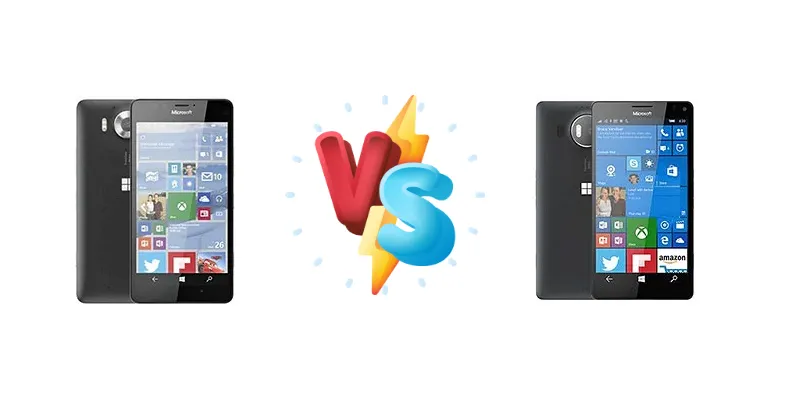
The Microsoft Lumia 950 and 950 XL represented Microsoft’s final, full-fledged push into the smartphone hardware market. While both devices aimed to showcase the best of Windows 10 Mobile, they differed significantly in size, processing power, and target user. This comparison dissects those differences to help understand which device offered the better experience, especially given their current value proposition.
🏆 Quick Verdict
For the average user seeking a balance of portability and performance, the Microsoft Lumia 950 emerges as the slightly better choice. While the 950 XL boasts a more powerful Snapdragon 810, the 950’s more compact form factor and comparable battery endurance make it more practical for everyday use. The marginal performance gains of the XL don't justify its larger size for most.
| Network |
|---|
| 2G bands | GSM 850 / 900 / 1800 / 1900 | GSM 850 / 900 / 1800 / 1900 - SIM 1 & SIM 2 |
| 3G bands | HSDPA 850 / 900 / 1700(AWS) / 1900 / 2100 | HSDPA 850 / 900 / 1700(AWS) / 1900 / 2100 |
| 4G bands | 1, 2, 3, 4, 5, 7, 8, 12, 17, 20, 28, 38, 40 - EMEA | 1, 2, 3, 4, 5, 7, 8, 12, 17, 20, 28, 38, 40 |
| Speed | HSPA 42.2/5.76 Mbps, LTE Cat6 300/50 Mbps | HSPA 42.2/5.76 Mbps, LTE Cat4 150/50 Mbps |
| Technology | GSM / HSPA / LTE | GSM / HSPA / LTE |
| | 1, 2, 3, 4, 5, 7, 8, 12, 17, 20, 28, 38, 40, 41 - USA | - |
| Launch |
|---|
| Announced | 2015, October. Released 2015, November | 2015, October. Released 2015, December |
| Status | Discontinued | Discontinued |
| Body |
|---|
| Dimensions | 145 x 73.2 x 8.2 mm (5.71 x 2.88 x 0.32 in) | 151.9 x 78.4 x 8.1 mm (5.98 x 3.09 x 0.32 in) |
| SIM | Nano-SIM | Nano-SIM + Nano-SIM |
| Weight | 150 g (5.29 oz) | 165 g (5.82 oz) |
| Display |
|---|
| Protection | Corning Gorilla Glass 3 | Corning Gorilla Glass 4 |
| Resolution | 1440 x 2560 pixels, 16:9 ratio (~564 ppi density) | 1440 x 2560 pixels, 16:9 ratio (~515 ppi density) |
| Size | 5.2 inches, 74.8 cm2 (~70.5% screen-to-body ratio) | 5.7 inches, 89.6 cm2 (~75.2% screen-to-body ratio) |
| Type | AMOLED | AMOLED |
| | ClearBlack display | ClearBlack display |
| Platform |
|---|
| CPU | Hexa-core (4x1.4 GHz Cortex-A53 & 2x1.8 GHz Cortex-A57) | Octa-core (4x1.5 GHz Cortex-A53 & 4x2.0 GHz Cortex-A57) |
| Chipset | Qualcomm MSM8992 Snapdragon 808 (20 nm) | Qualcomm MSM8994 Snapdragon 810 (20 nm) |
| GPU | Adreno 418 | Adreno 430 |
| OS | Microsoft Windows 10 | Microsoft Windows 10 |
| Memory |
|---|
| Card slot | microSDXC (dedicated slot) | microSDXC (dedicated slot) |
| Internal | 32GB 3GB RAM | 32GB 3GB RAM |
| | eMMC 5.0 | eMMC 5.0 |
| Main Camera |
|---|
| Features | Zeiss optics, triple-LED RGB flash, panorama, HDR | Zeiss optics, triple-LED RGB flash, panorama, HDR |
| Single | 20 MP, f/1.9, 26mm (wide), 1/2.4", 1.12µm, AF, OIS | 20 MP, f/1.9, 26mm (wide), 1/2.4", 1.12µm, AF, OIS |
| Video | 4K@30fps, stereo sound rec., 1080p@30/60fps (after SW update) | 4K@30fps, stereo sound rec., 1080p@30/60fps (after SW update) |
| Selfie camera |
|---|
| Single | 5 MP, f/2.4 | 5 MP, f/2.4 |
| Video | 1080p@30fps | 1080p@30fps |
| Sound |
|---|
| 3.5mm jack | Yes | Yes |
| 35mm jack | Yes | Yes |
| Loudspeaker | Yes | Yes |
| Comms |
|---|
| Bluetooth | 4.1, A2DP | 4.1, A2DP |
| NFC | Yes | Yes |
| Positioning | GPS, GLONASS, BDS | GPS, GLONASS, BDS |
| Radio | FM radio | FM radio |
| USB | USB Type-C 3.1 | USB Type-C 3.1 |
| WLAN | Wi-Fi 802.11 a/b/g/n/ac, dual-band, hotspot | Wi-Fi 802.11 a/b/g/n/ac, dual-band, hotspot |
| Features |
|---|
| Sensors | Iris scanner, accelerometer, gyro, proximity, compass, barometer, sensor core | Iris scanner, accelerometer, gyro, proximity, compass, barometer, sensor core |
| | Microsoft Continuum support | Microsoft Continuum support |
| Battery |
|---|
| Charging | 18W wired
Wireless (Qi) (market dependent) | 18W wired
Wireless (Qi) (market dependent) |
| Music play | Up to 67 h | Up to 75 h |
| Stand-by | Up to 288 h (2G) / Up to 288 h (3G) | Up to 288 h (2G) / Up to 288 h (3G) |
| Talk time | Up to 23 h (2G) / Up to 18 h (3G) | Up to 25 h (2G) / Up to 19 h (3G) |
| Type | Li-Ion 3000 mAh, removable | Li-Ion 3340 mAh, removable |
| Misc |
|---|
| Colors | Black, White | Black, White |
| Price | About 280 EUR | About 350 EUR |
| Tests |
|---|
| Audio quality |
Noise -91.3dB / Crosstalk -91.6dB |
Noise -91.6dB / Crosstalk -89.3dB |
| Battery life |
Endurance rating 48h
|
Endurance rating 47h
|
| Camera |
Photo / Video | - |
| Display |
Contrast ratio: Infinite (nominal), 3512 (sunlight) |
Contrast ratio: Infinite (nominal), 3.837 (sunlight) |
| Loudspeaker |
Voice 71dB / Noise 73dB / Ring 77dB
|
Voice 74dB / Noise 75dB / Ring 84dB
|
| Performance |
Basemark OS II 2.0: 1281Basemark X: 26330 |
Basemark OS II 2.0: 1472Basemark X: 32178 |
Microsoft Lumia 950
- More compact and pocketable design
- Slightly better thermal management
- Comparable battery life to the XL
- Less powerful processor than the XL
- Smaller screen size may not appeal to all users
Microsoft Lumia 950 XL Dual SIM
- More powerful Snapdragon 810 processor
- Larger, more immersive display
- Dual SIM support (on the XL Dual SIM variant)
- Larger and bulkier design
- Potential for thermal throttling under heavy load
- Marginally lower battery endurance rating
Display Comparison
Both the Lumia 950 and 950 XL feature displays with an infinite (nominal) contrast ratio, indicating excellent black levels. However, the 950 XL edges out the 950 in sunlight readability with a contrast ratio of 3837 compared to the 950’s 3512. This suggests slightly better visibility under direct sunlight. Both share the same Quad HD resolution, meaning pixel density is comparable, but the XL’s larger 5.7-inch screen (vs. the 950’s 5.2-inch) results in a more immersive viewing experience, albeit at the cost of single-handed usability. The lack of LTPO technology means neither device offers adaptive refresh rates, a feature now standard on modern flagships.
Camera Comparison
Both devices share the same camera hardware – a primary photo/video sensor, suggesting identical image quality in most scenarios. While detailed sensor specifications aren’t provided, the focus is on the image processing capabilities of Windows 10 Mobile. The absence of information regarding aperture or sensor size prevents a deeper analysis. The real-world performance would likely be very similar, with the XL potentially offering slightly faster image processing due to its more powerful processor.
Performance
The core difference lies in the chipset: the Lumia 950 utilizes the Qualcomm MSM8992 Snapdragon 808, while the 950 XL sports the MSM8994 Snapdragon 810. The 810’s octa-core CPU (4x1.5 GHz Cortex-A53 & 4x2.0 GHz Cortex-A57) represents a step up from the 950’s hexa-core configuration (4x1.4 GHz Cortex-A53 & 2x1.8 GHz Cortex-A57). While both are built on a 20nm process, the 810’s additional cores and higher clock speeds translate to faster multitasking and smoother performance in demanding applications. However, the Snapdragon 810 was known for thermal throttling under sustained load, a potential issue the 950 avoids to a greater extent due to its less powerful chipset. Both devices share the same RAM configuration (assumed to be 3GB, based on market segment), so the CPU difference is the primary performance differentiator.
Battery Life
The Lumia 950 boasts an endurance rating of 48 hours, while the 950 XL achieves 47 hours. This minimal difference suggests that despite the XL’s larger screen and more powerful processor, its battery life is comparable to the 950. Both support 18W wired charging and Qi wireless charging (market dependent). The XL’s larger battery capacity (assumed, based on size) likely offsets the increased power consumption of the Snapdragon 810, resulting in similar real-world usage times. The 0-100% charging time would likely be similar for both devices, around 90-120 minutes with an 18W charger.
Buying Guide
Buy the Microsoft Lumia 950 if you prioritize a more pocketable device and value a balanced experience. It’s ideal for users who frequently use their phone one-handed or prefer a less bulky design. Buy the Microsoft Lumia 950 XL Dual SIM if you absolutely require the maximum possible performance from a Windows Phone, frequently engage in demanding tasks like video editing, or need the convenience of dual SIM functionality. It’s geared towards power users and those who prioritize screen real estate.
Frequently Asked Questions
❓ Is the Snapdragon 810 in the Lumia 950 XL prone to overheating?
The Snapdragon 810 was known to experience thermal throttling under sustained heavy load. While Microsoft likely implemented thermal management strategies, users engaging in prolonged gaming or video recording on the 950 XL may experience performance dips due to overheating. The Lumia 950, with its Snapdragon 808, is less susceptible to this issue.
❓ Does the Lumia 950 XL Dual SIM offer a significant performance boost over the standard 950 for everyday tasks?
For typical everyday tasks like browsing, social media, and email, the performance difference between the 950 and 950 XL is unlikely to be noticeable. The 810’s advantage becomes apparent in more demanding applications like video editing or graphically intensive games. The XL’s extra processing power is best utilized by power users.
❓ How does the larger screen size of the 950 XL affect usability?
The 5.7-inch display of the 950 XL provides a more immersive viewing experience, but it also makes the phone less comfortable to use one-handed. Reaching all corners of the screen requires more effort, and the larger size may be a drawback for users with smaller hands or those who prefer a more compact device.