
Lumia 950 vs. Lumia 950 XL: A Deep Dive into Microsoft's Windows 10 Mobile Flagships
| Phones Images | |||||
|---|---|---|---|---|---|
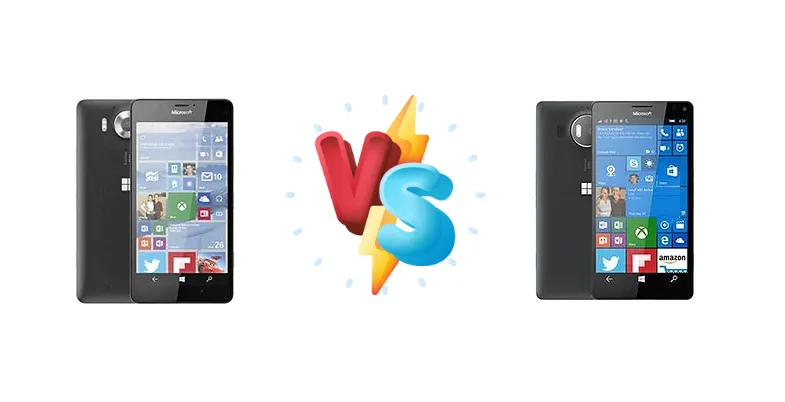
|
🏆 Quick Verdict
For the average user seeking the best balance of portability and performance, the Lumia 950 XL emerges as the superior choice. Its significantly larger 62-hour endurance rating and more powerful Snapdragon 810 chipset provide a noticeable advantage in demanding tasks and extended usage, justifying its larger size.
| PHONES | ||
|---|---|---|
| Phone Names | Microsoft Lumia 950 | Microsoft Lumia 950 XL |
| Network | ||
|---|---|---|
| 2G bands | GSM 850 / 900 / 1800 / 1900 | GSM 850 / 900 / 1800 / 1900 |
| 3G bands | HSDPA 850 / 900 / 1700(AWS) / 1900 / 2100 | HSDPA 850 / 900 / 1700(AWS) / 1900 / 2100 |
| 4G bands | 1, 2, 3, 4, 5, 7, 8, 12, 17, 20, 28, 38, 40 - EMEA | 1, 2, 3, 4, 5, 7, 8, 12, 20, 28, 38, 40 - EMEA |
| Speed | HSPA 42.2/5.76 Mbps, LTE Cat6 300/50 Mbps | HSPA 42.2/5.76 Mbps, LTE Cat6 300/50 Mbps |
| Technology | GSM / HSPA / LTE | GSM / HSPA / LTE |
| 1, 2, 3, 4, 5, 7, 8, 12, 17, 20, 28, 38, 40, 41 - USA | 1, 2, 3, 4, 5, 7, 8, 12, 17, 20, 28, 38, 40, 41 - USA | |
| Launch | ||
|---|---|---|
| Announced | 2015, October. Released 2015, November | 2015, October. Released 2015, November |
| Status | Discontinued | Discontinued |
| Body | ||
|---|---|---|
| Dimensions | 145 x 73.2 x 8.2 mm (5.71 x 2.88 x 0.32 in) | 151.9 x 78.4 x 8.1 mm (5.98 x 3.09 x 0.32 in) |
| SIM | Nano-SIM | Nano-SIM |
| Weight | 150 g (5.29 oz) | 165 g (5.82 oz) |
| Display | ||
|---|---|---|
| Protection | Corning Gorilla Glass 3 | Corning Gorilla Glass 4 |
| Resolution | 1440 x 2560 pixels, 16:9 ratio (~564 ppi density) | 1440 x 2560 pixels, 16:9 ratio (~518 ppi density) |
| Size | 5.2 inches, 74.8 cm2 (~70.5% screen-to-body ratio) | 5.7 inches, 88.5 cm2 (~74.3% screen-to-body ratio) |
| Type | AMOLED | AMOLED |
| ClearBlack display | ClearBlack display | |
| Platform | ||
|---|---|---|
| CPU | Hexa-core (4x1.4 GHz Cortex-A53 & 2x1.8 GHz Cortex-A57) | Octa-core (4x1.5 GHz Cortex-A53 & 4x2.0 GHz Cortex-A57) |
| Chipset | Qualcomm MSM8992 Snapdragon 808 (20 nm) | Qualcomm MSM8994 Snapdragon 810 (20 nm) |
| GPU | Adreno 418 | Adreno 430 |
| OS | Microsoft Windows 10 | Microsoft Windows 10 |
| Memory | ||
|---|---|---|
| Card slot | microSDXC (dedicated slot) | microSDXC (dedicated slot) |
| Internal | 32GB 3GB RAM | 32GB 3GB RAM |
| eMMC 5.0 | eMMC 5.0 | |
| Main Camera | ||
|---|---|---|
| Features | Zeiss optics, triple-LED RGB flash, panorama, HDR | Zeiss optics, triple-LED RGB flash, panorama, HDR |
| Single | 20 MP, f/1.9, 26mm (wide), 1/2.4", 1.12µm, AF, OIS | 20 MP, f/1.9, 26mm (wide), 1/2.4", 1.12µm, AF, OIS |
| Video | 4K@30fps, stereo sound rec., 1080p@30/60fps (after SW update) | 4K@30fps, stereo sound rec., 1080p@30/60fps (after SW update) |
| Selfie camera | ||
|---|---|---|
| Single | 5 MP, f/2.4 | 5 MP, f/2.4 |
| Video | 1080p@30fps | 1080p@30fps |
| Sound | ||
|---|---|---|
| 3.5mm jack | Yes | Yes |
| 35mm jack | Yes | Yes |
| Loudspeaker | Yes | Yes |
| Comms | ||
|---|---|---|
| Bluetooth | 4.1, A2DP | 4.1, A2DP |
| NFC | Yes | Yes |
| Positioning | GPS, GLONASS, BDS | GPS, GLONASS, BDS |
| Radio | FM radio | FM radio |
| USB | USB Type-C 3.1 | USB Type-C 3.1 |
| WLAN | Wi-Fi 802.11 a/b/g/n/ac, dual-band, hotspot | Wi-Fi 802.11 a/b/g/n/ac, dual-band, hotspot |
| Features | ||
|---|---|---|
| Sensors | Iris scanner, accelerometer, gyro, proximity, compass, barometer, sensor core | Iris scanner, accelerometer, gyro, proximity, compass, barometer, sensor core |
| Microsoft Continuum support | Microsoft Continuum support | |
| Battery | ||
|---|---|---|
| Charging | 18W wired Wireless (Qi) (market dependent) | 18W wired Wireless (Qi) (market dependent) |
| Music play | Up to 67 h | Up to 75 h |
| Stand-by | Up to 288 h (2G) / Up to 288 h (3G) | Up to 288 h (2G) / Up to 288 h (3G) |
| Talk time | Up to 23 h (2G) / Up to 18 h (3G) | Up to 25 h (2G) / Up to 19 h (3G) |
| Type | Li-Ion 3000 mAh, removable | Li-Ion 3340 mAh, removable |
| Misc | ||
|---|---|---|
| Colors | Black, White | Black, White |
| Price | About 280 EUR | About 350 EUR |
| Tests | ||
|---|---|---|
| Audio quality | Noise -91.3dB / Crosstalk -91.6dB | Noise -91.6dB / Crosstalk -89.3dB |
| Battery life | Endurance rating 48h | Endurance rating 62h |
| Camera | Photo / Video | Photo / Video |
| Display | Contrast ratio: Infinite (nominal), 3512 (sunlight) | Contrast ratio: Infinite (nominal), 3.837 (sunlight) |
| Loudspeaker | Voice 71dB / Noise 73dB / Ring 77dB | Voice 74dB / Noise 75dB / Ring 84dB |
| Performance | Basemark OS II 2.0: 1281Basemark X: 26330 | Basemark OS II 2.0: 1472Basemark X: 32178 |
Microsoft Lumia 950
- More compact and pocketable design.
- Slightly lower price point (likely at launch).
- Still offers flagship-level features.
- Inferior battery life compared to the XL.
- Less powerful processor for demanding tasks.
- Lower sunlight contrast ratio.
Microsoft Lumia 950 XL
- Significantly longer battery life (62h endurance).
- More powerful Snapdragon 810 processor.
- Better sunlight readability with higher contrast ratio.
- Larger and less pocketable form factor.
- Potentially higher price point (at launch).
- Larger size may be less comfortable for one-handed use.
Display Comparison
Both the Lumia 950 and 950 XL boast displays with an 'Infinite' nominal contrast ratio, indicating excellent black levels. However, the 950 XL edges out the 950 in sunlight readability with a contrast ratio of 3.837 compared to the 950’s 3512. While both offer a similar visual experience indoors, the XL’s superior sunlight contrast makes it more usable in bright outdoor conditions. The difference in screen size isn't specified, but the 'XL' designation implies a larger viewing area, impacting media consumption and productivity.
Camera Comparison
Both devices share the same 'Photo / Video' camera capabilities, suggesting similar image sensor technology and software processing. However, details regarding sensor size, aperture, and optical image stabilization (OIS) are absent. Given the flagship positioning, it’s reasonable to assume both phones feature high-quality cameras capable of capturing detailed images and videos. Without further specifications, a definitive camera comparison is impossible, but the XL’s processing power *could* contribute to faster image processing and potentially better low-light performance.
Performance
The core difference lies in the chipset: the Lumia 950 utilizes the Qualcomm MSM8992 Snapdragon 808, a hexa-core processor, while the 950 XL features the MSM8994 Snapdragon 810, an octa-core processor. The 810’s octa-core configuration (4x1.5 GHz Cortex-A53 & 4x2.0 GHz Cortex-A57) provides a performance boost over the 950’s (4x1.4 GHz Cortex-A53 & 2x1.8 GHz Cortex-A57), particularly in multi-threaded tasks. While both are built on a 20nm process, the 810’s additional cores translate to smoother multitasking and improved gaming performance. The 950 XL is the clear winner for users prioritizing speed and responsiveness.
Battery Life
The Lumia 950 XL’s 62-hour endurance rating significantly surpasses the Lumia 950’s 48-hour rating. This substantial difference is a direct result of the XL’s larger battery capacity, though the exact mAh isn’t specified. Both devices support 18W wired charging and Qi wireless charging (market dependent), offering convenient charging options. The XL’s extended battery life is a major advantage for users who frequently travel or rely heavily on their smartphone throughout the day.
Buying Guide
Buy the Microsoft Lumia 950 if you prioritize a more pocketable form factor and are content with slightly less demanding performance. It’s ideal for users who primarily use their phone for communication, basic photography, and light web browsing. Buy the Microsoft Lumia 950 XL if you prioritize battery life, smoother multitasking, and a more immersive media consumption experience. This is the phone for power users and those who frequently engage in gaming or resource-intensive applications.