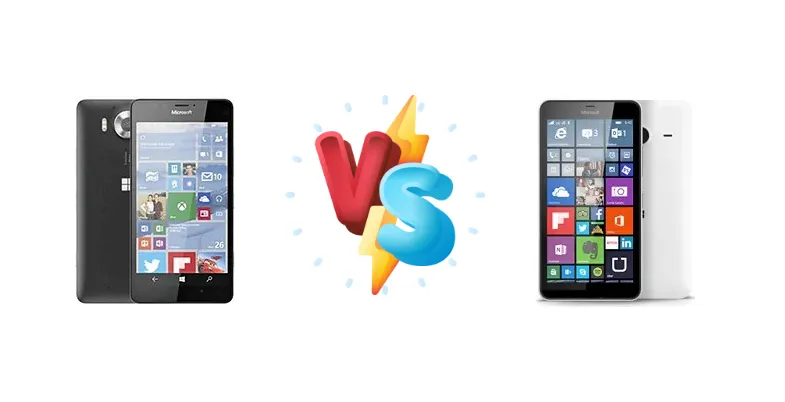
The Microsoft Lumia 950 and 640 XL represent distinct approaches within Microsoft’s Windows Phone ecosystem. The 950 aimed for a flagship experience, boasting a powerful Snapdragon 808 processor, while the 640 XL prioritized affordability and exceptional battery endurance. This comparison dissects their key differences to determine which device best suits your needs.
🏆 Quick Verdict
For users prioritizing performance and camera capabilities, the Lumia 950 is the clear winner. However, the Lumia 640 XL’s significantly longer battery life – offering 74 hours of endurance versus the 950’s 48 – makes it the superior choice for those who need a phone that lasts for days on a single charge.
| Network |
|---|
| 2G bands | GSM 850 / 900 / 1800 / 1900 | GSM 850 / 900 / 1800 / 1900 |
| 3G bands | HSDPA 850 / 900 / 1700(AWS) / 1900 / 2100 | HSDPA 850 / 900 / 1900 / 2100 |
| 4G bands | 1, 2, 3, 4, 5, 7, 8, 12, 17, 20, 28, 38, 40 - EMEA | - |
| Speed | HSPA 42.2/5.76 Mbps, LTE Cat6 300/50 Mbps | HSPA 42.2/5.76 Mbps |
| Technology | GSM / HSPA / LTE | GSM / HSPA |
| | 1, 2, 3, 4, 5, 7, 8, 12, 17, 20, 28, 38, 40, 41 - USA | - |
| Launch |
|---|
| Announced | 2015, October. Released 2015, November | 2015, March. Released 2015, April |
| Status | Discontinued | Discontinued |
| Body |
|---|
| Dimensions | 145 x 73.2 x 8.2 mm (5.71 x 2.88 x 0.32 in) | 157.9 x 81.5 x 9 mm (6.22 x 3.21 x 0.35 in) |
| SIM | Nano-SIM | Micro-SIM |
| Weight | 150 g (5.29 oz) | 171 g (6.03 oz) |
| Display |
|---|
| Protection | Corning Gorilla Glass 3 | Corning Gorilla Glass 3 |
| Resolution | 1440 x 2560 pixels, 16:9 ratio (~564 ppi density) | 720 x 1280 pixels, 16:9 ratio (~259 ppi density) |
| Size | 5.2 inches, 74.8 cm2 (~70.5% screen-to-body ratio) | 5.7 inches, 88.9 cm2 (~69.1% screen-to-body ratio) |
| Type | AMOLED | IPS LCD |
| | ClearBlack display | ClearBlack display |
| Platform |
|---|
| CPU | Hexa-core (4x1.4 GHz Cortex-A53 & 2x1.8 GHz Cortex-A57) | Quad-core 1.2 GHz Cortex-A7 |
| Chipset | Qualcomm MSM8992 Snapdragon 808 (20 nm) | Qualcomm MSM8226 Snapdragon 400 (28 nm) |
| GPU | Adreno 418 | Adreno 305 |
| OS | Microsoft Windows 10 | Microsoft Windows Phone 8.1, upgradable to Microsoft Windows 10 |
| Memory |
|---|
| Card slot | microSDXC (dedicated slot) | microSDXC (dedicated slot) |
| Internal | 32GB 3GB RAM | 8GB 1GB RAM |
| | eMMC 5.0 | eMMC 4.5 |
| Main Camera |
|---|
| Features | Zeiss optics, triple-LED RGB flash, panorama, HDR | Zeiss optics, LED flash |
| Single | 20 MP, f/1.9, 26mm (wide), 1/2.4", 1.12µm, AF, OIS | 13 MP, f/2.0, 28mm (wide), 1/3.0", AF |
| Video | 4K@30fps, stereo sound rec., 1080p@30/60fps (after SW update) | 1080p@30fps |
| Selfie camera |
|---|
| Single | 5 MP, f/2.4 | 5 MP |
| Video | 1080p@30fps | 1080p@30fps |
| Sound |
|---|
| 3.5mm jack | Yes | Yes |
| 35mm jack | Yes | Yes |
| Loudspeaker | Yes | Yes |
| Comms |
|---|
| Bluetooth | 4.1, A2DP | 4.0, A2DP |
| NFC | Yes | Yes |
| Positioning | GPS, GLONASS, BDS | GPS, GLONASS, BDS |
| Radio | FM radio | FM radio |
| USB | USB Type-C 3.1 | microUSB 2.0 |
| WLAN | Wi-Fi 802.11 a/b/g/n/ac, dual-band, hotspot | Wi-Fi 802.11 b/g/n, DLNA, hotspot |
| Features |
|---|
| Sensors | Iris scanner, accelerometer, gyro, proximity, compass, barometer, sensor core | Accelerometer, proximity, compass, sensor core |
| | Microsoft Continuum support | - |
| Battery |
|---|
| Charging | 18W wired
Wireless (Qi) (market dependent) | - |
| Music play | Up to 67 h | - |
| Stand-by | Up to 288 h (2G) / Up to 288 h (3G) | Up to 936 h (2G) / Up to 936 h (3G) |
| Talk time | Up to 23 h (2G) / Up to 18 h (3G) | Up to 31 h 20 min (2G) / Up to 23 h 40 min (3G) |
| Type | Li-Ion 3000 mAh, removable | Li-Ion 3000 mAh, removable |
| Misc |
|---|
| Colors | Black, White | Matte cyan, Orange, Black, Matte white, Glossy white |
| Price | About 280 EUR | About 170 EUR |
| Tests |
|---|
| Audio quality |
Noise -91.3dB / Crosstalk -91.6dB |
Noise -93.0dB / Crosstalk -94.4dB |
| Battery life |
Endurance rating 48h
|
Endurance rating 74h
|
| Camera |
Photo / Video | - |
| Display |
Contrast ratio: Infinite (nominal), 3512 (sunlight) |
Contrast ratio: 1119:1 (nominal), 3.065 (sunlight) |
| Loudspeaker |
Voice 71dB / Noise 73dB / Ring 77dB
| - |
| Performance |
Basemark OS II 2.0: 1281Basemark X: 26330 | - |
Microsoft Lumia 950
- Significantly faster processor for smooth performance
- Superior display contrast for vibrant visuals
- Potentially better camera quality with advanced features
- Shorter battery life compared to the 640 XL
- Higher price point
Microsoft Lumia 640 XL
- Exceptional battery life for multi-day usage
- More affordable price
- Large display for media consumption
- Slower processor for demanding tasks
- Lower display contrast ratio
Display Comparison
The Lumia 950’s display boasts an infinite (nominal) contrast ratio, jumping to 3512 in sunlight, indicating superior visibility in bright conditions. This contrasts sharply with the 640 XL’s 1119:1 nominal ratio and 3.065 sunlight contrast. While both displays offer adequate outdoor visibility, the 950’s panel delivers a richer, more vibrant image. The lack of detailed display specifications like resolution or panel type for either device makes a precise comparison difficult, but the contrast ratio difference is a significant indicator of quality.
Camera Comparison
Both devices are listed as having 'Photo / Video' capabilities, but the underlying hardware is vastly different. While specific sensor details are missing, the 950’s flagship positioning suggests a more advanced camera system with features like optical image stabilization (OIS) and potentially larger sensor size. The 640 XL, being a budget device, likely features a simpler camera setup. The 950’s superior processing power also aids in image processing, resulting in better low-light performance and more detailed images. The absence of detailed camera specs prevents a precise comparison, but the 950 is expected to deliver a significantly better photographic experience.
Performance
The core difference lies in the chipsets: the Lumia 950 utilizes the Qualcomm MSM8992 Snapdragon 808, a 20nm hexa-core processor, while the 640 XL features the MSM8226 Snapdragon 400, built on a less efficient 28nm process. The 808’s combination of four Cortex-A53 cores at 1.4 GHz and two Cortex-A57 cores at 1.8 GHz provides significantly more processing power than the 640 XL’s quad-core 1.2 GHz Cortex-A7 setup. This translates to smoother multitasking, faster app loading times, and a more responsive overall experience on the 950. The 28nm process of the Snapdragon 400 also suggests potentially higher heat output for similar workloads.
Battery Life
The Lumia 640 XL dominates in battery endurance, achieving a remarkable 74-hour rating compared to the 950’s 48 hours. This difference is primarily due to the less power-hungry Snapdragon 400 processor and potentially a larger battery capacity (though specific mAh figures are unavailable). While the 950 supports 18W wired charging and Qi wireless charging (market dependent), the 640 XL’s extended battery life minimizes the need for frequent charging. The 950’s faster charging speeds are offset by the 640 XL’s sheer longevity.
Buying Guide
Buy the Microsoft Lumia 950 if you need a responsive user experience for demanding applications, a better camera for capturing detailed photos and videos, and the convenience of wireless charging. Buy the Microsoft Lumia 640 XL if you prioritize maximizing battery life above all else, require a large-screen device for media consumption, and are on a tighter budget.
Frequently Asked Questions
❓ Does the Snapdragon 400 in the Lumia 640 XL struggle with modern apps, even years after release?
The Snapdragon 400 was a budget-oriented processor, and while it could handle Windows Phone 8.1/10 at launch, it may exhibit noticeable slowdowns with newer, more demanding applications. Basic tasks like calling, texting, and web browsing should remain functional, but complex apps or multitasking will likely be sluggish.
❓ Is the Lumia 950's Qi wireless charging universally available, or was it region-locked?
The availability of Qi wireless charging on the Lumia 950 was market-dependent. It was not included in all regions, so verifying compatibility based on the original purchase location is crucial. This was a common practice for Microsoft at the time to manage costs and regional regulations.
❓ Given the age of both devices, are software updates still available for either the Lumia 950 or 640 XL?
Unfortunately, Microsoft officially ended support for Windows Phone in 2019. Neither the Lumia 950 nor the 640 XL receive official software updates. While community-driven efforts exist, they are not officially supported and may introduce instability.