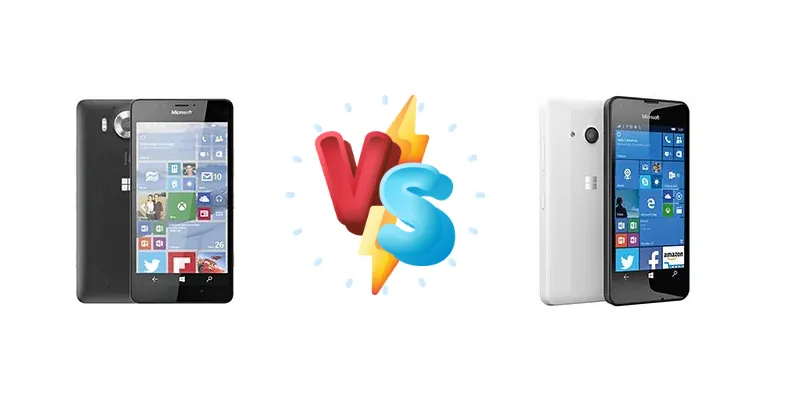
The Microsoft Lumia 950 and 550 represent opposite ends of the Windows Phone spectrum. The 950 aimed for a premium experience with flagship specs, while the 550 focused on affordability. Years after their release, understanding their differences remains crucial for those still invested in the platform or seeking a retro mobile experience.
🏆 Quick Verdict
For the average user seeking a more capable and future-proofed experience (even within the limitations of the Windows Phone ecosystem), the Lumia 950 is the clear winner. Its significantly more powerful Snapdragon 808 processor and superior display contrast offer a noticeable improvement in performance and usability, justifying the price difference.
| Network |
|---|
| 2G bands | GSM 850 / 900 / 1800 / 1900 | GSM 850 / 900 / 1800 / 1900 |
| 3G bands | HSDPA 850 / 900 / 1700(AWS) / 1900 / 2100 | HSDPA 850 / 900 / 2100 |
| 4G bands | 1, 2, 3, 4, 5, 7, 8, 12, 17, 20, 28, 38, 40 - EMEA | 1, 3, 7, 8, 20 |
| Speed | HSPA 42.2/5.76 Mbps, LTE Cat6 300/50 Mbps | HSPA 42.2/5.76 Mbps, LTE Cat4 150/50 Mbps |
| Technology | GSM / HSPA / LTE | GSM / HSPA / LTE |
| | 1, 2, 3, 4, 5, 7, 8, 12, 17, 20, 28, 38, 40, 41 - USA | - |
| Launch |
|---|
| Announced | 2015, October. Released 2015, November | 2015, October. Released 2015, December |
| Status | Discontinued | Discontinued |
| Body |
|---|
| Dimensions | 145 x 73.2 x 8.2 mm (5.71 x 2.88 x 0.32 in) | 136.1 x 67.8 x 9.9 mm (5.36 x 2.67 x 0.39 in) |
| SIM | Nano-SIM | Nano-SIM |
| Weight | 150 g (5.29 oz) | 141.9 (5.01 oz) |
| Display |
|---|
| Protection | Corning Gorilla Glass 3 | - |
| Resolution | 1440 x 2560 pixels, 16:9 ratio (~564 ppi density) | 720 x 1280 pixels, 16:9 ratio (~315 ppi density) |
| Size | 5.2 inches, 74.8 cm2 (~70.5% screen-to-body ratio) | 4.7 inches, 59.7 cm2 (~64.7% screen-to-body ratio) |
| Type | AMOLED | IPS LCD, |
| | ClearBlack display | - |
| Platform |
|---|
| CPU | Hexa-core (4x1.4 GHz Cortex-A53 & 2x1.8 GHz Cortex-A57) | Quad-core 1.1 GHz Cortex-A7 |
| Chipset | Qualcomm MSM8992 Snapdragon 808 (20 nm) | Qualcomm MSM8909 Snapdragon 210 (28 nm) |
| GPU | Adreno 418 | Adreno 304 |
| OS | Microsoft Windows 10 | Microsoft Windows 10 |
| Memory |
|---|
| Card slot | microSDXC (dedicated slot) | microSDXC (dedicated slot) |
| Internal | 32GB 3GB RAM | 8GB 1GB RAM |
| | eMMC 5.0 | eMMC 4.5 |
| Main Camera |
|---|
| Features | Zeiss optics, triple-LED RGB flash, panorama, HDR | LED flash |
| Single | 20 MP, f/1.9, 26mm (wide), 1/2.4", 1.12µm, AF, OIS | 5 MP, f/2.4, 1/4.0", AF |
| Video | 4K@30fps, stereo sound rec., 1080p@30/60fps (after SW update) | 720p@30fps |
| Selfie camera |
|---|
| Single | 5 MP, f/2.4 | 2 MP, f/2.8 |
| Video | 1080p@30fps | 480p |
| Sound |
|---|
| 3.5mm jack | Yes | Yes |
| 35mm jack | Yes | Yes |
| Loudspeaker | Yes | Yes |
| Comms |
|---|
| Bluetooth | 4.1, A2DP | 4.1, A2DP |
| NFC | Yes | No |
| Positioning | GPS, GLONASS, BDS | GPS, GLONASS, BDS |
| Radio | FM radio | FM radio |
| USB | USB Type-C 3.1 | microUSB 2.0 |
| WLAN | Wi-Fi 802.11 a/b/g/n/ac, dual-band, hotspot | Wi-Fi 802.11 b/g/n, hotspot |
| Features |
|---|
| Sensors | Iris scanner, accelerometer, gyro, proximity, compass, barometer, sensor core | Accelerometer, proximity |
| | Microsoft Continuum support | - |
| Battery |
|---|
| Charging | 18W wired
Wireless (Qi) (market dependent) | - |
| Music play | Up to 67 h | Up to 60 h |
| Stand-by | Up to 288 h (2G) / Up to 288 h (3G) | Up to 672 h (2G) / Up to 672 h (3G) |
| Talk time | Up to 23 h (2G) / Up to 18 h (3G) | Up to 16 h (2G) / Up to 14 h (3G) |
| Type | Li-Ion 3000 mAh, removable | Li-Ion 2100 mAh, removable |
| Misc |
|---|
| Colors | Black, White | Black, White |
| Price | About 280 EUR | About 90 EUR |
| Tests |
|---|
| Audio quality |
Noise -91.3dB / Crosstalk -91.6dB | - |
| Battery life |
Endurance rating 48h
| Endurance rating 42h |
| Camera |
Photo / Video |
Photo / Video |
| Display |
Contrast ratio: Infinite (nominal), 3512 (sunlight) | - |
| Loudspeaker |
Voice 71dB / Noise 73dB / Ring 77dB
| - |
| Performance |
Basemark OS II 2.0: 1281Basemark X: 26330 | - |
Microsoft Lumia 950
- Significantly faster processor for smoother performance
- Superior display contrast for better viewing experience
- Wireless charging support (market dependent)
- Higher price point
- Potentially shorter battery life due to more powerful hardware
Microsoft Lumia 550
- Extremely affordable price
- Decent battery life for basic usage
- Compact and lightweight design
- Slow processor struggles with demanding tasks
- Inferior display quality
- Limited features compared to the 950
Display Comparison
The Lumia 950 boasts a significantly superior display experience. While both phones lack detailed display specifications beyond contrast ratio, the 950’s ‘Infinite (nominal), 3512 (sunlight)’ contrast ratio suggests a much more vibrant and readable screen, especially outdoors. The 550’s display specs are absent, implying a lower-quality panel geared towards cost savings. This difference is critical for media consumption and general usability.
Camera Comparison
Both phones feature 'Photo / Video' capabilities, but the underlying hardware likely differs significantly. While specific sensor details are missing, the 950, as the flagship, almost certainly features a larger sensor and more advanced image processing. The 550’s camera is likely optimized for basic snapshots. The 950’s superior processing power would also contribute to faster image capture and better low-light performance.
Performance
The performance gap between these devices is substantial. The Lumia 950’s Qualcomm MSM8992 Snapdragon 808, a hexa-core processor built on a 20nm process, offers a considerable advantage over the Lumia 550’s Qualcomm MSM8909 Snapdragon 210, a quad-core processor on a less efficient 28nm node. The 808’s combination of Cortex-A53 and A57 cores provides a much smoother experience for multitasking and running applications. The 28nm process of the 210 also means it will generate more heat and consume more power for the same tasks.
Battery Life
The Lumia 950 offers an endurance rating of 48 hours, slightly better than the Lumia 550’s 42 hours. However, this difference is likely offset by the 950’s more power-hungry processor and display. The 950 also supports 18W wired charging and, market-dependent, Qi wireless charging, offering greater convenience than the 550’s likely slower wired charging only. The 950’s charging capabilities are a significant advantage for users who prioritize quick power-ups.
Buying Guide
Buy the Microsoft Lumia 950 if you need a device capable of handling more demanding tasks, appreciate a better viewing experience with its high contrast display, and value features like wireless charging. Buy the Microsoft Lumia 550 if you prioritize extreme affordability, require a basic smartphone for essential communication, and are willing to compromise on performance and features.
Frequently Asked Questions
❓ Is the Snapdragon 210 in the Lumia 550 powerful enough for modern apps, even if they were available for Windows Phone?
No. The Snapdragon 210 is a very basic processor designed for entry-level smartphones. It would struggle significantly with even moderately demanding apps, leading to lag and a poor user experience. It's primarily suited for basic tasks like calling, texting, and light web browsing.
❓ Does the Lumia 950's wireless charging work with all Qi chargers, or are there compatibility issues?
The Lumia 950 supports the Qi wireless charging standard, but compatibility can vary depending on the specific charger. While most Qi chargers should work, some older or non-standard chargers may not provide optimal charging speeds or may not work at all. It's best to use a Qi charger that is certified and known to be compatible with Lumia devices.
❓ Given the end of support for Windows Phone, is either of these phones still useful in 2024?
Usefulness is limited. While they can still function as basic phones for calls and texts, the lack of security updates and app support makes them vulnerable to security risks and limits their functionality. They are primarily of interest to collectors or those seeking a retro mobile experience.