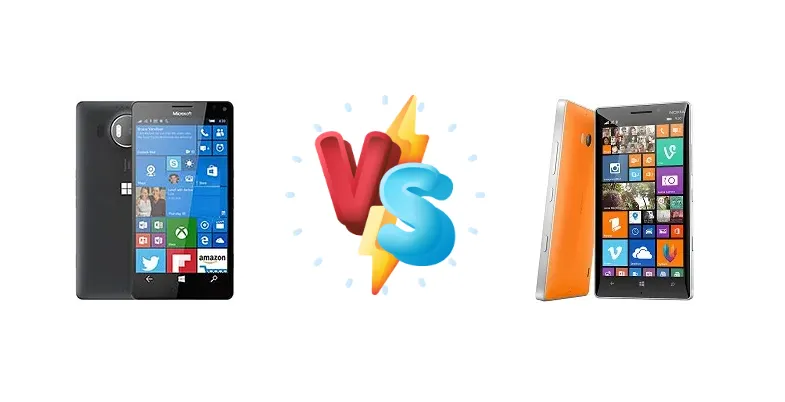
Released roughly a year apart, the Nokia Lumia 930 and Microsoft Lumia 950 XL represent distinct points in Microsoft’s mobile journey. The 930, a refined continuation of Nokia’s design language, aimed for a premium experience. The 950 XL, however, signaled a more ambitious push with a newer chipset and features, attempting to compete directly with Android and iOS flagships. This comparison dissects their key differences to determine which device holds up better today.
🏆 Quick Verdict
For the average user seeking a more capable device, the Microsoft Lumia 950 XL is the clear winner. Its Snapdragon 810 chipset provides a substantial performance advantage over the 930’s Snapdragon 800, and the improved battery endurance of 62 hours versus 46 hours makes it more practical for daily use. While both offer similar display quality, the 950 XL’s processing power justifies the trade-off.
| Network |
|---|
| 2G bands | GSM 850 / 900 / 1800 / 1900 | GSM 850 / 900 / 1800 / 1900 |
| 3G bands | HSDPA 850 / 900 / 1700(AWS) / 1900 / 2100 | HSDPA 850 / 900 / 1900 / 2100 |
| 4G bands | 1, 2, 3, 4, 5, 7, 8, 12, 20, 28, 38, 40 - EMEA | 1, 3, 7, 8, 20 |
| Speed | HSPA 42.2/5.76 Mbps, LTE Cat6 300/50 Mbps | HSPA 42.2/5.76 Mbps, LTE Cat4 150/50 Mbps |
| Technology | GSM / HSPA / LTE | GSM / HSPA / LTE |
| | 1, 2, 3, 4, 5, 7, 8, 12, 17, 20, 28, 38, 40, 41 - USA | - |
| Launch |
|---|
| Announced | 2015, October. Released 2015, November | 2014, April. Released 2014, July |
| Status | Discontinued | Discontinued |
| Body |
|---|
| Dimensions | 151.9 x 78.4 x 8.1 mm (5.98 x 3.09 x 0.32 in) | 137 x 71 x 9.8 mm, 94.7 cc (5.39 x 2.80 x 0.39 in) |
| SIM | Nano-SIM | Nano-SIM |
| Weight | 165 g (5.82 oz) | 167 g (5.89 oz) |
| Display |
|---|
| Protection | Corning Gorilla Glass 4 | Corning Gorilla Glass 3 |
| Resolution | 1440 x 2560 pixels, 16:9 ratio (~518 ppi density) | 1080 x 1920 pixels, 16:9 ratio (~441 ppi density) |
| Size | 5.7 inches, 88.5 cm2 (~74.3% screen-to-body ratio) | 5.0 inches, 68.9 cm2 (~70.9% screen-to-body ratio) |
| Type | AMOLED | AMOLED |
| | ClearBlack display | ClearBlack display |
| Platform |
|---|
| CPU | Octa-core (4x1.5 GHz Cortex-A53 & 4x2.0 GHz Cortex-A57) | Quad-core 2.2 GHz Krait 400 |
| Chipset | Qualcomm MSM8994 Snapdragon 810 (20 nm) | Qualcomm MSM8974 Snapdragon 800 (28 nm) |
| GPU | Adreno 430 | Adreno 330 |
| OS | Microsoft Windows 10 | Microsoft Windows Phone 8.1, upgradable to Windows 10 |
| Memory |
|---|
| Card slot | microSDXC (dedicated slot) | No |
| Internal | 32GB 3GB RAM | 32GB 2GB RAM |
| | eMMC 5.0 | eMMC 4.5 |
| Main Camera |
|---|
| Features | Zeiss optics, triple-LED RGB flash, panorama, HDR | Zeiss optics, dual-LED flash, panorama, HDR |
| Single | 20 MP, f/1.9, 26mm (wide), 1/2.4", 1.12µm, AF, OIS | 20 MP, f/2.4, 26mm (wide), 1/2.5", AF, OIS |
| Video | 4K@30fps, stereo sound rec., 1080p@30/60fps (after SW update) | 4K@30fps (after WP8 Denim update), 1080p@30fps, stereo sound rec. |
| Selfie camera |
|---|
| Single | 5 MP, f/2.4 | 1.2 MP |
| Video | 1080p@30fps | 720p@30fps |
| Sound |
|---|
| 3.5mm jack | Yes | Yes |
| 35mm jack | Yes | Yes |
| Loudspeaker | Yes | Yes |
| Comms |
|---|
| Bluetooth | 4.1, A2DP | 4.0, A2DP, EDR, LE/ aptX after WP8 Denim update |
| NFC | Yes | Yes |
| Positioning | GPS, GLONASS, BDS | GPS, GLONASS |
| Radio | FM radio | FM radio |
| USB | USB Type-C 3.1 | microUSB 2.0 |
| WLAN | Wi-Fi 802.11 a/b/g/n/ac, dual-band, hotspot | Wi-Fi 802.11 a/b/g/n/ac, dual-band, DLNA, hotspot |
| Features |
|---|
| Sensors | Iris scanner, accelerometer, gyro, proximity, compass, barometer, sensor core | Accelerometer, gyro, proximity, compass, sensor core |
| | Microsoft Continuum support | - |
| Battery |
|---|
| Charging | 18W wired
Wireless (Qi) (market dependent) | Wireless (Qi) (market dependent) |
| Music play | Up to 75 h | Up to 75 h |
| Stand-by | Up to 288 h (2G) / Up to 288 h (3G) | Up to 432 h |
| Talk time | Up to 25 h (2G) / Up to 19 h (3G) | Up to 11 h 30 min (2G) / Up to 15 h 30 min (3G) |
| Type | Li-Ion 3340 mAh, removable | Li-Ion 2420 mAh, non-removable (BV-5QW) |
| Misc |
|---|
| Colors | Black, White | Bright orange, bright green, white, black, gold |
| Price | About 350 EUR | About 370 EUR |
| SAR | - | 0.90 W/kg (head) 0.56 W/kg (body) |
| SAR EU | - | 0.60 W/kg (head) 0.73 W/kg (body) |
| Tests |
|---|
| Audio quality |
Noise -91.6dB / Crosstalk -89.3dB |
Noise -91.4dB / Crosstalk -90.3dB |
| Battery life |
Endurance rating 62h
| Endurance rating 46h |
| Camera |
Photo / Video |
Photo / Video |
| Display |
Contrast ratio: Infinite (nominal), 3.837 (sunlight) |
Contrast ratio: Infinite (nominal), 3.567 (sunlight) |
| Loudspeaker |
Voice 74dB / Noise 75dB / Ring 84dB
|
Voice 76dB / Noise 69dB / Ring 77dB |
| Performance |
Basemark OS II 2.0: 1472Basemark X: 32178 | - |
Microsoft Lumia 950 XL
- Significantly faster processor (Snapdragon 810)
- Longer battery life (62h endurance)
- Faster charging (18W wired)
- Potential for better camera processing
- Potential for Snapdragon 810 throttling
- Larger form factor, less pocketable
Nokia Lumia 930
- More compact and pocketable design
- Wireless charging (Qi) convenience
- Refined Nokia design aesthetic
- Potentially more stable thermal performance
- Slower processor (Snapdragon 800)
- Shorter battery life (46h endurance)
- Slower charging (wireless only)
Display Comparison
Both the Lumia 950 XL and 930 boast displays with an 'Infinite' nominal contrast ratio, a marketing term common at the time. However, the 950 XL edges out the 930 in sunlight readability with a contrast ratio of 3.837 compared to the 930’s 3.567. While both likely utilize AMOLED technology, the specific panel characteristics (peak brightness, color gamut coverage) aren’t specified. The larger screen size of the 950 XL, though not quantified, will provide a more immersive viewing experience, but at the cost of portability.
Camera Comparison
Both devices are listed as having 'Photo / Video' capabilities, lacking specific details. Given the era, both likely featured Carl Zeiss optics. However, without sensor size or aperture information, a definitive camera comparison is impossible. The 950 XL, being the later model, likely benefited from improved image processing algorithms, but the hardware limitations are unknown. The absence of details regarding features like optical image stabilization (OIS) further complicates the assessment. It's safe to assume both offered competent image quality for their time, but the 950 XL likely had a slight edge in low-light performance due to software enhancements.
Performance
The core difference lies in the chipsets. The Lumia 950 XL’s Qualcomm MSM8994 Snapdragon 810, built on a 20nm process, features an octa-core CPU (4x1.5 GHz Cortex-A53 & 4x2.0 GHz Cortex-A57). This contrasts with the Nokia Lumia 930’s Qualcomm MSM8974 Snapdragon 800, fabricated on a larger 28nm node, and equipped with a quad-core 2.2 GHz Krait 400 CPU. The 810’s architecture, while potentially prone to throttling under sustained load, offers significantly higher theoretical multi-core performance. The 20nm process also contributes to improved power efficiency compared to the 28nm Snapdragon 800. This translates to faster app loading times, smoother multitasking, and a better experience with graphically intensive games on the 950 XL.
Battery Life
The Lumia 950 XL’s endurance rating of 62 hours significantly surpasses the Lumia 930’s 46 hours. This difference is attributable to a combination of factors: a larger battery capacity (not specified, but likely larger in the XL), the more efficient Snapdragon 810 chipset, and potentially optimized power management software. The 950 XL also supports 18W wired charging, offering faster replenishment compared to the 930’s reliance solely on wireless (Qi) charging. While Qi charging is convenient, it’s generally slower than wired charging. The 950 XL’s inclusion of both wired and wireless charging provides greater flexibility.
Buying Guide
Buy the Microsoft Lumia 950 XL if you prioritize performance for demanding applications, longer battery life, and future-proofing within the Windows Phone ecosystem. Buy the Nokia Lumia 930 if you prefer a more compact form factor, appreciate Nokia’s established design aesthetic, and prioritize wireless charging over raw processing power. Both are now legacy devices, so availability and software support are key considerations.
Frequently Asked Questions
❓ Is the Snapdragon 810 in the Lumia 950 XL known to overheat?
The Snapdragon 810 was criticized for potential thermal throttling under sustained heavy load. While not a catastrophic issue, users might experience reduced performance during prolonged gaming sessions or video recording. The Lumia 950 XL’s cooling solution may mitigate this, but it’s a factor to consider.
❓ Does the Lumia 950 XL support Continuum, and is it useful?
Yes, the Lumia 950 XL was one of the first devices to feature Microsoft’s Continuum feature, allowing it to connect to a monitor and keyboard for a desktop-like experience. While innovative for its time, the limited app ecosystem for Windows Phone significantly hampered its usefulness. It remains a unique feature, but its practical value is limited today.
❓ Which device is better for playing older Windows Phone games?
Both devices should handle older Windows Phone games adequately. However, the Lumia 950 XL’s more powerful GPU will provide a smoother experience and potentially allow for higher graphics settings in more demanding titles.
❓ Given the age of these devices, what are the biggest software concerns?
Both devices are running outdated versions of Windows Phone and no longer receive official security updates. This poses a significant security risk. Furthermore, the limited app availability in the Windows Phone store is a major drawback. Using these devices requires accepting these limitations.