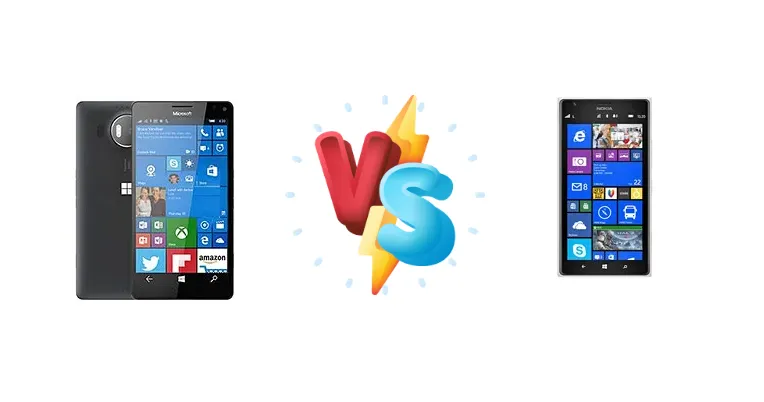
Released roughly a year apart, the Nokia Lumia 1520 and Microsoft Lumia 950 XL represent different approaches to the Windows Phone experience. The 1520 prioritized massive battery life and a large screen, while the 950 XL aimed for a more modern processor and improved display contrast. This comparison dissects their strengths and weaknesses to determine which device holds up better today.
🏆 Quick Verdict
For the average user seeking longevity, the Nokia Lumia 1520 wins decisively thanks to its exceptional 107-hour endurance rating. However, the Lumia 950 XL offers a more modern chipset and significantly improved display contrast, making it preferable for those prioritizing performance and visual clarity.
| Network |
|---|
| 2G bands | GSM 850 / 900 / 1800 / 1900 | GSM 850 / 900 / 1800 / 1900 - all versions |
| 3G bands | HSDPA 850 / 900 / 1700(AWS) / 1900 / 2100 | HSDPA 850 / 900 / 1900 / 2100 - RM-937, RM-939, RM-940 |
| 4G bands | 1, 2, 3, 4, 5, 7, 8, 12, 20, 28, 38, 40 - EMEA | 1, 3, 7, 8, 20 - RM-937 |
| Speed | HSPA 42.2/5.76 Mbps, LTE Cat6 300/50 Mbps | HSPA 42.2/5.76 Mbps, LTE Cat4 150/50 Mbps |
| Technology | GSM / HSPA / LTE | GSM / HSPA / LTE |
| | 1, 2, 3, 4, 5, 7, 8, 12, 17, 20, 28, 38, 40, 41 - USA | 2, 4, 5, 7, 17 - RM-938, RM-940 |
| Launch |
|---|
| Announced | 2015, October. Released 2015, November | 2013, October. Released 2013, November |
| Status | Discontinued | Discontinued |
| Body |
|---|
| Dimensions | 151.9 x 78.4 x 8.1 mm (5.98 x 3.09 x 0.32 in) | 162.8 x 85.4 x 8.7 mm, 120.3 cc (6.41 x 3.36 x 0.34 in) |
| SIM | Nano-SIM | Nano-SIM |
| Weight | 165 g (5.82 oz) | 209 g (7.37 oz) |
| Display |
|---|
| Protection | Corning Gorilla Glass 4 | Corning Gorilla Glass 2 |
| Resolution | 1440 x 2560 pixels, 16:9 ratio (~518 ppi density) | 1080 x 1920 pixels, 16:9 ratio (~367 ppi density) |
| Size | 5.7 inches, 88.5 cm2 (~74.3% screen-to-body ratio) | 6.0 inches, 99.2 cm2 (~71.4% screen-to-body ratio) |
| Type | AMOLED | IPS LCD |
| | ClearBlack display | ClearBlack display |
| Platform |
|---|
| CPU | Octa-core (4x1.5 GHz Cortex-A53 & 4x2.0 GHz Cortex-A57) | Quad-core 2.2 GHz Krait 400 |
| Chipset | Qualcomm MSM8994 Snapdragon 810 (20 nm) | Qualcomm MSM8974 Snapdragon 800 (28 nm) |
| GPU | Adreno 430 | Adreno 330 |
| OS | Microsoft Windows 10 | Microsoft Windows Phone 8, upgradable to Windows 10 |
| Memory |
|---|
| Card slot | microSDXC (dedicated slot) | microSDXC (dedicated slot) |
| Internal | 32GB 3GB RAM | 16GB 2GB RAM, 32GB 2GB RAM |
| | eMMC 5.0 | eMMC 4.5 |
| Main Camera |
|---|
| Features | Zeiss optics, triple-LED RGB flash, panorama, HDR | Zeiss optics, dual-LED flash, panorama |
| Single | 20 MP, f/1.9, 26mm (wide), 1/2.4", 1.12µm, AF, OIS | 20 MP, f/2.4, 26mm (wide), 1/2.5", 1.12µm, AF, OIS |
| Video | 4K@30fps, stereo sound rec., 1080p@30/60fps (after SW update) | 4K@30fps (after WP8 Denim update), 1080p@30fps, stereo sound rec. |
| Selfie camera |
|---|
| Single | 5 MP, f/2.4 | 1.2 MP, f/2.4 |
| Video | 1080p@30fps | 720p@30fps |
| Sound |
|---|
| 3.5mm jack | Yes | Yes |
| 35mm jack | Yes | Yes |
| Loudspeaker | Yes | Yes |
| Comms |
|---|
| Bluetooth | 4.1, A2DP | 4.0, A2DP, EDR, LE/ aptX after WP8 Denim update |
| NFC | Yes | Yes |
| Positioning | GPS, GLONASS, BDS | GPS, GLONASS |
| Radio | FM radio | FM radio |
| USB | USB Type-C 3.1 | microUSB 2.0 |
| WLAN | Wi-Fi 802.11 a/b/g/n/ac, dual-band, hotspot | Wi-Fi 802.11 a/b/g/n/ac, dual-band, hotspot |
| Features |
|---|
| Sensors | Iris scanner, accelerometer, gyro, proximity, compass, barometer, sensor core | Accelerometer, gyro, proximity, compass, sensor core |
| | Microsoft Continuum support | - |
| Battery |
|---|
| Charging | 18W wired
Wireless (Qi) (market dependent) | Wireless (Qi) |
| Music play | Up to 75 h | Up to 124 h |
| Stand-by | Up to 288 h (2G) / Up to 288 h (3G) | Up to 768 h (2G) / Up to 768 h (3G) |
| Talk time | Up to 25 h (2G) / Up to 19 h (3G) | Up to 27 h 40 min (2G) / Up to 25 h (3G) |
| Type | Li-Ion 3340 mAh, removable | Li-Ion 3400 mAh, non-removable (BV-4BW) |
| Misc |
|---|
| Colors | Black, White | Yellow, white, black, red, green (AT&T) |
| Price | About 350 EUR | About 350 EUR |
| SAR EU | - | 0.64 W/kg (head) 0.20 W/kg (body) |
| Tests |
|---|
| Audio quality |
Noise -91.6dB / Crosstalk -89.3dB |
Noise -89.3dB / Crosstalk -89.4dB |
| Battery life |
Endurance rating 62h
|
Endurance rating 107h
|
| Camera |
Photo / Video |
Photo / Video |
| Display |
Contrast ratio: Infinite (nominal), 3.837 (sunlight) |
Contrast ratio: 1207:1 (nominal) / 1.813:1 (sunlight) |
| Loudspeaker |
Voice 74dB / Noise 75dB / Ring 84dB
|
Voice 73dB / Noise 66dB / Ring 74dB
|
| Performance |
Basemark OS II 2.0: 1472Basemark X: 32178 | - |
Microsoft Lumia 950 XL
- More powerful Snapdragon 810 processor
- Superior display contrast for better visibility
- Faster 18W wired charging
- Significantly shorter battery life
- Wireless charging availability market-dependent
Nokia Lumia 1520
- Exceptional 107-hour battery life
- Wireless charging support
- Large display for media consumption
- Older Snapdragon 800 processor
- Lower display contrast ratio
Display Comparison
The Lumia 1520 boasts a contrast ratio of 1207:1 (nominal) and 1.813:1 in sunlight, a respectable figure for its time, but significantly lower than the Lumia 950 XL’s ‘infinite’ nominal contrast and 3.837:1 sunlight contrast. This suggests the 950 XL offers much deeper blacks and a more vibrant image, particularly outdoors. While both displays share the same resolution, the superior contrast of the 950 XL translates to a more visually engaging experience. The 1520's lower contrast means colors appear washed out in bright conditions.
Camera Comparison
Both devices feature capable photo and video capabilities, but the context data doesn’t provide enough detail for a meaningful comparison. Given Microsoft’s later camera advancements, it’s reasonable to assume the 950 XL benefits from more refined image processing algorithms. However, without sensor size or aperture information, it’s difficult to definitively declare a winner. The absence of details regarding optical image stabilization (OIS) on either device further complicates the assessment.
Performance
The Lumia 950 XL’s Qualcomm MSM8994 Snapdragon 810, built on a 20nm process, represents a significant architectural leap over the Lumia 1520’s Snapdragon 800 (28nm). The 810’s octa-core CPU (4x1.5 GHz Cortex-A53 & 4x2.0 GHz Cortex-A57) provides more processing power than the 1520’s quad-core 2.2 GHz Krait 400. The smaller manufacturing node of the 810 also implies better thermal efficiency, potentially reducing throttling during sustained workloads. While the Krait 400 is a capable core, the 810’s architecture offers a noticeable performance advantage for modern applications.
Battery Life
The Nokia Lumia 1520’s defining feature is its exceptional endurance rating of 107 hours, dwarfing the Lumia 950 XL’s 62 hours. This difference is likely due to the more efficient Snapdragon 800 and a larger battery capacity (not specified in the data, but known to be 3430 mAh). While the 950 XL supports faster 18W wired charging and Qi wireless charging (market dependent), the 1520’s longevity significantly outweighs the convenience of faster charging. The 1520’s wireless charging is a bonus, but the sheer battery life is the primary advantage.
Buying Guide
Buy the Microsoft Lumia 950 XL if you need a faster processor for app loading and multitasking, and value a display with superior contrast for outdoor visibility. Buy the Nokia Lumia 1520 if you prioritize all-day (and then some) battery life, and a large screen for media consumption, even if it means sacrificing processing power and display quality.
Frequently Asked Questions
❓ Is the Snapdragon 810 in the Lumia 950 XL known for throttling under heavy load?
The Snapdragon 810 was known to experience thermal throttling under sustained heavy workloads due to its architecture. While the 20nm process helped, demanding games or prolonged video recording could lead to performance drops. The Lumia 1520’s Snapdragon 800, while less powerful, is less prone to this issue due to its lower thermal output.
❓ Given the age of both devices, are replacement batteries readily available?
Finding replacement batteries for both the Lumia 950 XL and 1520 is becoming increasingly difficult. Third-party options exist, but quality and reliability can vary significantly. The 1520’s larger battery capacity means a replacement will have a more substantial impact on restoring its original endurance.
❓ Does the Lumia 950 XL's Qi wireless charging work with all Qi chargers?
Qi wireless charging compatibility on the Lumia 950 XL was market-dependent. Some regions did not receive the Qi charging hardware. Even with compatible chargers, charging speeds were relatively slow compared to modern wireless charging standards.