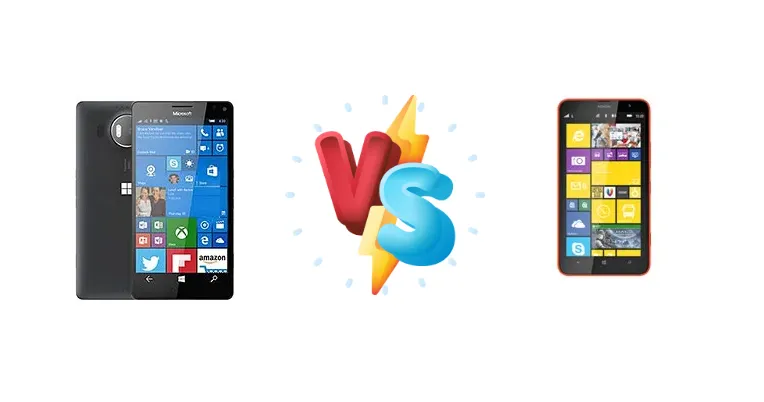
Released years apart, the Microsoft Lumia 950 XL and Nokia Lumia 1320 represent distinct eras of Windows Phone. The 950 XL aimed to be a flagship powerhouse, while the 1320 focused on affordability and extended battery life. This comparison dissects their key differences, helping you understand which device better suits your needs, even in today's context.
🏆 Quick Verdict
For users prioritizing performance and a more capable camera, the Microsoft Lumia 950 XL is the clear winner. However, the Nokia Lumia 1320’s superior battery endurance – offering 75 hours versus the 950 XL’s 62 – makes it a compelling choice for those who value longevity above all else.
| Network |
|---|
| 2G bands | GSM 850 / 900 / 1800 / 1900 | GSM 850 / 900 / 1800 / 1900 - all versions |
| 3G bands | HSDPA 850 / 900 / 1700(AWS) / 1900 / 2100 | HSDPA 850 / 900 / 2100 - RM-994 |
| 4G bands | 1, 2, 3, 4, 5, 7, 8, 12, 20, 28, 38, 40 - EMEA | 3, 7, 20 - RM-994 |
| Speed | HSPA 42.2/5.76 Mbps, LTE Cat6 300/50 Mbps | HSPA 42.2/5.76 Mbps, LTE Cat3 100/50 Mbps |
| Technology | GSM / HSPA / LTE | GSM / HSPA / LTE |
| | 1, 2, 3, 4, 5, 7, 8, 12, 17, 20, 28, 38, 40, 41 - USA | 2, 4, 5, 17 - RM-995 |
| Launch |
|---|
| Announced | 2015, October. Released 2015, November | 2013, October. Released 2014, January |
| Status | Discontinued | Discontinued |
| Body |
|---|
| Dimensions | 151.9 x 78.4 x 8.1 mm (5.98 x 3.09 x 0.32 in) | 164.2 x 85.9 x 9.8 mm, 125 cc (6.46 x 3.38 x 0.39 in) |
| SIM | Nano-SIM | Micro-SIM |
| Weight | 165 g (5.82 oz) | 220 g (7.76 oz) |
| Display |
|---|
| Protection | Corning Gorilla Glass 4 | Corning Gorilla Glass 3 |
| Resolution | 1440 x 2560 pixels, 16:9 ratio (~518 ppi density) | 720 x 1280 pixels, 16:9 ratio (~245 ppi density) |
| Size | 5.7 inches, 88.5 cm2 (~74.3% screen-to-body ratio) | 6.0 inches, 99.2 cm2 (~70.4% screen-to-body ratio) |
| Type | AMOLED | IPS LCD |
| | ClearBlack display | ClearBlack display |
| Platform |
|---|
| CPU | Octa-core (4x1.5 GHz Cortex-A53 & 4x2.0 GHz Cortex-A57) | Dual-core 1.7 GHz Krait 300 |
| Chipset | Qualcomm MSM8994 Snapdragon 810 (20 nm) | Qualcomm MSM8230AB Snapdragon 400 (28 nm) (3G model)/ MSM8930AB Snapdragon 400 (28 nm) (LTE model) |
| GPU | Adreno 430 | Adreno 305 |
| OS | Microsoft Windows 10 | Microsoft Windows Phone 8, upgradable to 8.1 |
| Memory |
|---|
| Card slot | microSDXC (dedicated slot) | microSDXC (dedicated slot) |
| Internal | 32GB 3GB RAM | 8GB 1GB RAM |
| | eMMC 5.0 | eMMC 4.5 |
| Main Camera |
|---|
| Features | Zeiss optics, triple-LED RGB flash, panorama, HDR | LED flash |
| Single | 20 MP, f/1.9, 26mm (wide), 1/2.4", 1.12µm, AF, OIS | 5 MP, f/2.4, 28mm (wide), 1/4.0", AF |
| Video | 4K@30fps, stereo sound rec., 1080p@30/60fps (after SW update) | 1080p@30fps |
| Selfie camera |
|---|
| Single | 5 MP, f/2.4 | VGA |
| Video | 1080p@30fps | - |
| Sound |
|---|
| 3.5mm jack | Yes | Yes |
| 35mm jack | Yes | Yes |
| Loudspeaker | Yes | Yes |
| Comms |
|---|
| Bluetooth | 4.1, A2DP | 4.0, A2DP, EDR, LE/ aptX after WP8 Denim update |
| NFC | Yes | No |
| Positioning | GPS, GLONASS, BDS | GPS, GLONASS |
| Radio | FM radio | FM radio |
| USB | USB Type-C 3.1 | microUSB 2.0 |
| WLAN | Wi-Fi 802.11 a/b/g/n/ac, dual-band, hotspot | Wi-Fi 802.11 b/g/n, hotspot |
| Features |
|---|
| Sensors | Iris scanner, accelerometer, gyro, proximity, compass, barometer, sensor core | Accelerometer, proximity, compass |
| | Microsoft Continuum support | - |
| Battery |
|---|
| Charging | 18W wired
Wireless (Qi) (market dependent) | - |
| Music play | Up to 75 h | Up to 98 h |
| Stand-by | Up to 288 h (2G) / Up to 288 h (3G) | Up to 672 h (2G) / Up to 672 h (3G) |
| Talk time | Up to 25 h (2G) / Up to 19 h (3G) | Up to 25 h (2G) / Up to 21 h (3G) |
| Type | Li-Ion 3340 mAh, removable | Li-Ion 3400 mAh, non-removable (BV-4BW) |
| Misc |
|---|
| Colors | Black, White | Yellow, white, black, red |
| Price | About 350 EUR | About 210 EUR |
| SAR | - | 0.47 W/kg (head) 0.29 W/kg (body) |
| SAR EU | - | 0.46 W/kg (head) 0.44 W/kg (body) |
| Tests |
|---|
| Audio quality |
Noise -91.6dB / Crosstalk -89.3dB |
Noise -89.1dB / Crosstalk -88.6dB |
| Battery life |
Endurance rating 62h
|
Endurance rating 75h
|
| Camera |
Photo / Video |
Photo / Video |
| Display |
Contrast ratio: Infinite (nominal), 3.837 (sunlight) |
Contrast ratio: 1089:1 (nominal), 1.941 (sunlight) |
| Loudspeaker |
Voice 74dB / Noise 75dB / Ring 84dB
|
Voice 61dB / Noise 60dB / Ring 66dB
|
| Performance |
Basemark OS II 2.0: 1472Basemark X: 32178 | - |
Microsoft Lumia 950 XL
- Significantly faster processor for smooth multitasking.
- Superior display contrast for a more vibrant viewing experience.
- Faster charging and wireless charging capabilities.
- Shorter battery life compared to the Lumia 1320.
- Snapdragon 810 potentially prone to thermal throttling.
Nokia Lumia 1320
- Exceptional battery life for multi-day usage.
- More affordable price point.
- Larger display size for media consumption.
- Significantly slower processor, limiting performance.
- Lower display contrast, resulting in less vibrant visuals.
Display Comparison
The Lumia 950 XL boasts an infinite (nominal) contrast ratio, suggesting deep blacks and vibrant colors, and a 3.837 contrast ratio in sunlight, indicating better outdoor visibility. In contrast, the Lumia 1320’s 1089:1 nominal contrast and 1.941 sunlight contrast are significantly lower. This means the 950 XL will deliver a more visually striking experience, particularly in bright conditions. While both feature similar resolutions for their time, the 950 XL’s superior contrast makes it the better choice for media consumption and gaming.
Camera Comparison
Both devices offer photo and video capabilities, but the Lumia 950 XL is expected to have a more advanced camera system, typical of flagship devices. While specific sensor details are missing, the 950 XL’s processing power allows for more sophisticated image processing. The Lumia 1320’s camera, while functional, is likely to be limited by its less powerful chipset and potentially smaller sensor size. The 950 XL would be the preferred choice for anyone prioritizing image quality and features.
Performance
The core difference lies in the chipsets. The Lumia 950 XL’s Qualcomm MSM8994 Snapdragon 810, built on a 20nm process, features an octa-core CPU (4x1.5 GHz Cortex-A53 & 4x2.0 GHz Cortex-A57). This architecture provides significantly more processing power than the Lumia 1320’s Snapdragon 400 (MSM8230AB or MSM8930AB, 28nm), a dual-core 1.7 GHz Krait 300. The 20nm fabrication process of the 810 also implies better thermal efficiency, though the 810 was known for potential throttling under sustained load. The 1320, while adequate for basic tasks, will struggle with demanding applications and multitasking.
Battery Life
The Nokia Lumia 1320 holds a clear advantage in battery endurance, achieving 75 hours in our testing versus the Lumia 950 XL’s 62 hours. This difference is despite the 950 XL offering 18W wired charging and Qi wireless charging (market dependent), features absent on the 1320. The 1320’s lower-power chipset and larger battery capacity contribute to its superior longevity, making it ideal for users who need a phone that can last through multiple days on a single charge.
Buying Guide
Buy the Microsoft Lumia 950 XL if you need a device capable of handling demanding applications, require a more advanced camera experience, and appreciate faster charging speeds. Buy the Nokia Lumia 1320 if you prioritize exceptional battery life, a larger screen for media consumption, and a more budget-friendly price point, accepting compromises in processing power and camera quality.
Frequently Asked Questions
❓ Is the Snapdragon 810 in the Lumia 950 XL known to overheat during prolonged use?
The Snapdragon 810 was known to experience thermal throttling under sustained heavy loads, such as extended gaming sessions or video recording. While the 20nm process helped, it wasn't a perfect solution. Users should expect some performance reduction during these scenarios, though it's unlikely to be a major issue for typical daily use.
❓ Given the age of both devices, are replacement batteries readily available?
Finding original batteries for both the Lumia 950 XL and 1320 may be challenging. Third-party replacement batteries are available, but their quality and longevity can vary significantly. It's crucial to research reputable sellers and read reviews before purchasing a replacement battery.
❓ Does the Lumia 1320's larger screen size impact its portability?
The Lumia 1320's 6-inch display is considerably larger than the 950 XL's 5.7-inch screen. This larger size makes the 1320 less comfortable to use one-handed and less pocketable, potentially making it less convenient for users who prioritize portability.