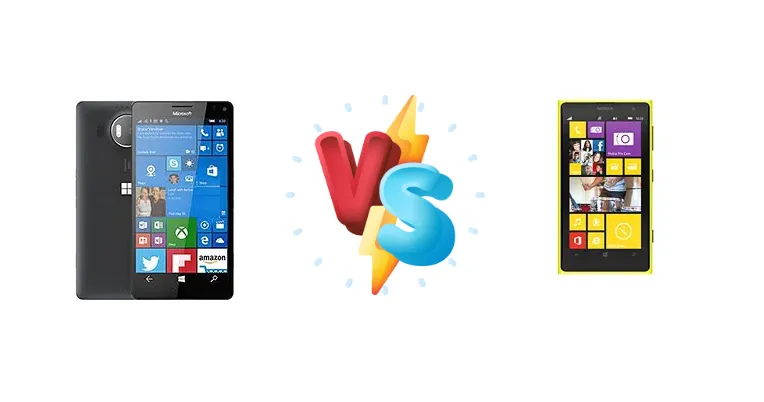
The Microsoft Lumia 950 XL and Nokia Lumia 1020 represent distinct peaks in Windows Phone development. The 950 XL, arriving later in the platform's lifecycle, aimed for flagship power, while the 1020, a Nokia icon, prioritized groundbreaking mobile photography. This comparison dissects their strengths and weaknesses, revealing which device holds up better today.
🏆 Quick Verdict
For the average user seeking a more capable device, the Microsoft Lumia 950 XL emerges as the winner. Its significantly more powerful Snapdragon 810 chipset provides a far superior user experience, despite both phones offering comparable battery endurance. While the Lumia 1020’s camera was revolutionary, the 950 XL’s overall performance and modern features offer greater long-term value.
| Network |
|---|
| 2G bands | GSM 850 / 900 / 1800 / 1900 | GSM 850 / 900 / 1800 / 1900 - all versions |
| 3G bands | HSDPA 850 / 900 / 1700(AWS) / 1900 / 2100 | HSDPA 850 / 900 / 1900 / 2100 - RM-875, RM-877 |
| 4G bands | 1, 2, 3, 4, 5, 7, 8, 12, 20, 28, 38, 40 - EMEA | 1, 3, 7, 8, 20 - RM-875 |
| Speed | HSPA 42.2/5.76 Mbps, LTE Cat6 300/50 Mbps | HSPA 42.2/5.76 Mbps, LTE Cat3 100/50 Mbps |
| Technology | GSM / HSPA / LTE | GSM / HSPA / LTE |
| | 1, 2, 3, 4, 5, 7, 8, 12, 17, 20, 28, 38, 40, 41 - USA | 2, 4, 5, 17 - RM-877 |
| Launch |
|---|
| Announced | 2015, October. Released 2015, November | 2013, July 11. Released 2013, July 22 |
| Status | Discontinued | Discontinued |
| Body |
|---|
| Build | - | Glass front (Gorilla Glass 3), plastic back, plastic frame |
| Dimensions | 151.9 x 78.4 x 8.1 mm (5.98 x 3.09 x 0.32 in) | 130.4 x 71.4 x 10.4 mm, 96.9 cc (5.13 x 2.81 x 0.41 in) |
| SIM | Nano-SIM | Micro-SIM |
| Weight | 165 g (5.82 oz) | 158 g (5.57 oz) |
| Display |
|---|
| Protection | Corning Gorilla Glass 4 | Corning Gorilla Glass 3 |
| Resolution | 1440 x 2560 pixels, 16:9 ratio (~518 ppi density) | 768 x 1280 pixels, 5:3 ratio (~332 ppi density) |
| Size | 5.7 inches, 88.5 cm2 (~74.3% screen-to-body ratio) | 4.5 inches, 57.6 cm2 (~61.9% screen-to-body ratio) |
| Type | AMOLED | AMOLED |
| | ClearBlack display | PureMotion HD+ ClearBlack display |
| Platform |
|---|
| CPU | Octa-core (4x1.5 GHz Cortex-A53 & 4x2.0 GHz Cortex-A57) | Dual-core 1.5 GHz Krait |
| Chipset | Qualcomm MSM8994 Snapdragon 810 (20 nm) | Qualcomm MSM8960 Snapdragon S4 Plus |
| GPU | Adreno 430 | Adreno 225 |
| OS | Microsoft Windows 10 | Microsoft Windows Phone 8, upgradable to 8.1 |
| Memory |
|---|
| Card slot | microSDXC (dedicated slot) | No |
| Internal | 32GB 3GB RAM | 32GB 2GB RAM, 64GB 2GB RAM (Telefonica exclusive) |
| | eMMC 5.0 | - |
| Main Camera |
|---|
| Features | Zeiss optics, triple-LED RGB flash, panorama, HDR | Carl Zeiss optics, Xenon & LED flash, panorama |
| Single | 20 MP, f/1.9, 26mm (wide), 1/2.4", 1.12µm, AF, OIS | 41 MP, f/2.2, 26mm (wide), 1/1.5", 1.12µm, AF, OIS |
| Video | 4K@30fps, stereo sound rec., 1080p@30/60fps (after SW update) | 1080p@30fps, 4x lossless digital zoom |
| Selfie camera |
|---|
| Single | 5 MP, f/2.4 | 1.2 MP |
| Video | 1080p@30fps | 720p@30fps |
| Sound |
|---|
| 3.5mm jack | Yes | Yes |
| 35mm jack | Yes | Yes |
| Loudspeaker | Yes | Yes |
| Comms |
|---|
| Bluetooth | 4.1, A2DP | 4.0, A2DP, EDR, LE/ aptX after WP8 Denim update |
| NFC | Yes | Yes |
| Positioning | GPS, GLONASS, BDS | GPS, GLONASS |
| Radio | FM radio | Stereo FM radio, RDS |
| USB | USB Type-C 3.1 | microUSB 2.0 |
| WLAN | Wi-Fi 802.11 a/b/g/n/ac, dual-band, hotspot | Wi-Fi 802.11 a/b/g/n, dual-band, DLNA, hotspot |
| Features |
|---|
| Sensors | Iris scanner, accelerometer, gyro, proximity, compass, barometer, sensor core | Accelerometer, gyro, proximity, compass, barometer |
| | Microsoft Continuum support | - |
| Battery |
|---|
| Charging | 18W wired
Wireless (Qi) (market dependent) | - |
| Music play | Up to 75 h | Up to 63 h |
| Stand-by | Up to 288 h (2G) / Up to 288 h (3G) | Up to 384 h (3G) |
| Talk time | Up to 25 h (2G) / Up to 19 h (3G) | Up to 19 h (2G) / Up to 13 h 20 min (3G) |
| Type | Li-Ion 3340 mAh, removable | Li-Ion 2000 mAh, non-removable (BV-5XW) |
| Misc |
|---|
| Colors | Black, White | Yellow, white, black, red (AT&T exclusive) |
| Price | About 350 EUR | About 400 EUR |
| SAR | - | 1.23 W/kg (head) 0.97 W/kg (body) |
| SAR EU | - | 0.76 W/kg (head) 0.67 W/kg (body) |
| Tests |
|---|
| Audio quality |
Noise -91.6dB / Crosstalk -89.3dB | - |
| Battery life |
Endurance rating 62h
|
Endurance rating 61h
|
| Camera |
Photo / Video |
Photo / Video |
| Display |
Contrast ratio: Infinite (nominal), 3.837 (sunlight) |
Contrast ratio: Infinite (nominal), 2.103 (sunlight) |
| Loudspeaker |
Voice 74dB / Noise 75dB / Ring 84dB
|
Voice 69dB / Noise 66dB / Ring 72dB
|
| Performance |
Basemark OS II 2.0: 1472Basemark X: 32178 | - |
Microsoft Lumia 950 XL
- Significantly faster processor for smoother performance
- Faster charging with 18W wired and Qi wireless support
- Better sunlight visibility due to higher contrast ratio
- Larger size may not appeal to all users
- Windows Phone OS is no longer actively supported
Nokia Lumia 1020
- Iconic design and build quality
- Exceptional camera detail in good lighting conditions
- Compact and comfortable to hold
- Outdated processor limits performance
- Slower charging speeds
- Lower sunlight visibility
Display Comparison
Both the Lumia 950 XL and 1020 boast 'Infinite' nominal contrast ratios, a common marketing claim at the time. However, the 950 XL’s sunlight contrast ratio of 3.837 significantly surpasses the 1020’s 2.103, indicating superior visibility in bright outdoor conditions. While both displays likely utilized AMOLED technology, the 950 XL’s higher contrast suggests better panel calibration and potentially improved outdoor usability. The resolution isn't specified for either, but the 950 XL's larger screen size likely benefits from a higher pixel density.
Camera Comparison
The Nokia Lumia 1020’s 41MP sensor was a landmark achievement in mobile photography, but raw megapixels aren’t everything. Both devices offer photo and video capabilities, but the 950 XL benefits from the advancements in image processing technology available at the time of its release. While the 1020 excels in capturing detail in ideal lighting, the 950 XL’s more modern image signal processor (ISP) likely delivers better low-light performance and dynamic range. The 950 XL also benefits from potentially improved video stabilization and recording capabilities.
Performance
The performance gap between these devices is substantial. The Lumia 950 XL’s Qualcomm MSM8994 Snapdragon 810, built on a 20nm process, features an octa-core CPU (4x1.5 GHz Cortex-A53 & 4x2.0 GHz Cortex-A57) offering significantly more processing power than the Lumia 1020’s dual-core 1.5 GHz Krait processor based on the Snapdragon S4 Plus. This translates to faster app loading times, smoother multitasking, and a more responsive user interface on the 950 XL. The 810’s Adreno 430 GPU also provides a considerable graphical advantage, though both phones are limited by the Windows Phone operating system.
Battery Life
Despite the Lumia 950 XL’s more powerful processor, both phones achieve a similar endurance rating of approximately 61-62 hours. The 950 XL supports 18W wired charging and Qi wireless charging (market dependent), offering significantly faster charging speeds compared to the 1020, which likely relied on slower charging standards. This faster charging capability mitigates any potential battery drain from the more demanding processor, making the 950 XL more convenient for users who need to quickly top up their device.
Buying Guide
Buy the Microsoft Lumia 950 XL if you need a device capable of handling modern apps (within the Windows Phone ecosystem), multitasking, and benefit from faster processing speeds. Buy the Nokia Lumia 1020 if you prioritize a unique, high-resolution camera experience and appreciate its iconic design, understanding its performance will be limited by its older chipset.
Frequently Asked Questions
❓ Is the Snapdragon 810 in the Lumia 950 XL known for overheating issues?
The Snapdragon 810 was initially criticized for thermal throttling under sustained load. However, Microsoft likely implemented thermal management strategies to mitigate this issue in the 950 XL. While it may still warm up during intensive tasks, it's unlikely to experience severe overheating that significantly impacts performance, especially compared to the consistently slower performance of the 1020.
❓ Given that Windows Phone is discontinued, is either of these phones still useful in 2024?
Usefulness is limited. While basic functions like calls and texts may still work, app support is severely restricted. Both phones can function as basic cameras, but the lack of software updates and app availability significantly diminishes their value. They are primarily collector's items or for enthusiasts who wish to experience the Windows Phone ecosystem.
❓ Does the Lumia 1020's camera retain its image quality when cropping heavily?
Yes, the 41MP sensor of the Lumia 1020 excels at cropping. The high resolution allows for significant digital zoom and cropping without a drastic loss of detail, making it ideal for capturing distant subjects or reframing photos after the fact. However, the image processing of the 950 XL may produce more pleasing results in challenging lighting conditions.