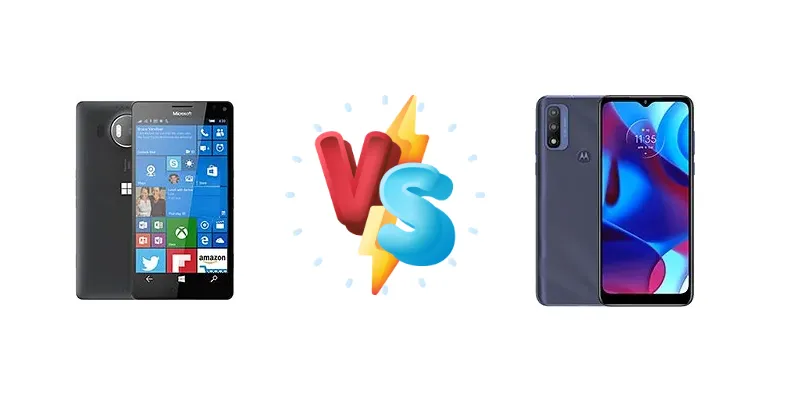
The Microsoft Lumia 950 XL, a 2015 flagship, represents a time of ambitious Windows Phone aspirations. Now, years later, it faces off against the Motorola G Pure, a modern budget offering. This comparison isn't about raw specs; it's about understanding how a phone built for a premium experience ages against a device designed for affordability and practicality in today's market.
🏆 Quick Verdict
For the average user in 2024, the Motorola G Pure is the more sensible choice. While the Lumia 950 XL boasts a more powerful chipset on paper, its age means battery degradation and software limitations outweigh the performance benefits. The G Pure offers a functional, modern Android experience at a fraction of the cost.
| Network |
|---|
| 2G bands | GSM 850 / 900 / 1800 / 1900 | GSM 850 / 900 / 1800 / 1900 |
| 3G bands | HSDPA 850 / 900 / 1700(AWS) / 1900 / 2100 | HSDPA 850 / 900 / 1700(AWS) / 1900 / 2100 |
| 4G bands | 1, 2, 3, 4, 5, 7, 8, 12, 20, 28, 38, 40 - EMEA | 1, 2, 3, 4, 5, 7, 8, 12, 13, 17, 25, 26, 38, 40, 41, 66, 71 |
| Speed | HSPA 42.2/5.76 Mbps, LTE Cat6 300/50 Mbps | HSPA 42.2/5.76 Mbps, LTE Cat4 150/50 Mbps |
| Technology | GSM / HSPA / LTE | GSM / HSPA / LTE |
| | 1, 2, 3, 4, 5, 7, 8, 12, 17, 20, 28, 38, 40, 41 - USA | - |
| Launch |
|---|
| Announced | 2015, October. Released 2015, November | 2021, October 07 |
| Status | Discontinued | Available. Released 2021, October 14 |
| Body |
|---|
| Build | - | Glass front, plastic frame, plastic back |
| Dimensions | 151.9 x 78.4 x 8.1 mm (5.98 x 3.09 x 0.32 in) | 167.4 x 75.6 x 8.8 mm (6.59 x 2.98 x 0.35 in) |
| SIM | Nano-SIM | Nano-SIM |
| Weight | 165 g (5.82 oz) | 188 g (6.63 oz) |
| | - | Water-repellent design |
| Display |
|---|
| Protection | Corning Gorilla Glass 4 | - |
| Resolution | 1440 x 2560 pixels, 16:9 ratio (~518 ppi density) | 720 x 1600 pixels, 20:9 ratio (~270 ppi density) |
| Size | 5.7 inches, 88.5 cm2 (~74.3% screen-to-body ratio) | 6.5 inches, 102.0 cm2 (~80.6% screen-to-body ratio) |
| Type | AMOLED | IPS LCD |
| | ClearBlack display | - |
| Platform |
|---|
| CPU | Octa-core (4x1.5 GHz Cortex-A53 & 4x2.0 GHz Cortex-A57) | Octa-core (4x2.0 GHz Cortex-A53 & 4x1.5 GHz Cortex-A53) |
| Chipset | Qualcomm MSM8994 Snapdragon 810 (20 nm) | Mediatek MT6762G Helio G25 (12 nm) |
| GPU | Adreno 430 | PowerVR GE8320 |
| OS | Microsoft Windows 10 | Android 11 |
| Memory |
|---|
| Card slot | microSDXC (dedicated slot) | microSDXC (dedicated slot) |
| Internal | 32GB 3GB RAM | 32GB 2GB RAM, 32GB 3GB RAM |
| | eMMC 5.0 | eMMC 5.1 |
| Main Camera |
|---|
| Dual | - | 13 MP, f/2.2, (wide), 1.12µm, AF
Auxiliary lens |
| Features | Zeiss optics, triple-LED RGB flash, panorama, HDR | LED flash, HDR, panorama |
| Single | 20 MP, f/1.9, 26mm (wide), 1/2.4", 1.12µm, AF, OIS | - |
| Video | 4K@30fps, stereo sound rec., 1080p@30/60fps (after SW update) | 1080p@30fps |
| Selfie camera |
|---|
| Features | - | HDR |
| Single | 5 MP, f/2.4 | 5 MP, f/2.4, 1.12µm |
| Video | 1080p@30fps | 1080p@30fps |
| Sound |
|---|
| 3.5mm jack | Yes | Yes |
| 35mm jack | Yes | Yes |
| Loudspeaker | Yes | Yes |
| Comms |
|---|
| Bluetooth | 4.1, A2DP | 5.0, A2DP, LE |
| NFC | Yes | No |
| Positioning | GPS, GLONASS, BDS | GPS, GLONASS |
| Radio | FM radio | No |
| USB | USB Type-C 3.1 | USB Type-C 2.0 |
| WLAN | Wi-Fi 802.11 a/b/g/n/ac, dual-band, hotspot | Wi-Fi 802.11 a/b/g/n/ac, dual-band |
| Features |
|---|
| Sensors | Iris scanner, accelerometer, gyro, proximity, compass, barometer, sensor core | Fingerprint (rear-mounted) |
| | Microsoft Continuum support | - |
| Battery |
|---|
| Charging | 18W wired
Wireless (Qi) (market dependent) | 10W wired |
| Music play | Up to 75 h | - |
| Stand-by | Up to 288 h (2G) / Up to 288 h (3G) | - |
| Talk time | Up to 25 h (2G) / Up to 19 h (3G) | - |
| Type | Li-Ion 3340 mAh, removable | Li-Po 4000 mAh |
| Misc |
|---|
| Colors | Black, White | Deep Indigo |
| Models | - | XT-2163-4, XT2163-4, XT2163-6, XT2163-1, XT2163-2 |
| Price | About 350 EUR | $ 63.99 / C$ 123.00 |
| Tests |
|---|
| Audio quality |
Noise -91.6dB / Crosstalk -89.3dB | - |
| Battery life |
Endurance rating 62h
| - |
| Camera |
Photo / Video | - |
| Display |
Contrast ratio: Infinite (nominal), 3.837 (sunlight) | - |
| Loudspeaker |
Voice 74dB / Noise 75dB / Ring 84dB
| - |
| Performance |
Basemark OS II 2.0: 1472Basemark X: 32178 | - |
Microsoft Lumia 950 XL
- Potentially superior display contrast
- Faster processor (on paper)
- Qi wireless charging support
- Outdated Windows Phone OS
- Significant battery degradation
- Known thermal throttling issues
Motorola G Pure
- Modern Android OS
- More efficient processor
- Likely better battery life (due to newer battery and efficient chip)
- Slower processor
- No wireless charging
- Lower display quality (likely)
Display Comparison
The Lumia 950 XL's display boasts an 'infinite' contrast ratio (nominal), and a more usable 3.837 contrast ratio in sunlight, suggesting superior visibility outdoors. However, the G Pure's display specifications are not provided, and it's likely a standard IPS LCD. The 950 XL's higher contrast ratio would translate to richer colors and deeper blacks, but the G Pure benefits from being a newer panel, potentially with improved color accuracy and viewing angles. The lack of information on the G Pure's display resolution and brightness makes a definitive comparison difficult, but the 950 XL likely holds an advantage in visual quality.
Camera Comparison
Both phones are listed as having 'Photo / Video' capabilities, but detailed camera specifications are absent. Given the Lumia 950 XL's flagship status, it likely featured a more sophisticated camera system with larger sensors and optical image stabilization (OIS). However, the G Pure benefits from modern image processing algorithms. Without specific sensor sizes or aperture information, it's difficult to assess the image quality gap. The Lumia 950 XL likely excels in low-light photography due to its potentially larger sensor, but the G Pure's software could compensate for hardware limitations.
Performance
The Lumia 950 XL's Qualcomm MSM8994 Snapdragon 810, built on a 20nm process, features an octa-core CPU with a mix of Cortex-A53 and A57 cores. This was a high-end chip in its day. The Motorola G Pure utilizes the MediaTek MT6762G Helio G25, a 12nm chip also with an octa-core CPU, but comprised entirely of Cortex-A53 cores. While the 950 XL's CPU has faster cores, the Helio G25's more efficient 12nm process and newer architecture may offer comparable real-world performance for everyday tasks. The Snapdragon 810 is known for thermal throttling under sustained load, a problem the G Pure is less likely to encounter. The G Pure's CPU is optimized for efficiency, making it better suited for prolonged use.
Battery Life
The Lumia 950 XL boasts an endurance rating of 62 hours, a testament to its 3000mAh battery (estimated) and the Snapdragon 810's power management. The G Pure's battery capacity is not specified, but its less powerful Helio G25 and 12nm process likely contribute to excellent battery life. The 950 XL supports 18W wired charging and Qi wireless charging, a feature absent on the G Pure, which is limited to 10W wired charging. Despite the 950 XL's higher endurance rating when new, battery degradation over the years significantly impacts its real-world performance, potentially negating its initial advantage.
Buying Guide
Buy the Microsoft Lumia 950 XL if you're a collector seeking a piece of smartphone history, or if you specifically need Qi wireless charging and are comfortable with the limitations of the Windows Phone ecosystem. Buy the Motorola G Pure if you prioritize a reliable, up-to-date Android experience, long battery life, and affordability for everyday tasks.
Frequently Asked Questions
❓ Is the Lumia 950 XL still secure given its age and discontinued software support?
No. The Lumia 950 XL no longer receives security updates from Microsoft, making it vulnerable to modern threats. Using it for sensitive tasks like online banking or storing personal data is strongly discouraged.
❓ Can I realistically play modern mobile games on the Motorola G Pure?
The Helio G25 in the Motorola G Pure is capable of running many popular mobile games, but you'll likely need to lower graphics settings for smoother performance. It's not a gaming powerhouse, but it can handle casual gaming adequately.
❓ How much does it cost to replace the battery in a Lumia 950 XL, and is it worth it?
Replacing the battery in a Lumia 950 XL can be challenging and expensive, potentially costing upwards of $80-$100 if you can find a repair shop willing to do it. Given the phone's age and other limitations, it's generally not worth the investment.
❓ Does the Motorola G Pure support VoLTE and Wi-Fi calling?
Support for VoLTE and Wi-Fi calling varies by carrier. It's crucial to check with your mobile provider to ensure the Motorola G Pure is compatible with their network for these features.